Table of Contents
Overview
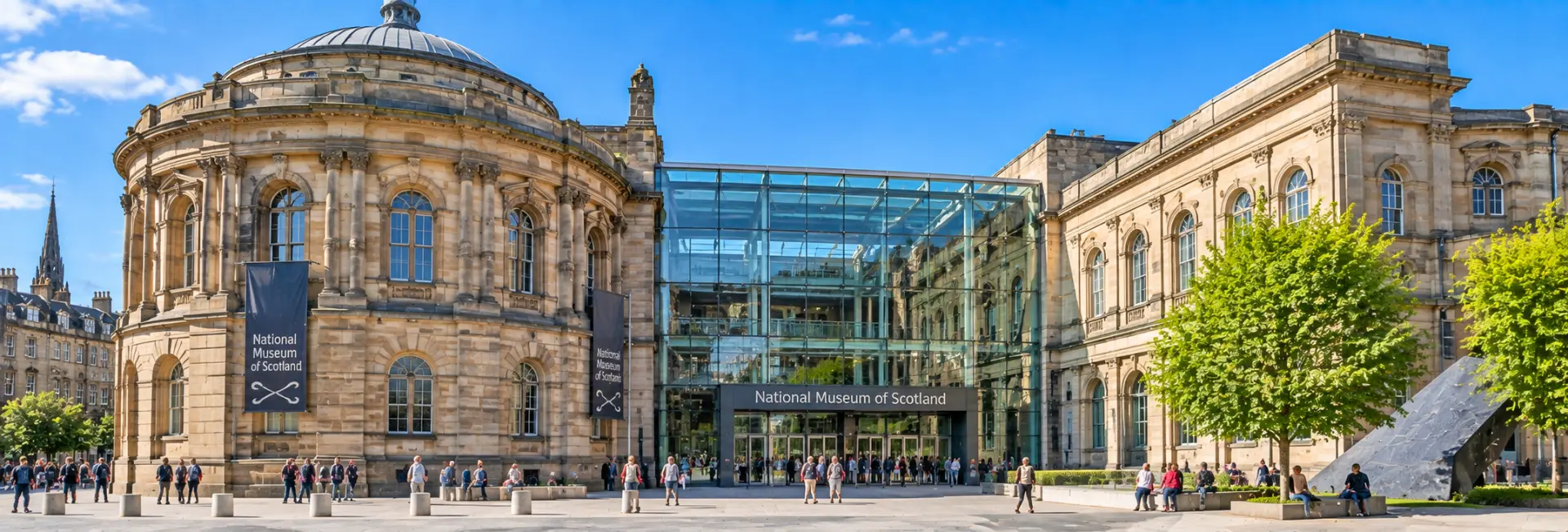
The National Museum of Scotland is one of the most popular attractions in the country, and it manages to be both enormous and welcoming. Standing on Chambers Street just south of the Royal Mile, it brings together Scottish history, natural history, science and technology, world cultures and art and design in a single, connected complex. Most of it is free to enter, which makes it one of the best-value days out in Edinburgh.
The museum is really two buildings joined together. One is a Victorian hall of iron and glass, home to dinosaurs, animals, ancient Egyptian objects and global collections. The other is a modern, sandstone-clad wing that tells the story of Scotland from its earliest settlers to the present day.
The range is what surprises most first-time visitors. In a single afternoon you can move from a medieval chess piece to a cloned sheep, then from a wildlife display to a steam engine, and finish with a view of Edinburgh Castle from the roof. It rewards both a quick highlights visit and a long, unhurried wander.
History of the Museum
A Victorian Vision
The museum began as the Industrial Museum of Scotland, founded in 1854 in the spirit of Victorian enthusiasm for education, science and design. Prince Albert laid the foundation stone of the new building on Chambers Street in 1861, in what was one of his last public appearances. The first part of the museum opened to the public in 1866 under the name Edinburgh Museum of Science and Art.
Growing Over Time
The original building took decades to finish, with the west wing opening in 1890. In 1904 the institution was renamed the Royal Scottish Museum. Extensions were added over the years, and electric power arrived in the early 20th century, bringing some of the museum's first push-button displays.
Bringing Collections Together
In 1985 the Royal Scottish Museum merged with the National Museum of Antiquities of Scotland, whose collections of archaeology and Scottish history had been housed separately. A new building, the Museum of Scotland, was constructed next door and opened in 1998, connected to the older building so that the two could be explored as one.
Reinvention
The Victorian building closed in 2008 for a major refurbishment costing around 47 million pounds. It reopened on 29 July 2011 with a new street-level entrance hall and 16 new galleries, and a large share of the objects on show were being displayed for the first time.
Architecture & Building
The Victorian Building
The original museum was designed by Captain Francis Fowke of the Royal Engineers, who also worked on the Royal Albert Hall, together with the local architect Robert Matheson. From the street it looks like a Venetian Renaissance palace, calm and stately in pale stone. Inside, the mood changes completely.
The Grand Gallery
The heart of the old building is the Grand Gallery, a soaring hall of white-painted cast iron and glass. It was inspired by the Crystal Palace built for London's Great Exhibition of 1851, and its roof floods the space with daylight. Balconies and slender columns rise around the edges, and the Millennium Clock Tower dominates one end.
The Modern Wing
The Museum of Scotland building was designed by Benson and Forsyth and opened in 1998. Its stone walls, curved forms and circular corner tower call to mind Scottish castles and brochs, and its golden sandstone was chosen to echo the country's geology. Inside, narrow passages and dramatic changes of level create a sense of moving through time.
Redesign and Listing
The 2011 redevelopment lowered the floor level to create a large, vaulted entrance hall, and added lifts and escalators. The building has been given Category A listed status, recognising its national importance.
Collections & Exhibits
The collections are organised into several themed areas, which are spread across multiple levels and both buildings.
Scottish History and Archaeology
These galleries run chronologically from the earliest human settlers through the medieval kingdom, the Reformation and Jacobite era, industrial growth and the modern nation. The earliest displays are in the lower levels, with prehistoric and early medieval objects arranged in low-lit, intimate spaces, and you rise through the building as the story moves forward.
The Natural World
The natural history galleries include a huge range of animals, from tiny insects to towering mammals, as well as fossils and dinosaur material. Displays explore habitats around the planet and the geology of Scotland itself.
Science and Technology
Here you will find engines, machines and inventions that shaped modern life, together with interactive exhibits and objects linked to famous Scottish scientists. One well-known item is a specimen of penicillin annotated by Alexander Fleming.
World Cultures
This collection includes objects from ancient Egypt, Asia and beyond, such as a painted Egyptian coffin and mummies, alongside art and everyday items from communities around the world.
Art and Design
Decorative arts, ceramics, silver, fashion and design from different periods and countries show how style and craft have changed across centuries.
Must-See Highlights
Dolly the Sheep
Dolly, the first mammal cloned from an adult cell, was born in Scotland in 1996 and is now preserved and displayed in the science galleries. She remains one of the museum's most popular objects, and she is the sort of exhibit that makes people stop and think about how much science has changed.
The Lewis Chessmen
These 12th-century chess pieces, carved from walrus ivory and found on the Isle of Lewis, are among Scotland's most famous archaeological finds. The museum displays 11 of them, with the rest of the set in the British Museum. Their wide-eyed, expressive faces make them easy to love, and one of the bishops has become an internet favourite for his worried look.
The Millennium Clock Tower
Standing about 10 metres tall in the Grand Gallery, this kinetic sculpture is full of carved figures, moving parts and curious details. It usually performs on the hour, so it is worth timing part of your visit around it.
The Maiden and Other Curiosities
Among the many unusual objects on display is the Scottish Maiden, an early type of guillotine used for executions. The museum has also been home to the tiny carved coffins found on Arthur's Seat in 1836, one of Edinburgh's enduring mysteries.
The Rooftop Terrace
A free terrace on the roof of the modern wing offers a panoramic view over the Old Town, with Edinburgh Castle and Arthur's Seat both in sight. It is one of the best free viewpoints in the city.
Ways to Experience It
The museum is big enough that it helps to choose an approach before you arrive.
- A highlights visit of around two hours, focusing on the Grand Gallery, Dolly, the Lewis Chessmen and the rooftop.
- A themed visit, such as Scottish history only, natural history or science, which gives you time to look properly without feeling rushed.
- A family visit, using the interactive displays and hands-on areas that keep children engaged.
- A special exhibition visit, since the museum runs changing exhibitions that may need a ticket.
- A long day, including lunch at one of the cafes, an afternoon in the galleries and a sunset visit to the roof terrace.
Pick up a floor plan at the entrance, and consider starting at the top and working down if you want to avoid the busiest routes.
Best Time to Visit
The museum is open every day of the year apart from Christmas Day, so it works as an all-weather choice in a city where rain is never far away. That is also why it can be very busy on wet afternoons, at weekends and during school holidays.
The quietest time is usually a weekday morning shortly after opening, when the Grand Gallery is calm and the popular exhibits are easy to see. August, when the festivals fill the city, tends to be the busiest month.
If you want to catch the Millennium Clock Tower performing, plan around the top of the hour. For the roof terrace, a clear afternoon or early evening gives the best views, and it is worth checking the forecast first as the terrace is open to the weather.
Visitor Tips
- Entry to the main galleries is free, although some special exhibitions charge admission. Check the official website for what is on.
- Allow at least two hours for the highlights and up to a full day if you want to explore in depth.
- Choose two or three areas that interest you most. Trying to see everything in one visit can be tiring.
- Use the lockers in the entrance hall if you are carrying luggage or a large bag.
- Accessibility is good, with lifts and ramps to the galleries, toilets on every level and a buggy park on the Scotland galleries level.
- There are several cafes, and a lunch space in the entrance hall where you can eat your own food.
- There are two entrances, the main one on Chambers Street and the Tower entrance, and staff at information desks can help with directions.
- Check the opening hours before you go. The museum is usually open daily, with adjusted times on some holidays.
The museum is a short walk from Edinburgh Waverley station and from the Princes Street tram stop, and several bus routes stop nearby.
Nearby Attractions
The museum sits in the heart of the Old Town, so it is easy to combine with other sights.
- Greyfriars Kirkyard and the memorial to Greyfriars Bobby, only a few minutes' walk away.
- The Royal Mile, a short walk north, leading to St Giles' Cathedral and Edinburgh Castle.
- Edinburgh Castle, roughly half a mile from the museum.
- The Writers' Museum in Lady Stair's Close, off the Royal Mile.
- The Grassmarket, a lively square with pubs, shops and views up to the castle.
- The Scottish National Gallery on The Mound, for art lovers looking to add a second museum to the day.
Museum lovers often plan a full free day, starting here in the morning and then continuing along the Royal Mile to the Writers' Museum and the National Gallery.
FAQs about visiting the National Museum of Scotland
Is the National Museum of Scotland free? +
Entry to the main galleries is free. Some special exhibitions have a charge, and you can support the museum through donations or by using the shop and cafes.
How long should I spend at the National Museum of Scotland? +
Plan two to three hours for the highlights, or half a day if you want to see several sections properly. A full day is easy to fill if you love museums.
What are the must-see exhibits? +
Most visitors go to see Dolly the Sheep, the Lewis Chessmen, the Millennium Clock Tower and the Grand Gallery. The rooftop terrace is also a favourite for its views of the city.
Where is the National Museum of Scotland? +
It is on Chambers Street in Edinburgh's Old Town, close to the Royal Mile and about a ten-minute walk from Edinburgh Castle. The nearest railway station is Edinburgh Waverley.
What are the opening hours? +
The museum is usually open daily from 10 am to 5 pm, with adjusted hours around Christmas and New Year. It is a good idea to check the official website before you go.
Is the museum suitable for children? +
Yes, it is very popular with families. There are interactive displays, animals, dinosaurs and hands-on exhibits, and the varied collections keep children interested for hours.
Is the museum accessible? +
Lifts and ramps give access to the galleries, there are toilets on every level, and a buggy park is available. Staff at the information desks can help with specific access questions.
Can I see the Stone of Destiny there? +
No. The Stone of Destiny moved to Perth Museum in 2024. The National Museum of Scotland's Scottish history galleries do hold other important objects, including the Lewis Chessmen.
What else is there to do nearby? +
Greyfriars Kirkyard, the Royal Mile, the Grassmarket and Edinburgh Castle are all within walking distance.