Table of Contents
Overview
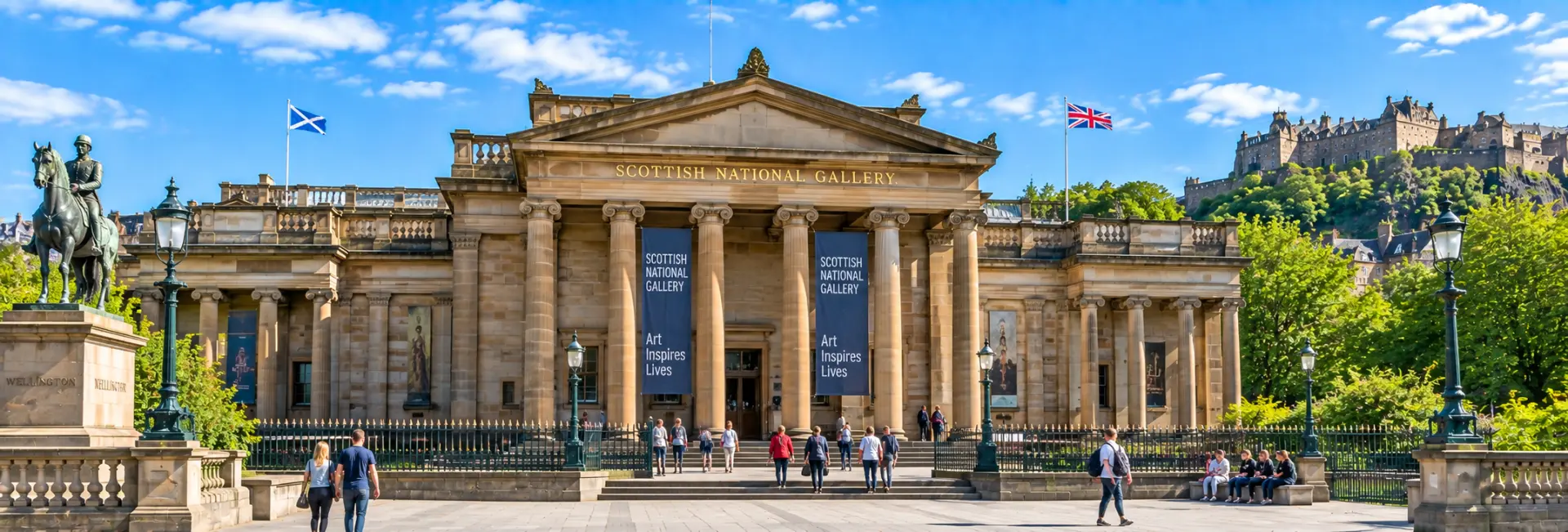
The Scottish National Gallery sits on The Mound, the artificial slope that links Edinburgh's Old and New Towns, holding the country's principal collection of fine art. Its calm, columned exterior gives little hint of the depth inside, where centuries of European painting sit alongside a rich survey of Scottish art in a series of intimate, top-lit rooms.
Free to enter and comfortably sized for a single visit, the gallery is often ranked among Edinburgh's top attractions, drawing art lovers who want to see major European names without the scale or crowds of a larger national museum, alongside a distinctly Scottish collection found nowhere else in such depth.
History of the Gallery
The gallery was established in the mid-19th century as Scotland's first dedicated public collection of fine art, opening its doors on The Mound in 1859 after several years of construction. It was designed to sit alongside the Royal Scottish Academy building directly in front of it, with the two structures sharing a similar classical style so that they read almost as a single architectural composition from Princes Street Gardens below.
The collection grew steadily through donations, bequests and purchases over the following century and a half, with major gifts of Old Master paintings and an important annual bequest of watercolours helping to build a collection that today numbers among the most respected national holdings in Europe relative to its size. In the early 2000s, an underground extension known as the Gardens Entrance was added beneath the gallery and the neighbouring Academy building, improving access and adding visitor facilities without altering the historic exteriors above.
Architecture & Building
The building was designed by the Scottish architect William Henry Playfair in a restrained neoclassical style, using plain Doric columns rather than more ornate classical detailing, in keeping with Edinburgh's reputation as the "Athens of the North." Its long, low profile and Ionic porticoes were designed to complement the Royal Scottish Academy building standing just in front of it, creating a matched pair of classical structures at the foot of the Mound.
Inside, the galleries are arranged around a sequence of octagonal, top-lit rooms, a layout that allows natural daylight to fall evenly across the paintings. Several rooms have been restored to their original Victorian decorative scheme of deep green carpets and dark red wall coverings, giving the interior a warm, period atmosphere that contrasts with the pale stone exterior.
Collections & Exhibits
The permanent collection spans European painting from the early Renaissance through to the end of the 19th century, including works by artists such as Titian, Rembrandt, Vermeer, Rubens and Poussin, alongside later French painters including Monet, Gauguin and Cézanne. A dedicated Duke of Sutherland loan has long supplemented the collection with additional Old Master paintings, deepening its holdings of Italian and Spanish art in particular.
Running alongside this international collection is an extensive survey of Scottish painting from the 1600s to 1900, covering figures such as Allan Ramsay, Henry Raeburn, David Wilkie and William McTaggart. This dual focus, major European art shown together with the national Scottish collection, is one of the gallery's defining features and distinguishes it from many similarly sized institutions elsewhere.
Must-See Highlights
- The Reverend Robert Walker Skating on Duddingston Loch, widely known as "The Skating Minister," one of the most recognisable images in Scottish art.
- Titian's paired mythological paintings Diana and Actaeon and Diana and Callisto, considered among the finest Renaissance works in the United Kingdom.
- Antonio Canova's marble sculpture The Three Graces, displayed at the heart of the gallery.
- A strong holding of French Impressionist and Post-Impressionist works, including paintings by Monet, Van Gogh and Gauguin.
- An annual January display of J.M.W. Turner's watercolours, shown together each year under the terms of a historic bequest.
Ways to Experience It
Most visitors explore the gallery independently at their own pace, since the collection is compact enough to see thoroughly in a couple of hours without feeling rushed. Free guided tours and talks are offered at set times, giving useful context on individual works and the history of the building, and an audio guide is generally available for a more self-directed deep dive.
- Free daily highlight tours run at scheduled times and are a good introduction for first-time visitors.
- The underground Gardens Entrance connects the gallery directly to the neighbouring Royal Scottish Academy, making it easy to combine both in one visit.
- Temporary exhibitions, usually held in the Academy building, often require a separate paid ticket.
Best Time to Visit
Weekday mornings shortly after opening tend to be the quietest time to visit, particularly outside the busy summer festival period when Edinburgh's city centre attractions see a significant rise in visitors. Thursday evenings, when the gallery has traditionally kept extended hours, can offer a calmer, later alternative for those wanting to avoid daytime crowds.
Because entry to the permanent collection is free, the gallery also works well as a shorter, flexible stop that can be folded into a day of sightseeing around Princes Street Gardens and the Old Town, rather than requiring a dedicated half day.
Visitor Tips
- Entry to the permanent collection is free, though temporary exhibitions in the Royal Scottish Academy building usually carry a separate charge.
- The Gardens Entrance beneath the building offers step-free access, a cafe, restaurant and shop, and is the easiest way in for visitors with mobility needs.
- Photography without flash is generally permitted in the permanent galleries, though rules can vary for temporary exhibitions.
- Bag storage and cloakroom facilities are available near the Gardens Entrance for visitors carrying luggage or large bags.
- Check the current exhibition schedule in advance if a specific temporary show is the main reason for visiting.
Nearby Attractions
Standing at the foot of the Mound between the Old and New Towns, the gallery is within easy walking distance of several other central Edinburgh landmarks.
- The Royal Scottish Academy, directly in front of the gallery and linked via the shared Gardens Entrance.
- Princes Street Gardens, bordering the gallery to the south.
- Edinburgh Castle, a short uphill walk along the Mound.
- The Scottish National Portrait Gallery, a short walk away on Queen Street.
FAQs about visiting the Scottish National Gallery
Is the Scottish National Gallery free to enter? +
Yes, entry to the permanent collection is free, though temporary exhibitions held in the adjoining Royal Scottish Academy building usually require a paid ticket.
How long should I spend at the Scottish National Gallery? +
Most visitors spend around one to two hours exploring the permanent collection, longer if joining a guided tour or visiting a temporary exhibition as well.
What is the most famous painting at the Scottish National Gallery? +
The Reverend Robert Walker Skating on Duddingston Loch, known as "The Skating Minister," is generally considered the gallery's most iconic single work.
Is the Scottish National Gallery connected to the Royal Scottish Academy? +
Yes, the two buildings are linked underground by the Gardens Entrance, which also houses a cafe, restaurant and shop shared by both venues.
Is the gallery accessible for wheelchair users? +
Yes, the underground Gardens Entrance provides step-free access into the building, which is the recommended entrance for visitors with mobility needs.
Can I take photographs inside the gallery? +
Photography without flash is generally allowed in the permanent collection, though rules can differ for temporary exhibitions, so it is worth checking signage on arrival.
What kind of art will I see at the Scottish National Gallery? +
The collection covers European painting from the early Renaissance to the end of the 19th century, alongside an extensive collection of Scottish art from the 1600s to 1900.
Is the Scottish National Gallery suitable for a short visit? +
Yes, its compact layout makes it easy to see the highlights in an hour or so, making it a practical stop for visitors with limited time in the city centre.