Table of Contents
Overview
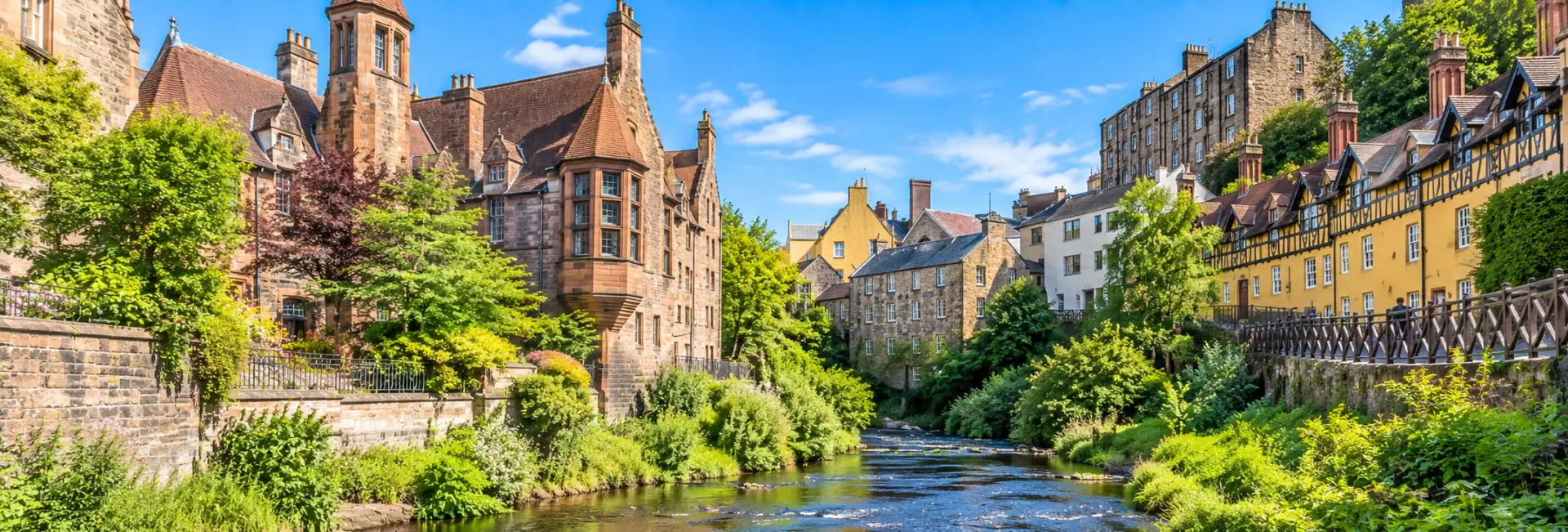
Dean Village is one of Edinburgh's best-kept secrets, a former milling settlement tucked into a steep river gorge just a few minutes' walk from the bustle of Princes Street. Stepping down from the West End into the village feels like crossing into another era, as tall stone tenements, arched bridges and the sound of the Water of Leith replace the city's usual traffic noise almost instantly.
For more than eight centuries this small community ground grain for Edinburgh using the fast-flowing river below, before falling into decline and later being rediscovered as one of the city's most photogenic residential corners. Today Dean Village is a quiet, mostly residential area, but its converted mill buildings, carved stone plaques and riverside walkways make it a favourite short detour for visitors exploring beyond the Royal Mile.
History
A Village Built on Milling
Dean Village takes its name from "dene," an old word for a deep valley, and grew up around the Water of Leith, which once powered as many as eleven separate mills along this short stretch of river. The settlement's milling role goes back remarkably far: a charter connected to the founding of Holyrood Abbey in the 12th century already refers to a mill in the area, and for centuries afterward the village supplied much of Edinburgh's bread flour, giving it close ties to the city's bakers' guild.
Decline and Isolation
The village's fortunes changed sharply in the early 19th century. Until then, traffic heading northwest out of Edinburgh had to descend into the valley and cross the river here, keeping Dean Village on a busy route. The construction of the high Dean Bridge overhead in the early 1830s allowed traffic to bypass the valley entirely, and the mills gradually lost ground to larger, more modern operations closer to the port of Leith. A tannery later took over as the main local employer, and by the early 20th century much of the village had fallen into disrepair and poverty.
Revival
Recovery came slowly over the 20th century, helped by the earlier construction of model housing for workers and later by a broader wave of conservation interest in Edinburgh's historic areas. From the 1970s onward, restored mill buildings were converted into private housing, and Dean Village gradually became one of the city's more sought-after residential addresses, valued today for the same riverside setting that once made it an industrial hub.
Architecture & Streetscape
Dean Village's charm lies largely in its compact scale and mix of building styles packed into a short stretch of riverbank. Sturdy, plain stone mill buildings from the 18th and 19th centuries sit close to more decorative Victorian housing, creating a streetscape that feels handmade rather than planned. Several former mills still carry carved stone panels showing baked goods or milling tools, a reminder of the trades that once operated behind their walls.
Steep lanes, narrow closes and a hump-backed bridge across the Water of Leith add to the village's tucked-away feel, while high above, the elegant stone arches of Dean Bridge frame views along the gorge without intruding on the village's low-rise scale below.
Key Areas
Bell's Brae
This steep cobbled street forms the traditional entrance into the village from the West End side and offers one of the most photographed views in Edinburgh, looking down toward the old stone bridge over the Water of Leith.
Miller Row and the Riverside Path
Following the water downstream, this stretch of path threads between former mill buildings and leads walkers onward along the Water of Leith Walkway toward Stockbridge, passing weirs and old millraces along the way.
Well Court
Set slightly apart from the main cluster of mill buildings, this courtyard development represents the village's Victorian-era attempt at renewal, and remains one of its most striking architectural landmarks.
Notable Landmarks
- Well Court, a red sandstone courtyard building with crow-stepped gables and a clock tower, built in the 1880s as housing for local workers.
- Dean Bridge, a tall stone arch bridge completed in 1831, which passes high above the village and offers sweeping views over the gorge.
- The Water of Leith Bridge, a much older stone crossing at the foot of Bell's Brae, close to the historic heart of the village.
- Former mill buildings along Miller Row and Damside, several still bearing carved stone emblems from their working days.
Ways to Experience It
Dean Village rewards slow, on-foot exploration rather than a rushed visit, since its appeal lies in small architectural details and quiet riverside views rather than any single attraction. Many visitors combine it with a longer stroll along the Water of Leith Walkway, which links the village to Stockbridge in one direction and toward the Scottish National Gallery of Modern Art in the other.
- A short self-guided loop around Bell's Brae, the old bridge and Well Court typically takes under an hour.
- Photographers often time a visit for soft morning or evening light along the riverbank.
- The walkway toward Stockbridge extends the visit into a longer riverside walk for those with more time.
Best Time to Visit
Dean Village can be visited comfortably at any time of year, though its narrow streets and riverside paths are especially pleasant in spring and autumn, when foliage along the Water of Leith adds extra colour to photographs. Weekday mornings tend to be quietest, since the village is a working residential area rather than a staffed attraction and can otherwise see a steady trickle of visitors during peak tourist season.
Visitor Tips
- Dean Village is a residential neighbourhood, so visitors are asked to keep noise down and respect private property while exploring.
- Wear comfortable shoes, as the streets are cobbled and include some steep, uneven sections.
- There are no ticket booths or set opening hours, since the village is freely accessible at any time.
- Facilities such as cafes and toilets are limited within the village itself, so plan accordingly if combining it with a longer walk.
- Combine a visit with the nearby Water of Leith Walkway for a longer, more varied route.
FAQs about visiting Dean Village
Is Dean Village free to visit? +
Yes, Dean Village is a public residential area with no entry fee or set opening hours, so it can be explored at any time.
How long does it take to see Dean Village? +
A basic loop around the main sights, such as Bell's Brae, Well Court and the old bridge, usually takes 30 to 60 minutes, longer if combined with a riverside walk.
Why is Dean Village called a village if it's part of Edinburgh? +
It began as a separate milling settlement outside the old city boundaries, and though it was later absorbed into Edinburgh, the name and its distinct, village-like character have stuck.
What is Well Court? +
Well Court is a Victorian courtyard building constructed in the 1880s as affordable housing for local mill workers, and it remains one of the village's most recognisable landmarks.
Can I walk from Dean Village to Stockbridge? +
Yes, the Water of Leith Walkway connects Dean Village directly to Stockbridge along a pleasant riverside path, typically taking around 20 to 30 minutes on foot.
Is Dean Village suitable for photography? +
Very much so, with its cobbled streets, old stone bridges and riverside mill buildings making it one of Edinburgh's most photographed hidden corners, especially around Bell's Brae.
Is Dean Village accessible for visitors with mobility needs? +
Some caution is needed, since the area includes steep lanes, cobbled surfaces and uneven steps, which may be challenging for those with limited mobility.