Table of Contents
Overview
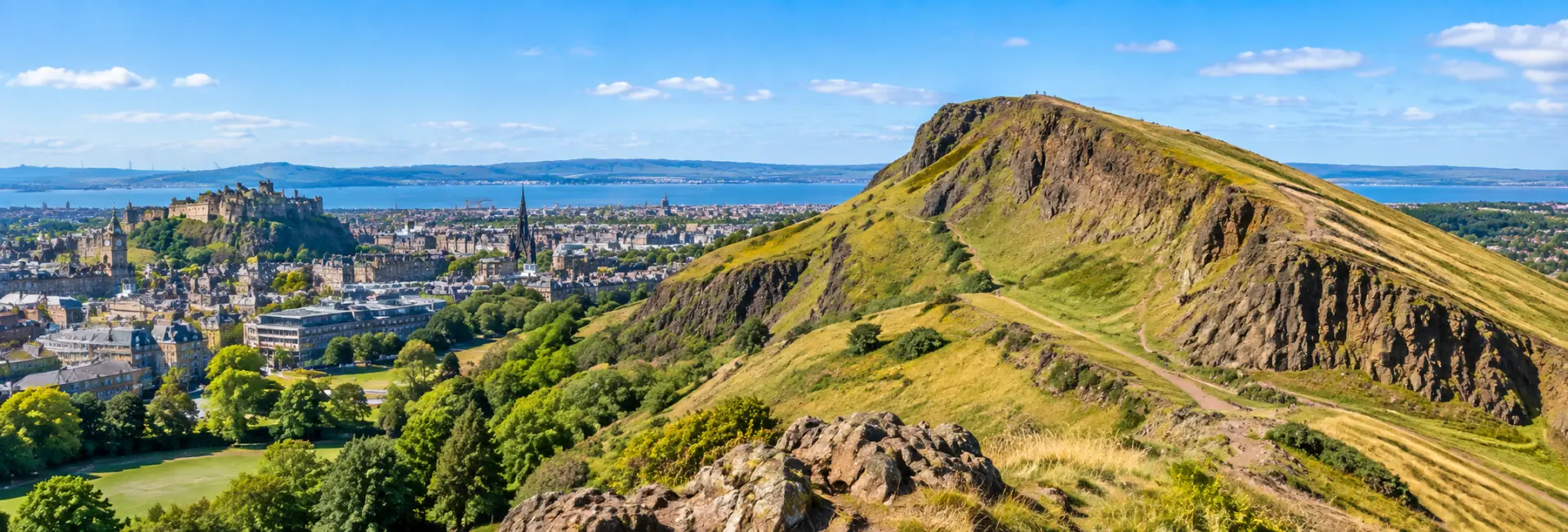
Arthur's Seat is the highest peak in Holyrood Park and the most recognisable natural landmark in Edinburgh. It rises 251 metres (823 feet) from the edge of the Old Town, a rugged, lion-shaped hill that looks far more like the Highlands than a city park. It is the remains of an extinct volcano, and its slopes, cliffs and lochs sit only about a mile from Edinburgh Castle.
What surprises many first-time visitors is how quickly the city falls away. Within a few minutes of leaving the Royal Mile you are on grassy slopes and rocky paths with wind in your face and wide views opening up in every direction. From the summit you can look across the rooftops of the Old and New Towns, north over the Firth of Forth, and east towards the coast.
The hill is part of a 650-acre royal park that is free to enter and open all day, every day. The climb is short enough to fit into a morning yet varied enough to keep regular walkers coming back, and it works equally well as a quick sunrise scramble or a slow afternoon ramble.
Formation & Natural History
A Tropical Beginning
The rocks of Holyrood Park tell a story that starts far from Scotland's present-day climate. In the Carboniferous period, more than 340 million years ago, this area sat close to the equator as a low, swampy plain near the sea. Layers of sand, mud and pebbles built up here, forming the sedimentary rock that later supplied Edinburgh with building stone, coal and other resources.
Eruption and Burial
Around that time, a volcano erupted here, pouring lava across the landscape. Later the volcanic vent and its surroundings were buried under more sediment. The Lion's Head and Lion's Haunch, the two rocky summits at the top of the hill, mark the remains of the volcanic vent at the heart of the old cone.
Ice and Erosion
Long after the volcano died, glaciers ground across the region during the Ice Age. They stripped away much of the softer rock and left the harder volcanic core standing tall, with a long tail of debris trailing behind it. That is the origin of the steep western faces and the gentler eastern slope that give the hill its distinctive profile.
Salisbury Crags and James Hutton
Salisbury Crags, the long cliff line that overlooks the city, were formed when molten rock forced its way between existing layers and cooled into a hard sill of dolerite. In the late 18th century, the Scottish naturalist James Hutton studied the contact between this igneous rock and the older sandstone below it. His observations helped him argue that the Earth was far older than most people then believed, and he is often called the father of modern geology. The site is known as Hutton's Section, and it remains one of the most important geological locations in the world.
Flora & Fauna
Because Holyrood Park has been protected as a royal estate for centuries, its habitats have survived largely intact. The mix of steep rock, open grassland, gorse-covered slopes, small lochs and patches of woodland makes it an unexpectedly rich wildlife area for a spot so close to the city centre.
Plants and Habitats
The park is the only place in Edinburgh with lowland dry heath, and it also holds areas of species-rich grassland. In late spring and summer, wildflowers dot the hillsides, while the yellow blossom of gorse is a familiar sight for much of the year. Native trees grow around the edges of the park and near the lochs.
Birds and Mammals
The three lochs, St Margaret's, Dunsapie and Duddingston, attract swans, tufted ducks, geese and gulls. Duddingston Loch is a bird sanctuary with a large heronry and reedbeds that shelter grebes and other waterbirds, and otters are sometimes seen there. On the open hill, look out for hares, squirrels and ground-nesting birds.
Looking After Nature
Dogs are welcome in the park, but there are periods when they need to be kept on a lead to protect nesting birds. Fires, camping and barbecues are not allowed. Visitors are also asked not to feed birds bread, and to use the bins provided.
Key Areas, Trails & Viewpoints
The Main Summit Route
Most people start next to the Palace of Holyroodhouse on Queen's Drive, where the crags of Salisbury Crags loom overhead. From here a steady earth path climbs up towards the summit, moving from grassy slopes to rockier ground as it approaches the top. The route is roughly 2.5 miles round trip and takes about two hours at a relaxed pace, depending on how long you spend at the top.
The Summit
The top is a small rocky plateau, often windy, with a panoramic view. To the north lies the Firth of Forth, while the city sprawls out to the west and the coast is visible to the east. A short section near the summit is steep and rocky, with a chain railing to help on the way up.
Dunsapie Loch and the Easier Approach
Drivers and those wanting a gentler climb can start at Dunsapie Loch on the eastern side of the park. This approach is shorter and less steep, although it misses some of the scenery of the palace-side route.
Salisbury Crags and the Radical Road
The Salisbury Crags trail is a fine alternative if you would rather stay lower. It follows the base of the cliffs and gives constant views over the Old Town, Calton Hill and the Firth of Forth. The Radical Road, the historic path along the foot of the cliffs, was built in the 1820s and has been closed for years because of rockfall. Historic Environment Scotland has been working towards reopening part of it, so check the official website for the current position.
St Anthony's Chapel and St Margaret's Loch
The ruins of St Anthony's Chapel sit on a rocky spur above St Margaret's Loch. It is the only building standing within the park, and it is believed to have fallen into disrepair after the Reformation of 1560.
Queen's Drive Circuit
For a gentle option, Queen's Drive is a tarmac road that loops around the park. It is a longer but easier walk, and it offers changing views of the hill from every side.
History & Legends
Royal Park and Ancient Landscape
There are traces of prehistoric settlement across the park, and the hill has been a landmark for as long as people have lived nearby. In the 16th century it was set aside as a royal park, and it has since been managed to protect both its landscape and its history. The entire park is now a scheduled monument, and it is looked after by Historic Environment Scotland.
Where Does the Name Come From?
Nobody knows for sure how Arthur's Seat got its name. It is often linked to the legend of King Arthur, but there is no clear evidence for this, and other explanations have been proposed. An older name, Craggenmarf, appears in the records of Holyrood Abbey. The mystery is part of the hill's charm.
The Tiny Coffins
In 1836, a group of boys hunting for rabbits on the hill discovered a small cave containing 17 miniature coffins, each holding a carved wooden figure. Their purpose has never been fully explained. Theories range from folk magic to a memorial for victims of the notorious Burke and Hare murders. The coffins are now in the National Museum of Scotland.
May Day and Local Traditions
The hill has long played a part in Edinburgh's seasonal customs. On May Day morning, people traditionally climb to greet the dawn, and the summit is a popular spot for sunrise gatherings throughout the year.
Ways to Experience It
Arthur's Seat suits many types of visitor, from confident hikers to families looking for a manageable climb.
- A standard summit hike, using one of the marked routes from the palace or from Dunsapie Loch.
- A sunrise or sunset walk, when the light over the city is at its most atmospheric.
- A loop of Salisbury Crags, which offers strong views for less effort than the full climb.
- A wildlife or birdwatching visit, especially around the lochs and Duddingston.
- Ranger-led or guided walks, which are a good way to learn about the geology and history, and may offer access to areas that are otherwise restricted.
- Geology-focused visits, including the Hutton's Section area, where it is open to visitors or on guided walks.
An audio guide to the park's history and wildlife is available through the Geotourist app.
Best Time to Visit
The hill can be climbed all year, and the views are excellent in any season. The best conditions usually come on dry, clear days in late spring, summer and early autumn, when paths are firm and the light is good. Bright weather also makes it easier to pick out landmarks such as the Forth bridges and, on very clear days, the coast beyond.
Early morning is usually the quietest time, and sunrise offers a memorable, if chilly, experience. Sunset is equally popular, with warm light across the Old Town and Salisbury Crags. Weekends and summer afternoons tend to be busy, so if you prefer a calmer climb, aim for a weekday.
In winter, the days are short and the paths can be icy, wet or muddy, and the summit can be very exposed to wind. Good footwear and warm layers matter far more than the calendar, so check the forecast before you set off.
Visitor Tips
- Wear sturdy shoes with good grip. The paths are earth and rock, the lower sections can be muddy, and the rocks near the top can be slippery when wet.
- Bring a windproof layer, even on sunny days. The summit is exposed and the wind can pick up quickly.
- Keep to the paths and stay well back from cliff edges, particularly around Salisbury Crags. Rockfall has closed sections of the park in the past.
- Follow any signs and closures. Some areas, including parts of the Radical Road and the climbing areas, may be closed for safety reasons.
- Allow around two hours for the main summit route from Holyrood Palace, and less from Dunsapie Loch.
- Parking is available at several points in the park, but roads may be closed to vehicles at certain times, particularly at weekends, so check before you drive.
- Take rubbish home or use the bins provided, and do not light fires or camp.
- Drones cannot be flown inside the park without permission.
- Take a bottle of water, as there are limited facilities on the hill itself. Public toilets are available at the Holyrood Park Education Centre.
The park is open around the clock and free to enter, but take extra care if you go up at dawn or dusk.
Nearby Attractions
Arthur's Seat sits at the foot of the Royal Mile, so it is easy to combine with a day in the Old Town.
- The Palace of Holyroodhouse, at the park entrance, with royal apartments, abbey ruins and gardens.
- The Scottish Parliament, a striking modern building opposite the palace, with public access and tours.
- Our Dynamic Earth, a science centre near the park entrance, well suited to families and anyone curious about the planet's geology.
- Duddingston village and Duddingston Loch, on the southern side of the park, which has a historic pub and is good for a quiet stroll or birdwatching.
- Dr Neil's Garden, a small garden by the loch that makes a peaceful stop.
- The Royal Mile, which leads uphill to St Giles' Cathedral and Edinburgh Castle.
- Calton Hill, a short distance away, which offers another popular viewpoint over the city.
Many visitors pair a morning on the hill with the palace or a walk back up the Royal Mile.
FAQs about visiting Arthur's Seat
What is Arthur's Seat? +
It is the main peak of Holyrood Park in Edinburgh and the remains of an extinct volcano that erupted more than 340 million years ago. It rises 251 metres above sea level and offers panoramic views across the city.
How long does it take to climb Arthur's Seat? +
From Holyrood Palace, the round trip takes about two hours at a moderate pace. From Dunsapie Loch it is shorter, and fit walkers can reach the summit in well under an hour.
Is Arthur's Seat difficult? +
Most people find it moderate. The paths are not technical, but they are steep in places, with rocky ground and a chain railing near the top. Sturdy footwear and reasonable fitness are recommended.
Is it free to climb Arthur's Seat? +
Yes. Holyrood Park is free to enter and open around the clock, all year. Parking may carry a charge, so check the current arrangements if you plan to drive.
Where should I start the hike? +
The most popular starting point is on Queen's Drive beside the Palace of Holyroodhouse, where the main trailhead is signposted. Dunsapie Loch is a good alternative if you want a shorter, easier climb.
When is the best time to go? +
Clear, dry days in late spring to early autumn are ideal, and sunrise or sunset gives the best light. Early weekday mornings are usually the quietest.
Is the Radical Road open? +
The Radical Road has been closed since 2018 because of rockfall, and Historic Environment Scotland has been working on reopening part of it. Check the official website for the latest status before you go.
Can I take a dog or children? +
Dogs are welcome, although they must be kept on a lead in some areas during nesting season. Children can manage the climb if they are used to walking, but they should be supervised near the summit and on steep sections.
What is there to see nearby? +
The Palace of Holyroodhouse, the Scottish Parliament, Our Dynamic Earth, Duddingston Loch and the Royal Mile are all close to the park.