Table of Contents
Overview
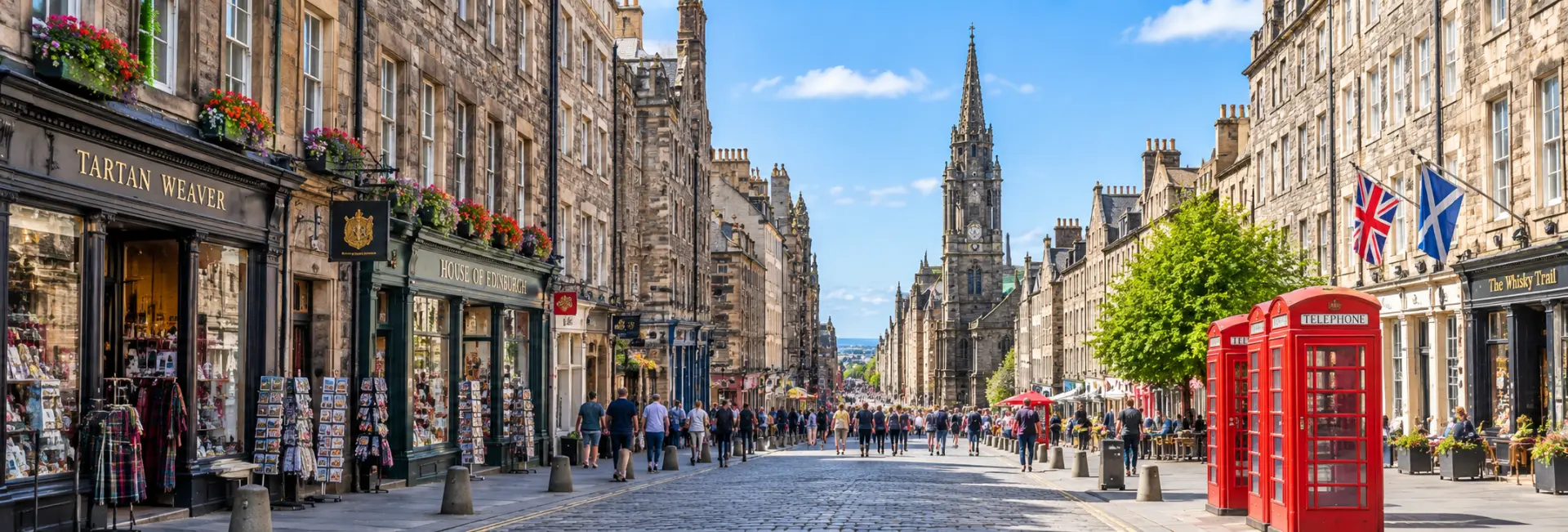
The Royal Mile is the main artery of Edinburgh's Old Town, a steep, cobbled ribbon of streets that drops from Edinburgh Castle at the top to the Palace of Holyroodhouse at the bottom. It measures about one Scots mile, which is a little longer than the modern mile, and it takes well under half an hour to walk end to end if you do not stop. Nobody ever does not stop.
What makes it special is how much is packed into such a short stretch. Cathedrals, courts, museums, whisky shops, street performers and pubs share the same pavements, while narrow alleys plunge off on either side towards lower streets. It is one of the busiest tourist routes in Scotland, yet it is also a living part of the city, with homes, offices, churches and courtrooms still in daily use.
For most visitors it works best as a slow descent through several centuries. The upper end is grand and busy, the middle is the civic and legal heart of the old capital, and the lower end is quieter and more residential, finishing at the edge of a wild hillside park.
History
A Ridge Above the Marsh
The Mile follows a natural ridge that slopes eastwards from Castle Rock, a landform that gave early settlers a defensible place to build. By the 12th century a royal castle stood at the top, and Holyrood Abbey was founded at the bottom in 1128 by King David I. The street between them grew into the spine of the medieval town, and the link between fortress and abbey later made it the natural route for royal processions.
Crowded Walls
Edinburgh's town walls kept the population squeezed onto the ridge, so buildings grew upwards instead of outwards. Tenements of many storeys, known as lands, rose along the street, and tens of thousands of people lived packed together with little sanitation. Rich and poor often shared the same building, with wealthier families on the middle floors and the poorest at the top and bottom. Household waste was famously thrown from windows with the warning cry of "Gardyloo".
Court, Church and Parliament
For centuries the Mile was where Scottish life was organised. Parliament met near St Giles' until 1707, the Old Tolbooth held the town's prisoners and officials, and the Mercat Cross was the place for royal proclamations. Preachers, printers, lawyers and philosophers all worked within a few hundred metres of each other, which helped make Edinburgh a centre of Enlightenment thinking in the 18th century.
Change and Survival
A major fire in 1824 destroyed a large part of the south side of the High Street, which was rebuilt in the Georgian style over the following years. The wealthy had by then moved to the New Town across the valley, leaving the Old Town to poorer residents and, for a time, decline. The name "Royal Mile" itself is quite modern, coined in the late 19th century and popularised in the early 20th, but the route it describes is far older.
Recognition / Status
The Royal Mile forms the core of the Old Town, which is part of the Old and New Towns of Edinburgh World Heritage Site, inscribed by UNESCO in 1995. The listing recognises the contrast between the medieval Old Town and the planned Georgian New Town, and the way the two together show centuries of urban development in a single city.
Many individual buildings along the route are listed for their architectural or historic importance, including St Giles' Cathedral and a number of the tenements and civic buildings around it. That protection is a big reason the street still looks so distinctive today.
The Mile is also central to the identity of the wider city. It is the setting for large annual events such as the Edinburgh Festival Fringe in August, when the High Street fills with performers, flyer-handers and crowds.
Architecture & Streetscape
Tall Tenements
The most striking feature is the height of the buildings. Stone tenements climb high above the street, some of them once among the tallest residential buildings in Europe, and their upper storeys jut out over narrow alleys below. Gladstone's Land, a preserved 17th-century tenement in the Lawnmarket, gives a clear idea of how these buildings were arranged and lived in.
The Herringbone Pattern
From above, the Mile looks like a fishbone. The main street is the spine, and dozens of closes and wynds run off it as ribs, most sloping steeply downhill with stairs and tight archways. A close was originally the entrance to a block of housing, often named after a notable resident, while a wynd was a slightly wider passage. Some are open to walk through, others are private or dead ends.
Layers of Style
The streetscape is a mix of periods. Medieval and 16th-century fragments sit beside 17th-century tenements, Georgian rebuilding after the 1824 fire, Victorian churches and a bold modern parliament building at the far end. The variety is part of the charm, and looking up rather than straight ahead tends to be rewarded.
The Five Sections of the Mile
The Royal Mile is not one street but five joined together, each with its own name and character.
Castlehill
The top section runs from the castle Esplanade downhill. It is home to the Camera Obscura, the Scotch Whisky Experience and The Hub, a Gothic church converted into a festival venue, and it has some of the best views back up to the castle walls.
Lawnmarket
Once a market for cloth and linen, this short stretch now mixes souvenir shops with historic buildings. Gladstone's Land sits here, and Lady Stair's Close leads down to the Writers' Museum, which celebrates Robert Burns, Sir Walter Scott and Robert Louis Stevenson.
High Street
The longest and busiest part holds St Giles' Cathedral, Parliament Square, the Mercat Cross, the City Chambers and the Tron Kirk area. It is the civic centre and the place where festival crowds gather in summer.
Canongate
Canongate was a separate burgh, independent from Edinburgh, until 1856. It feels calmer and more residential, with wider spaces and lower buildings, and it holds Canongate Kirk, the Museum of Edinburgh and the People's Story Museum.
Abbey Strand
The short final stretch leads past the Scottish Parliament to the gates of Holyroodhouse, with Holyrood Park rising steeply behind.
Notable Landmarks
St Giles' Cathedral
The High Kirk of Edinburgh is instantly recognisable by its crown-shaped steeple. Inside are soaring Gothic arches, stained glass and the ornate Thistle Chapel, built in the early 20th century for Scotland's highest order of chivalry. Outside its west door, a heart-shaped mosaic in the paving marks the site of the old Tolbooth prison.
The Real Mary King's Close
Beneath the City Chambers lies a set of 17th-century closes that were built over in the 18th century rather than demolished. Guided tours take visitors down into the preserved streets to hear about plague, poverty and everyday life underground.
John Knox House and the Storytelling Centre
One of the oldest surviving houses in the Old Town, John Knox House is tied to the Protestant reformer of the same name. It stands next to the Scottish Storytelling Centre, which hosts performances and events based on Scotland's oral traditions.
Canongate Kirk
The parish church of the Canongate dates to the late 17th century and is associated with Holyroodhouse. Its kirkyard is the burial place of the economist Adam Smith.
The Scottish Parliament
At the foot of the Mile, this striking modern building by architect Enric Miralles is very different from everything above it. It is free to visit, and guided tours and public debates are available on certain days.
The Palace of Holyroodhouse
The official residence of the monarch in Scotland stands at the end of the route. Visitors can see the State Apartments, the Great Gallery and the ruins of Holyrood Abbey, and the palace is linked to Mary, Queen of Scots and the murder of her secretary, David Rizzio, in 1566.
Ways to Experience It
The simplest way is to walk it downhill from the castle to Holyrood, allowing anything from two hours to a full day depending on how many places you go into. There are several other approaches worth considering.
- Guided walking tours, covering history, ghost stories, literary connections or the closes, which add context that is not obvious from the street.
- Self-guided exploration of the closes, where courtyards, gardens and cafes hide away from the crowds. Dunbar's Close Garden, off the Canongate, is a peaceful example.
- Museum-hopping, since several museums along the Mile are small and easy to fit into a short break.
- Underground tours, such as the Real Mary King's Close, for a different view of the Old Town.
- Festival visits, especially in August, when the street becomes an open-air stage.
For a change of pace, finish at Holyrood Park and follow one of its paths towards Arthur's Seat for views back across the Old Town.
Best Time to Visit
Early morning is the best time to see the Royal Mile at its calmest. Before the shops open and tour groups arrive, the street is quiet enough to notice the architecture, and the light on the stone is beautiful. Evenings can also be atmospheric, particularly on clear nights when the castle is lit above the street.
Seasonally, late spring and early autumn offer a good balance of pleasant weather and manageable crowds. July and August are the busiest months, and during the Edinburgh Festival Fringe in August the High Street can be packed with performers and audiences. That energy is part of the appeal for many, though it makes moving quickly along the Mile difficult.
Winter is quieter and colder, with wind funnelling along the ridge, but it can also be the most evocative time to visit. Christmas and Hogmanay bring their own events to the city, so it is worth checking local listings.
Visitor Tips
- Walking the street itself is free, and several attractions along it, including St Giles' Cathedral and a number of small museums, are free to enter. Others, such as Edinburgh Castle, Holyroodhouse and the Real Mary King's Close, are ticketed and best booked ahead in busy periods.
- Wear comfortable, grippy shoes. The pavements are cobbled and steep, and many closes have uneven steps.
- Walk downhill from the castle if you want an easier start, and use the buses or a short walk back up afterwards.
- Explore the closes, not just the main street. Many of the most interesting corners are a few steps off the Mile.
- Expect crowds and the odd pickpocket in peak periods, and keep bags closed.
- Be aware that the closes and some historic buildings are not always accessible for wheelchair users or anyone with limited mobility, so check individual attractions in advance.
- Confirm opening hours, prices and any closures with each attraction before you go, as these change often.
The Mile is easy to reach on foot from Waverley station, and buses serve the Old Town at several points along its length.
FAQs about visiting the Royal Mile
What is the Royal Mile? +
It is the name for the main street of Edinburgh's Old Town, made up of five joined streets that run from Edinburgh Castle down to the Palace of Holyroodhouse. It gets its name from being roughly a Scots mile long and from its role as a royal route between the two.
How long is the Royal Mile and how long does it take to walk? +
It is about one Scots mile, a little over a mile in modern measurement. Walking straight through takes around 20 to 25 minutes downhill, but most people spend two to four hours or more once they include stops.
Is the Royal Mile free to visit? +
Yes, the street is public and free to walk at any time. Some attractions on it are free to enter, while others, including the castle, the palace and underground tours, charge admission.
Where does the Royal Mile start and finish? +
The top is at Edinburgh Castle, on the Esplanade, and the bottom ends at the Palace of Holyroodhouse, close to the Scottish Parliament and Holyrood Park. Many visitors walk downhill because it is easier on the legs.
What are the main sights along the Royal Mile? +
Highlights include Edinburgh Castle, St Giles' Cathedral, Gladstone's Land, the Real Mary King's Close, John Knox House, Canongate Kirk, the Scottish Parliament and Holyroodhouse. The historic closes off the main street are also a big part of the experience.
When is the best time to go? +
Early morning is usually quietest, and late spring or early autumn tends to be more comfortable than midsummer. August is exciting but very crowded because of the festivals.
Is the Royal Mile suitable for children and people with limited mobility? +
Children usually enjoy the street performers, the underground tours and the museums. The Mile is steep and cobbled, and many closes have steps, so visitors with mobility needs should plan ahead and check access at individual attractions.
Can I combine the Royal Mile with other Edinburgh attractions? +
Yes. It links easily with Edinburgh Castle at the top and Holyrood Park and Arthur's Seat at the bottom, and the National Museum of Scotland and Princes Street Gardens are a short walk away.