Table of Contents
Overview
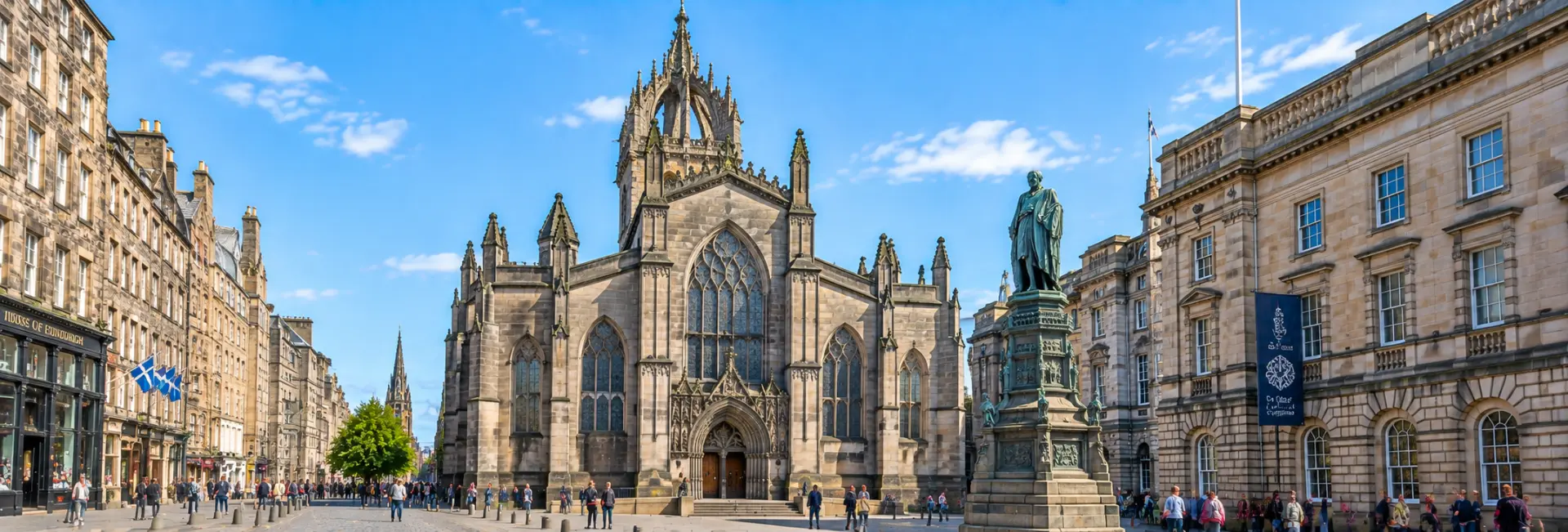
St Giles' Cathedral, more properly known as the High Kirk of Edinburgh, stands roughly halfway along the Royal Mile in the heart of the Old Town. Its grey stone walls and distinctive crown-shaped spire have watched over the city for more than six centuries, making it one of the most recognisable silhouettes on the Edinburgh skyline.
Though it is called a cathedral, the building has only briefly held that formal status in its history, since the Presbyterian Church of Scotland does not appoint bishops. What draws visitors today is less a matter of title and more a matter of layered history: this is the church where the reformer John Knox once preached, where a national covenant was signed against the crown, and where the elaborate Thistle Chapel still hosts ceremonies for Scotland's most senior order of chivalry.
History
Origins and the Medieval Church
A place of worship is believed to have stood on this site since at least the early 12th century, when a church dedicated to Saint Giles, a patron associated with the poor and disabled, was established under royal patronage. That early building was damaged during conflicts with England in the 14th century, and the structure seen today largely dates from a major rebuilding that began in the late 1300s and continued into the early 1500s, giving the church its Gothic character and its distinctive crown spire.
Reformation and John Knox
St Giles' became the epicentre of the Scottish Reformation in 1559, when John Knox took up the post of minister and used the pulpit to spread Protestant teaching across the city. The years that followed were turbulent: royal decree briefly split the building into several separate parish churches, a national covenant defending Presbyterian worship was signed nearby in 1638, and the church swung in and out of cathedral status twice during the 17th century as bishops were installed and then abolished.
Restoration and Modern Additions
By the 19th century the building had fallen into disrepair, prompting a significant restoration under architect William Burn between 1829 and 1833, followed by further work later in the century that re-faced much of the exterior in smooth stone and added many of the memorials seen inside today. The most celebrated addition came in the early 20th century, when architect Robert Lorimer designed the ornate Thistle Chapel, completed in 1911, to serve as the ceremonial home of the Order of the Thistle.
Architecture & Design
The Crown Spire and Exterior
The cathedral's most famous architectural feature is its open crown spire, supported by eight flying buttresses that meet above the central tower. This design, unusual among British churches, has become a defining image of Edinburgh and is thought to date from around 1500. The exterior overall reflects late Gothic style, with pointed arches, decorative stone tracery and carved pinnacles, much of it refreshed during the 19th-century restorations.
Interior Layout
Inside, the plan is unusual in that the nave and chancel are close to equal length, placing the crossing near the centre of the building rather than towards one end. Sturdy medieval piers, among the oldest surviving elements of the structure, support the tower and hint at the scale of the original 14th-century church. Side aisles branch off the main body of the building, each associated with different periods and patrons, giving the interior a sense of accumulated history rather than a single unified design.
Cultural & Religious Significance
St Giles' remains an active congregation of the Church of Scotland and continues to host regular worship alongside its role as a visitor destination, a combination that gives it a different atmosphere from purely historic sites. It has also served as a stage for state and national occasions, including thanksgiving services and events connected to the monarchy.
The church holds a special place in the ceremonial life of Scotland as the home of the Order of the Thistle, the country's most senior order of chivalry, whose knights and ladies are installed and honoured within the purpose-built Thistle Chapel. This dual identity, part working parish church and part stage for national ceremony, is central to why the building carries such weight in Scottish civic life.
Notable Features
The Thistle Chapel
Tucked into the southeast corner of the building, the Thistle Chapel is widely considered the artistic highlight of a visit. Its canopied stalls are carved with the heraldic emblems of the Order's knights, and visitors often search out a small carved angel playing bagpipes hidden among the woodwork, a playful touch amid otherwise solemn ceremonial surroundings.
Stained Glass and Memorials
Much of the stained glass dates from the 1870s onward, since earlier windows were lost or replaced with plain glass during the Reformation period. Notable later additions include a window commemorating the poet Robert Burns and a memorial to the writer Robert Louis Stevenson, reflecting the building's role as an unofficial hall of fame for notable Scots.
Historic Relics and Monuments
Several aisles contain tombs and monuments to figures from Scotland's turbulent 17th century, including opposing leaders from the civil war era, whose memorials now stand within a short distance of one another. A copy of the National Covenant, the 1638 document central to the Presbyterian cause, is also displayed inside, connecting the building directly to one of the defining episodes of Scottish history.
Visiting Etiquette & Tips
As a working church, St Giles' asks visitors to be mindful during services and quiet moments of prayer, and photography is sometimes restricted in the Thistle Chapel out of respect for its ceremonial use.
- Entry to the main body of the cathedral is generally free, with a suggested donation welcomed to support its upkeep.
- A small fee may apply for photography permits or for access to certain areas during special exhibitions.
- Volunteer guides are often on hand to share background on specific aisles, windows and monuments.
- The building can get busy with tour groups in peak season, so arriving earlier in the day tends to mean a quieter visit.
- Modest, respectful dress is appreciated, particularly around service times.
Best Time to Visit
Weekday mornings, shortly after opening, tend to offer the calmest experience, before Royal Mile foot traffic builds through the middle of the day. Visiting outside the busy summer festival season, such as in spring or autumn, generally means smaller crowds while the weather is still reasonable for exploring the surrounding Old Town on foot.
Those interested in the building's living role as a church may prefer to time a visit around a Sunday service or one of its regular concerts, when the cathedral's acoustics and atmosphere are shown to their fullest.
Nearby Attractions
Standing on the Royal Mile, St Giles' sits within easy walking distance of several other major Edinburgh landmarks, making it simple to combine with a broader day of sightseeing in the Old Town.
- Edinburgh Castle, a short walk uphill at the top of the Royal Mile.
- The Palace of Holyroodhouse, at the opposite end of the Royal Mile.
- The Real Mary King's Close, an underground historic close just steps away.
- Grassmarket and Victoria Street, a short detour into the surrounding Old Town streets.
FAQs about visiting St Giles' Cathedral
Is St Giles' Cathedral actually a cathedral? +
Not in the strict sense. It is properly the High Kirk of Edinburgh, a Church of Scotland parish church, and only held true cathedral status briefly in the 17th century since Presbyterian churches do not have bishops.
Is entry to St Giles' Cathedral free? +
Yes, general admission is free, though a donation is welcomed and a small fee may apply for photography permits or special areas.
How much time should I spend at St Giles' Cathedral? +
Most visitors spend around 30 to 45 minutes taking in the main body of the church and the Thistle Chapel, longer if joining a guided tour or attending a service.
What is the Thistle Chapel? +
It is an ornately carved chapel added in 1911 as the ceremonial home of the Order of the Thistle, Scotland's senior order of chivalry, and is considered the artistic highlight of the building.
Why is John Knox connected to St Giles' Cathedral? +
John Knox served as minister here from 1559, using the pulpit to lead the Scottish Reformation, which makes the church a key site in Scottish religious history.
Is St Giles' Cathedral suitable for visitors with mobility needs? +
The main entrance has been adapted for wheelchair access, though some older sections of the interior involve uneven historic flooring, so visitors with mobility needs may want to check current access details before arriving.
Can I combine a visit with other Royal Mile attractions? +
Yes, the cathedral sits roughly midway between Edinburgh Castle and the Palace of Holyroodhouse, making it easy to fold into a walk along the Royal Mile.
Does St Giles' Cathedral hold regular services? +
Yes, it remains an active congregation with regular Sunday worship, alongside concerts and civic events held throughout the year.