Table of Contents
Overview
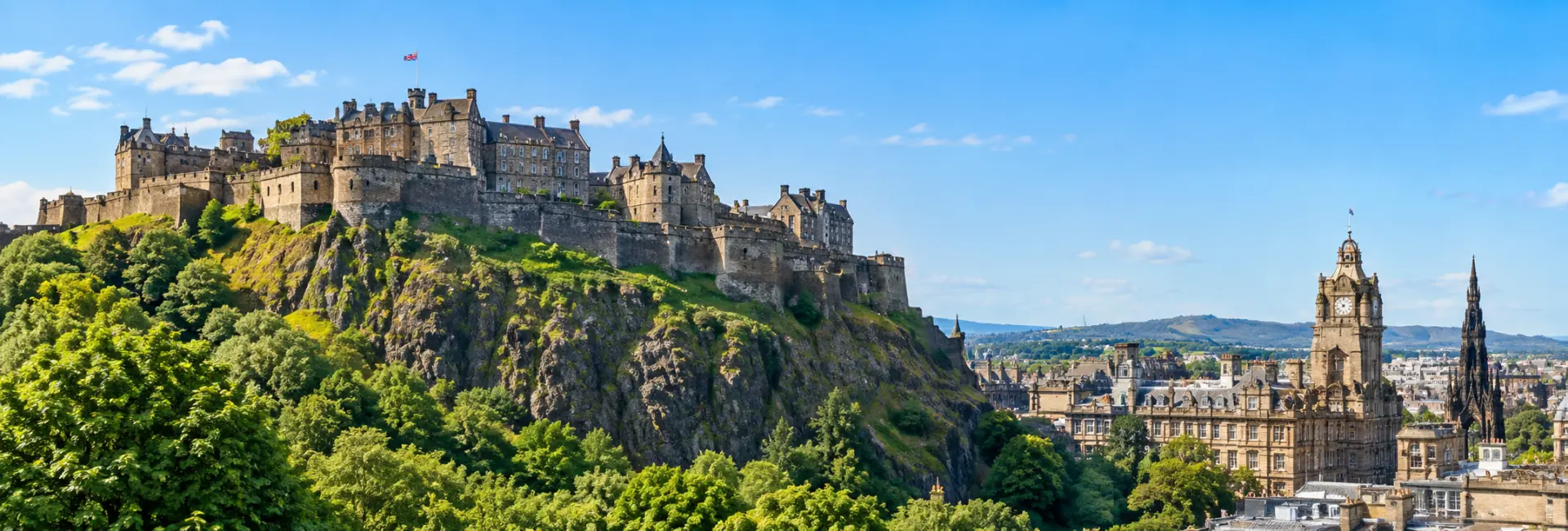
Edinburgh Castle sits on top of Castle Rock, a steep volcanic crag about 135 metres above sea level, and it is hard to look up at the Old Town without finding it staring back. For centuries it was a royal home, a garrison, a prison and a national symbol all at once, and traces of each role are still visible inside the walls. It is run today by Historic Environment Scotland and ranks among the most visited paid attractions in the country.
Part of the appeal is that the castle is not a single building. It is a cluster of structures added over roughly nine centuries, from a tiny Romanesque chapel to Victorian-era restorations and a memorial from the 1920s. Walking through it feels a bit like moving up through layers of Scottish history, with the ground rising steadily towards the oldest and most dramatic parts.
Highlights include the Honours of Scotland, the great medieval cannon Mons Meg, the room where a future king of Scotland and England was born, and some of the best rooftop-style views in the city. Most people need at least two hours, and many happily spend longer.
History
A Fortified Rock
Castle Rock is what remains of an ancient volcanic plug, formed more than 300 million years ago and later shaped by glaciers. People were living on the hill by at least the Iron Age, drawn by a natural defensive position that is steep on almost every side. By the 12th century a royal castle stood here, and King David I is credited with founding St Margaret's Chapel around 1130 in memory of his mother.
War, Capture and Recapture
During the Wars of Independence the castle changed hands repeatedly. Edward I of England took it after a short siege in 1296, and in 1314 a small Scottish party led by Thomas Randolph, nephew of Robert the Bruce, climbed the rock at night and won it back. Later in the 14th century David II built a large tower on the site, known as David's Tower, which would meet a violent end in the following centuries.
Royal Residence
By the late medieval period the castle was a major royal residence and treasury. James IV completed the Great Hall in 1511, and Mary, Queen of Scots gave birth here to the future James VI on 19 June 1566. That birth eventually put one monarch on both the Scottish and English thrones in 1603.
Sieges and Rebellions
The castle is often described as the most besieged place in Britain. The Lang Siege of 1573 destroyed David's Tower, and the Half Moon Battery was built in its aftermath. Covenanter forces took the castle in 1639 in about half an hour, and Oliver Cromwell's army besieged it in 1650. Jacobite attempts to seize it in 1715 and 1745 both failed.
Garrison, Prison and Revival
Between 1757 and 1814 the vaults were used to hold prisoners of war, and in 1811 dozens escaped through a hole in the wall. In 1818 Sir Walter Scott helped locate the long-sealed Honours of Scotland, sparking a wave of interest in the country's past. Mons Meg came home from London in 1829, and 19th-century restoration work gave the Great Hall and Royal Palace much of the look visitors see today.
Architecture & Notable Rooms
Because the castle grew in stages, its architecture is a patchwork rather than a single design. Stone from different centuries sits side by side, and defensive walls, barracks, palace rooms and a chapel all share the same cramped summit. Most of the key buildings cluster around Crown Square at the highest point.
St Margaret's Chapel
This small Romanesque chapel dates to around 1130 and is generally regarded as the oldest surviving building in Edinburgh. It is only a few metres long inside, plain and quiet, and still hosts weddings and christenings. Stained glass and a simple arched doorway are the main things to look for.
The Great Hall
Finished in 1511 for James IV, the Great Hall was built for feasts, ceremonies and gatherings of the royal court. Its most striking feature is the timber hammerbeam roof, an impressive piece of medieval carpentry. Arms and armour line the walls, giving a sense of how the room would have looked in a more martial age.
The Royal Palace and Crown Room
The Royal Palace on the east side of Crown Square holds the small chamber where James VI was born, along with rooms decorated with painted panelling and carved details. Upstairs is the Crown Room, the purpose-built vault where the Honours of Scotland are kept. It was refurbished in 2026 with a new bespoke display case and restored Victorian oak panelling.
The Scottish National War Memorial
Opened in 1927, the memorial occupies a converted barracks building on Crown Square and commemorates Scots who died in the First World War, with later additions for other conflicts. It is a solemn, reflective space and worth a few unhurried minutes.
Batteries, Cannons & Views
Mons Meg
This enormous bombard was built in 1449 for the Duke of Burgundy and presented to James II of Scotland in 1457. It weighs around six tons and could reportedly fire a stone ball of roughly 150 kilograms up to about two miles. After a long spell in London from 1754, it was returned to Edinburgh in 1829 and now sits in view of the castle's central courtyard.
The One O'Clock Gun
Every day except Sunday, a field gun on the Mills Mount Battery fires at 1 pm. The tradition began in 1861 as a time signal for ships anchored in the Firth of Forth, who could not always see the city's clocks. It still makes some visitors jump, so it is worth knowing it is coming.
Half Moon and Argyle Batteries
The Half Moon Battery is the curved, gun-lined bastion that faces the Royal Mile and forms the castle's most recognisable outline. From the Argyle Battery on the north side you can look over New Town rooftops, across to the Firth of Forth, and out to the hills of Fife on a clear day.
The Dogs' Cemetery
Just below the battlements is a small, neatly kept graveyard where soldiers' pets are buried. It is easy to miss, and it tends to become a favourite detail for people who find it.
Cultural Significance & Military Heritage
The Honours of Scotland
The Crown, Sceptre and Sword of State are the oldest crown jewels in Britain. The crown was refashioned for James V in 1540, and the Honours were first used together at the coronation of Mary, Queen of Scots in 1543. They were hidden from Cromwell's forces between 1651 and 1660, then sealed in an oak chest after the Union of 1707 and forgotten until Scott's search in 1818.
The Stone of Destiny
For nearly three decades the Stone of Destiny was displayed here alongside the Honours, after returning to Scotland in 1996. It moved to Perth Museum in March 2024, so it is no longer at the castle. That is a common point of confusion on older guidebooks and websites.
Military Life
The National War Museum of Scotland is housed within the castle complex and follows the stories of Scottish soldiers, campaigns and regiments across several centuries. Military links are very much alive here, and several regiments still have historic connections to the site.
The Royal Edinburgh Military Tattoo
Each August, the Esplanade in front of the castle becomes the stage for the Tattoo, an evening of massed pipes, drums, dance and military display performed against the floodlit walls. It has become one of the best-known events in the city's summer calendar, and the castle itself is what makes it so memorable.
Ways to Experience It
Most visitors explore independently, following the route uphill through the gatehouse and on to Crown Square. There are a few ways to add more depth to a visit.
- Official guided tours, which are bookable and offer more of the stories behind the sieges, the royal births and the Honours.
- Audio guides, useful if you prefer to move at your own speed and dip in where you are curious.
- The National War Museum, best for anyone interested in military history, uniforms and Scotland's regiments.
- The Prisons of War exhibition in the vaults, which gives a sense of everyday life for those held in the castle.
- Evening events and the Tattoo in August, when the castle is seen from the outside rather than explored within.
A flexi ticket offers one entry within a seven-day window from your chosen start date, which can be handy if your plans are still loose.
Best Time to Visit
The castle is open every day of the year apart from 25 and 26 December, with opening hours that shift slightly between summer and winter. Crowds are heaviest from late spring to early autumn, and especially in July and August during the festival season.
For a calmer visit, aim for weekday mornings soon after opening, or the last part of the afternoon. The Crown Room queue tends to build through the late morning in busy months, so heading there first can save a good deal of waiting. November to March is the quietest period, though the weather can be cold and blustery on the ramparts.
Clear days matter more than usual here. On a bright morning the views from the batteries are far-reaching, while on a grey or foggy day the castle takes on a moodier atmosphere, though the outlook is limited.
Visitor Tips
- Book tickets online in advance. The castle regularly sells out in summer, and once online tickets are gone, none are sold at the gate.
- Allow at least two hours, and more if you plan to visit the National War Museum and the Prisons of War exhibition properly.
- Wear comfortable shoes. The approach and the castle itself are steep, cobbled and uneven in places.
- Check accessibility details on the official website before you go, as some parts of the castle have steps and steep gradients.
- Time your visit around the One O'Clock Gun if you want to see it, and stand back from the battery for a comfortable view.
- Historic Environment Scotland members and Explorer Pass holders enter free or at a reduced rate, which can be worthwhile if you are visiting other sites.
- Confirm opening hours, prices and any closures with the official source before you travel, as these can change.
Getting there is straightforward. The castle stands at the top of the Royal Mile, the nearest tram stop is Princes Street, and several bus routes serve the Mound and George IV Bridge, both a short uphill walk away.
Nearby Attractions
The castle is a natural starting point for exploring the Old Town, and several sights are within a short walk.
- The Royal Mile, the historic street running downhill from the castle towards the Palace of Holyroodhouse.
- St Giles' Cathedral, a landmark medieval church with a distinctive crown-shaped spire.
- Camera Obscura and World of Illusions and the Scotch Whisky Experience, both located on Castlehill near the entrance.
- The Grassmarket, a lively square below the castle known for its pubs, independent shops and views up to the walls.
- Princes Street Gardens, a green space that sits directly beneath the rock and offers a very different angle on the castle.
- The National Museum of Scotland, a short walk away and well suited to a rainy afternoon.
Many visitors combine the castle with a walk down the Royal Mile towards Holyrood, which makes for an easy half-day or full-day itinerary through the heart of the Old Town.
FAQs about visiting Edinburgh Castle
What is Edinburgh Castle famous for? +
It is best known for its dramatic position on a volcanic rock above the city, its long history as a royal residence and fortress, and for housing the Honours of Scotland, the country's crown jewels. Mons Meg and the One O'Clock Gun are also popular draws.
How long does a visit take? +
Plan on at least two hours to see the main sights. If you want to explore the National War Museum and the Prisons of War exhibition as well, three hours or more is more realistic.
Do I need to book tickets in advance? +
It is strongly recommended. Tickets often sell out well ahead, particularly in summer, and once online tickets are gone none are available at the castle itself. A flexi ticket lets you choose any day within a seven-day window.
Can I still see the Stone of Destiny at Edinburgh Castle? +
No. The Stone of Destiny was moved to Perth Museum in 2024, so you will find it there rather than in Edinburgh. The Honours of Scotland remain on display in the castle's Crown Room.
When is the best time to go? +
Weekday mornings shortly after opening or the last part of the afternoon are usually quietest. The winter months are calmer overall, while July and August are the busiest.
Is the castle suitable for children and people with limited mobility? +
Children generally enjoy the cannons, the ramparts and the royal rooms. The site is hilly, cobbled and has stairs in places, so anyone with mobility needs should check the official accessibility information before visiting.
How do I get to Edinburgh Castle? +
It stands at the top of the Royal Mile in the Old Town. Buses stop at the Mound and George IV Bridge, and the nearest tram stop is Princes Street, roughly a 10-minute uphill walk from the entrance.
What else can I see nearby? +
The Royal Mile, St Giles' Cathedral, the Grassmarket and Princes Street Gardens are all close, and the National Museum of Scotland is a short walk away.