Table of Contents
Overview
Calton Hill is a small, grassy volcanic hill at the east end of Princes Street, and it is one of the easiest ways to get a big view of Edinburgh. It rises to roughly 100 metres above sea level, high enough to look across the whole city yet low enough to reach in five to ten minutes on foot. The summit is a wide open plateau dotted with monuments that look like they belong in ancient Greece, which is exactly what the city's planners had in mind.
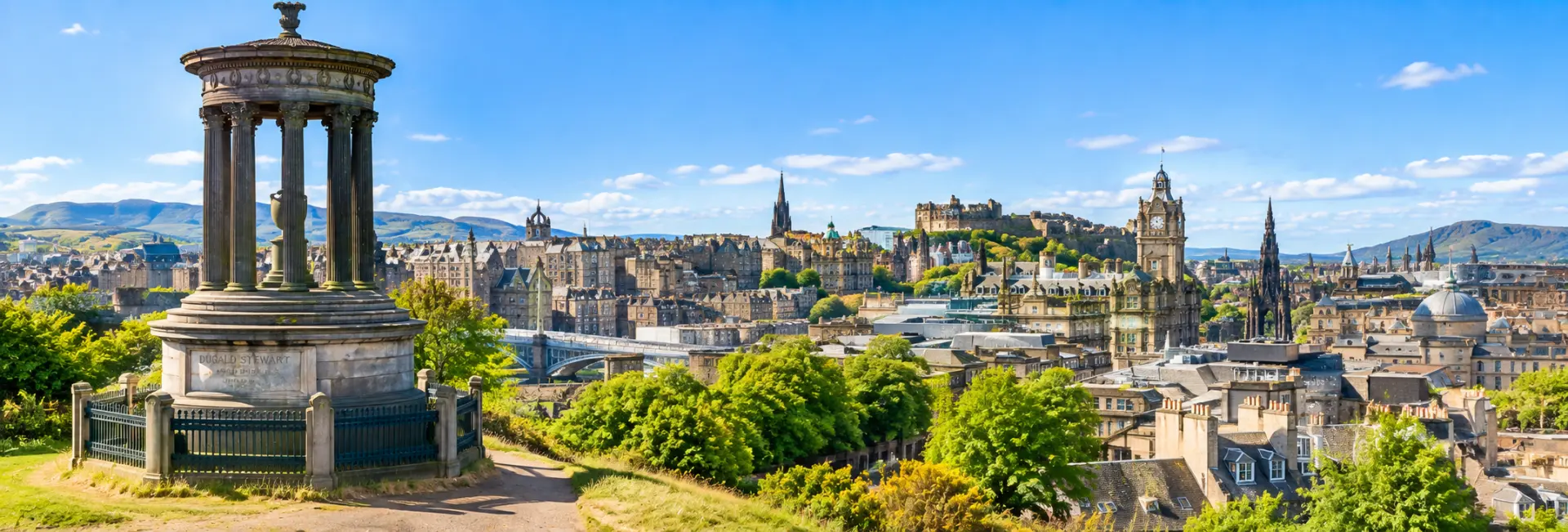
From the top you can see Edinburgh Castle on its rock, the spires of the Old Town, the Georgian streets of the New Town, Arthur's Seat rising to the south and the Firth of Forth stretching out to the north. On a clear day the view extends across the water to Fife.
The hill is free to enter, open at all hours and popular with locals as well as visitors. It is a favourite place to watch a sunset, take photographs, picnic on the grass or simply catch your breath above the busy centre.
History
An Ancient Hill
Like Arthur's Seat and Castle Rock, Calton Hill owes its shape to volcanic activity that took place more than 300 million years ago. The name appears in records as far back as the 15th century in the form "Cragingalt", and it may come from an old word for a small wood. Over the centuries the hill was used as farmland and a quarry, and it has also been linked to a monastery, a jousting ground and a leper colony.
Observatories and Enlightenment Ideas
The hill's association with science began in the late 18th century. A Gothic-style observatory house was begun in 1776, and the architect James Craig, who planned the New Town, later designed the Old Observatory House in 1792. In 1818 the larger City Observatory, designed by William Henry Playfair, was completed nearby.
The Athens of the North
In the early 19th century, Edinburgh's leaders wanted the city to reflect its role as a centre of the Scottish Enlightenment. Classical architecture was seen as the perfect expression of learning and civic pride, and Calton Hill became the stage for that idea. The Nelson Monument, the National Monument and the Dugald Stewart Monument all date from this period, and together they helped earn Edinburgh its nickname.
A Place for Gathering
The hill has long been a place where people meet. In 1838 a large Chartist rally was held here, with thousands calling for political reform, and it has continued to host demonstrations, festivals and celebrations ever since.
Recognition / Status
Calton Hill is part of the Old and New Towns of Edinburgh World Heritage Site, which UNESCO inscribed in 1995. The hill is considered an important part of the city's planned landscape, linking the medieval Old Town with the Georgian New Town, and its monuments are recognised for their architectural and historical value.
Several of the individual structures on the hill are listed buildings, including the Dugald Stewart Monument, which has Category A status. The hill also has an important place in the story of Scottish neoclassicism, as it shows how architects of the time borrowed from ancient Greece to give the city a distinctive identity.
The summit and its surroundings are public space, and the hill remains a much-loved green area in the middle of a busy city.
Monuments & Landmarks
The National Monument
Often called Edinburgh's Disgrace, this unfinished monument was meant to be a replica of the Parthenon in Athens, honouring Scottish soldiers who died in the Napoleonic Wars. The foundation stone was laid in 1822 during George IV's visit, and building began in 1826 to a design by Playfair and Charles Robert Cockerell. Money ran out in 1829, so only a row of columns and a base were ever completed. The ruin has become one of the most photographed features in the city.
The Nelson Monument
This 32-metre tower was built to commemorate Admiral Lord Nelson and the Battle of Trafalgar, and its shape is often compared to an upturned telescope. A spiral staircase of 143 steps leads to a public viewing gallery. A time ball on top was added in the early 1850s to help ships in the Firth of Forth set their clocks, and it still drops at 1 pm in step with the One O'Clock Gun from the castle.
The Dugald Stewart Monument
A small circular temple with elegant columns, this memorial to the Edinburgh philosopher Dugald Stewart was designed by Playfair and completed in 1831. It is modelled on an ancient monument in Athens and is one of the city's most photographed spots, especially at sunset.
The City Observatory and Collective
Playfair's City Observatory, with its green copper dome, has been restored and reopened as Collective, a contemporary art gallery that is free to enter. The complex also includes a viewing terrace and a restaurant with sweeping views. Nearby stands the Old Observatory House, designed by James Craig.
The Burns Monument and Old Calton Burial Ground
Down the southern slope, a small Greek-style temple honours the poet Robert Burns. Close to the foot of the hill is the Old Calton Burial Ground, where the philosopher David Hume is buried and where the Political Martyrs' Monument stands.
Views & Photo Spots
The views are the main reason people climb Calton Hill, and there are several great vantage points on the summit and along its slopes.
Looking West
The classic postcard view looks along Princes Street towards Edinburgh Castle. The clock tower of the Balmoral Hotel, the Scott Monument and the spires of the Old Town line up neatly, and the Dugald Stewart Monument often makes a natural foreground.
Looking South
To the south, Arthur's Seat dominates the skyline, close enough to feel within reach. The rocky crags of the park and the Palace of Holyroodhouse at its foot can be seen below.
Looking North and East
To the north, the streets fall away towards Leith and the Firth of Forth, with Fife and, on very clear days, the outline of the Forth bridges beyond. The eastern side of the hill looks out towards the coast.
Photography Tips
The golden hour before sunset is the most popular time, and the light can be beautiful on the columns of the National Monument. Sunrise is quieter and equally rewarding. A tripod is helpful after dark, when the city lights come on.
Events & Traditions
Calton Hill has become a stage for some of Edinburgh's best-known celebrations.
The Beltane Fire Festival
Each year on the evening of 30 April, performers gather on the hill for the Beltane Fire Festival, a theatrical celebration of spring. It was revived in 1988 and features drumming, costume, fire and ritual, and it has become one of the city's most distinctive events. Tickets are normally required, so it is worth checking the organisers' website in advance.
Fireworks Viewing
The hill is a popular place to watch fireworks displays over the city during the Edinburgh festivals and Hogmanay. Access and crowd arrangements can change, so check local guidance if you plan to go.
The Time Ball
Every day at 1 pm, the time ball on the Nelson Monument drops, a modest but charming tradition that dates back to the days of sailing ships. It is best to arrive a few minutes early and watch from the ground.
Ways to Experience It
Calton Hill suits a quick stop or a longer wander, and most visitors are done in an hour or two.
- A short walk up from Princes Street or Waterloo Place, taking in the monuments and views.
- A climb of the Nelson Monument for a higher perspective from its viewing gallery.
- A visit to Collective, the contemporary art gallery in the old observatory, followed by a coffee or meal with a view.
- A sunrise or sunset session, ideal for photography or for a quiet moment above the city.
- A picnic on the grass on a fine day, with the whole city laid out below.
- A self-guided architecture walk, comparing the monuments with the ancient Greek buildings that inspired them.
Many people combine the hill with a walk down to the Old Calton Burial Ground or an onward stroll towards the Royal Mile.
Best Time to Visit
Calton Hill is at its best in clear weather, when the views extend for miles and the light on the monuments is warm and golden. Sunset is the most popular time, particularly in summer, when the sky can stay light late into the evening. Sunrise is quieter and offers a calmer atmosphere and soft light for photography.
Weekday mornings tend to be the most peaceful, while summer evenings and weekends draw larger crowds. Winter afternoons can be very quiet, and the low sun makes for dramatic light, though it can be cold and windy at the top.
If you want to see the time ball drop, aim to be on the hill shortly before 1 pm. If your visit falls on 30 April, plan ahead for Beltane, as the hill will be busy and the event is ticketed.
Visitor Tips
- The hill is free to enter and open at all hours, but the Nelson Monument charges a small fee to climb, and its opening hours vary by season.
- Bring an extra layer. The summit is exposed and can feel noticeably colder and windier than the streets below.
- Wear shoes with good grip. The stone steps from Regent Road can be slippery when wet.
- Access by steps takes about 5 to 10 minutes, while the gentler tarmac path takes a little longer. The steps are not suitable for wheelchairs or pushchairs, and blue badge holders can use a gated vehicle route.
- Facilities on the hill itself are limited, although the Collective complex has a restaurant and other facilities during opening hours.
- Take care near the edge of the monuments and on uneven ground, particularly if you visit after dark.
- Dogs are welcome on the hill, and assistance dogs are allowed in the gallery.
- Confirm gallery hours, Nelson Monument opening times and any event closures with the official sources before you go.
The walk from Princes Street usually takes 15 to 20 minutes, including the approach.
Nearby Attractions
Calton Hill sits between the New Town and the Old Town, so there is plenty within walking distance.
- Princes Street and Princes Street Gardens, a short stroll west, with views up to the castle.
- Waverley Station, a short walk away, for onward trains and buses.
- The Old Royal High School, an impressive neoclassical building on Regent Road at the base of the hill.
- The Royal Mile, which is easy to reach on foot and leads to Edinburgh Castle and the Palace of Holyroodhouse.
- The Palace of Holyroodhouse and the Scottish Parliament, at the bottom of the Royal Mile, a longer walk downhill from the hill.
- Arthur's Seat and Holyrood Park, a good pairing for a full day of hillside views.
A popular plan is to see the sunrise from Calton Hill, then head down to Holyrood for breakfast and a walk up Arthur's Seat.
FAQs about visiting Calton Hill
What is Calton Hill known for? +
It is known for its panoramic views over Edinburgh and for the neoclassical monuments on its summit, including the unfinished National Monument, the Nelson Monument and the Dugald Stewart Monument.
Is Calton Hill free to visit? +
Yes, the hill itself is free and open at all hours. Climbing the Nelson Monument and visiting some cafes or events may cost money, but the monuments and viewpoints can be enjoyed for free.
How long does it take to climb Calton Hill? +
The walk up from Regent Road takes about 5 to 10 minutes via the stone steps, or a little longer on the gentler path. Most people spend one to two hours on the hill.
Is Calton Hill worth visiting? +
For most visitors, yes. It offers one of the best free views of Edinburgh with very little effort, and it works well for sunrise, sunset and photography.
When is the best time to go? +
Sunset and sunrise are the most popular times, and clear days give the best visibility. Weekday mornings are usually quietest, and the 1 pm time ball drop is a nice extra if you are there in the middle of the day.
Can you climb the Nelson Monument? +
Yes, a spiral staircase of 143 steps leads to a viewing gallery at the top. There is a small admission fee, and opening times vary with the season, so check before you go.
What is the Beltane Fire Festival? +
It is an annual event held on Calton Hill on the evening of 30 April, celebrating the arrival of spring with fire, costume and performance. It is usually ticketed, so book ahead if you want to attend.
Is Calton Hill accessible for people with limited mobility? +
The steps from Regent Road are not suitable for wheelchairs or pushchairs. There is a gentler tarmac path, and blue badge holders can use a gated vehicle route, but check current access arrangements before you go.
What can I combine with a visit to Calton Hill? +
The hill sits at the east end of Princes Street, so it pairs easily with the Royal Mile, the Palace of Holyroodhouse and Arthur's Seat.