Table of Contents
Overview
Tucked inside the leafy grounds of Kensington Gardens in west London, Kensington Palace has been a royal residence for more than 300 years. It began life as a modest Jacobean mansion before being transformed into a palace fit for monarchs, and today it remains both a working home for members of the Royal Family and a museum open to the public.
Visitors come to walk through opulent state rooms, trace the early life of Queen Victoria, and learn about Princess Diana, who lived at the palace for much of her adult life. With its blend of royal history, decorative art, and beautifully kept gardens, Kensington Palace offers a personal, human-scale counterpart to London's grander royal sites.
History
From Nottingham House to Royal Palace
The building began as a modest country house built in the early 17th century and later known as Nottingham House after it was purchased by the Earl of Nottingham. In 1689, newly crowned monarchs William III and Mary II bought the property so they could escape the polluted air around Whitehall, and commissioned Sir Christopher Wren to enlarge it into a proper royal residence.
The Georgian Transformation
Under George I and George II, the palace was expanded and richly decorated. George I commissioned the lavish Privy Chamber, Withdrawing Room, and the Cupola Room, the last featuring a striking trompe l'oeil ceiling by the then little-known architect William Kent. Queen Anne, meanwhile, focused on the grounds, commissioning the Orangery and laying out much of the palace's formal gardens.
Queen Victoria's Kensington
Kensington Palace was the birthplace and childhood home of Queen Victoria, who lived there until she became queen in 1837. Her fondness for the palace later helped save it from decline, as public affection for her early life there built support for the State Apartments to be restored and opened to visitors.
A Modern Royal Residence
In the 20th century, parts of the palace were used by the London Museum before it relocated to the City of London. Diana, Princess of Wales, lived at Kensington Palace from her marriage in 1981 until her death in 1997, cementing its place in modern royal history. Today it continues to serve as a working residence for senior royals, alongside its role as a major visitor attraction.
Recognition & Status
Kensington Palace is a Grade I listed building, the highest level of protection given to structures of exceptional architectural or historic interest in England. The palace's Orangery carries the same Grade I status, while several features in the surrounding gardens, including the original entrance gates and the statue of William III, are separately listed at Grade II.
- Owned by the Crown and cared for by the independent charity Historic Royal Palaces
- Grade I listed for its architectural and historic significance
- Set within Kensington Gardens, one of London's eight Royal Parks
- Continues to combine a working royal residence with a publicly accessible museum
Architecture & Design
Wren's Additions
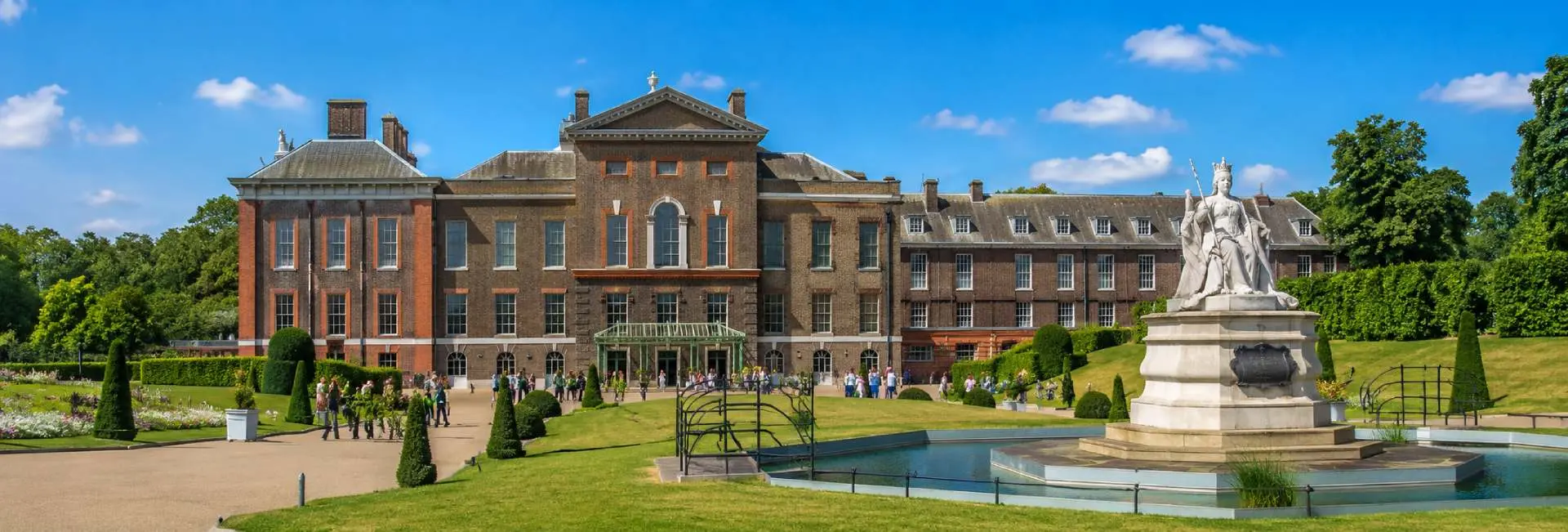
Sir Christopher Wren's late 17th-century work gave Nottingham House the bones of a palace, adding new ranges around a series of courtyards in warm red brick, a style that still defines the building's exterior today. His practical, restrained approach suited William and Mary's wish for a comfortable retreat rather than an overtly grand statement.
The King's Gallery and Cupola Room
The most theatrical interiors date from the Georgian period. The King's Gallery, added by William III, was later hung with Old Master paintings and fitted with an ingenious wind-direction dial connected to a weathervane on the roof. The Cupola Room, William Kent's masterpiece, uses painted architectural illusion to make its ceiling appear far grander and more three-dimensional than it actually is.
The Orangery
Designed for Queen Anne and completed in 1704, the Orangery is a refined Baroque garden building intended for both growing orange trees and entertaining guests. Its tall arched windows, pale stone detailing, and elegant proportions make it one of the most admired garden structures from the period.
Key Areas
The King's State Apartments
This sequence of rooms was built for William III and later embellished by George I. Highlights include the King's Staircase, the trompe l'oeil Cupola Room, and the King's Gallery, giving visitors a strong sense of the pomp and formality of early Georgian court life.
The Queen's State Apartments
Smaller and more intimate than the King's rooms, these apartments were used by Mary II and later by Queen Anne. They offer a quieter, more domestic view of royal life at the palace, in contrast to the grandeur found elsewhere in the building.
Victoria: A Royal Childhood
A dedicated route through the rooms where Queen Victoria grew up, including the bedroom in which she was woken with the news that she was queen. The apartments have been arranged to evoke her sheltered, closely supervised upbringing at the palace.
The Palace Gardens
The gardens surrounding the palace include the formal Sunken Garden, the shaded Cradle Walk, and open lawns leading toward the wider expanse of Kensington Gardens. They are landscaped in a mix of formal Edwardian and more naturalistic styles.
Notable Landmarks
- The Sunken Garden, a terraced Edwardian garden built in 1908 around a central ornamental pond
- The statue of Diana, Princess of Wales, unveiled in the Sunken Garden in 2021 by her sons, Princes William and Harry
- The Cupola Room, with its illusionistic painted ceiling and gilded decoration
- The King's Gallery, lined with Old Master paintings and royal portraits
- The bronze statue of William III, presented as a gift to Edward VII and installed in front of the palace
- The statue of a young Queen Victoria, sculpted by her own daughter, Princess Louise
- The Orangery, now used as a café but retaining its original 18th-century interior
Collections & Exhibits
Kensington Palace houses part of the Royal Ceremonial Dress Collection, which includes court, ceremonial, and everyday clothing worn by royals from the 18th century to the present day. Rotating displays have featured gowns associated with Diana, Princess of Wales, alongside outfits worn by other prominent royal women.
The palace regularly hosts temporary exhibitions exploring different aspects of royal history and culture, from fashion and photography to the lives of specific royal figures connected to the building. Because exhibition content changes over time, it is worth checking the official Historic Royal Palaces website for what is currently on display before visiting.
Cultural Significance
Few buildings capture the private side of royal life as vividly as Kensington Palace. It was here that a young Princess Victoria grew up largely isolated from court life, an upbringing that shaped the sense of duty and reserve she carried into her long reign as queen.
The palace holds a different but equally powerful resonance as the London home of Diana, Princess of Wales. Her years living there, and the outpouring of public grief that followed her death in 1997, turned the palace gates and gardens into an enduring site of remembrance, a role reflected today in her memorial statue and garden.
Ways to Experience It
Standard admission includes access to several self-guided routes through the palace, allowing visitors to move through the King's State Apartments, the Queen's State Apartments, and the Victoria: A Royal Childhood exhibition at their own pace. Free audio guides are typically available to add context to each room.
- Self-guided tours through the main state apartments and exhibitions
- Included audio guide covering the history of key rooms
- Access to the palace gardens, including the Sunken Garden and Diana memorial
- Seasonal and ticketed special exhibitions on specific royal figures or themes
Best Time to Visit
Spring and early summer are especially rewarding, when the Sunken Garden and wider Kensington Gardens are in full bloom. Visiting on a weekday morning, shortly after opening, generally means smaller crowds inside the state apartments compared with weekends and school holidays.
Because the palace is a popular stop for visitors to Kensington Gardens and Hyde Park, midday and early afternoon tend to be the busiest periods, particularly in summer. Arriving early or later in the afternoon can make for a more relaxed visit.
Visitor Tips
- Booking tickets online in advance is recommended, especially during peak summer months and school holidays
- Allow at least two hours to see the state apartments, exhibitions, and gardens without rushing
- Combine your visit with a walk through the wider Kensington Gardens, which is free to enter
- Wear comfortable shoes, as the route covers several staircases and uneven garden paths
- Check current opening hours, ticket prices, and any exhibition changes on the official website before you go, since these details can change
Nearby Attractions
Kensington Palace sits within Kensington Gardens, which flows directly into Hyde Park, making it easy to combine a palace visit with a longer walk around the Serpentine lake. The Serpentine Galleries, known for contemporary art exhibitions, are a short walk away within the park itself.
To the south, the museum district of South Kensington is within easy reach, home to the Victoria and Albert Museum, the Natural History Museum, and the Science Museum. Kensington High Street, just beyond the gardens, offers a wide range of shops, cafés, and restaurants for after your visit.
FAQs about Kensington Palace
What is Kensington Palace known for? +
It is a working royal residence and museum best known as the birthplace and childhood home of Queen Victoria and as the London home of Diana, Princess of Wales, alongside its lavishly decorated Georgian state rooms.
How much time should I plan for a visit? +
Most visitors spend around two hours exploring the state apartments, exhibitions, and gardens, though history enthusiasts may want to allow longer.
Do I need to book tickets in advance? +
Advance booking is strongly recommended, particularly in summer and during school holidays, as it helps guarantee entry and can reduce time spent queuing.
Is Kensington Palace still a royal residence today? +
Yes, parts of the palace remain private apartments for members of the Royal Family, while other areas are open to the public as a museum.
Are the gardens free to visit? +
The wider Kensington Gardens surrounding the palace are free and open to the public daily, though the Sunken Garden and palace interior are included only with a paid ticket.
Is Kensington Palace suitable for children and visitors with limited mobility? +
The palace welcomes families and offers routes suitable for pushchairs in most areas, though some historic staircases have limited step-free access, so it is worth checking accessibility information before visiting.
What else can I combine with a visit to Kensington Palace? +
Its location makes it easy to pair with a walk through Hyde Park, a visit to the Serpentine Galleries, or an afternoon at the South Kensington museums, all within walking distance or a short trip away.