Table of Contents
Overview
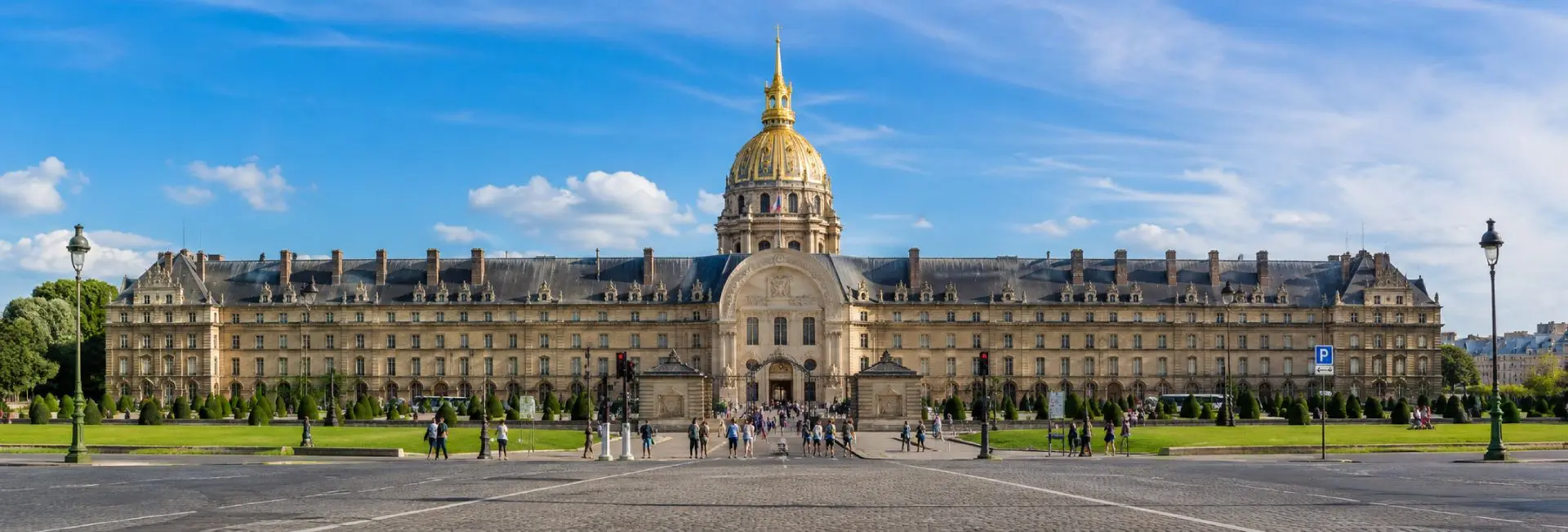
Les Invalides is one of Paris's most striking landmarks, instantly recognizable by the gleaming golden dome that rises above the city's 7th arrondissement. What began as a hospital and retirement home for wounded soldiers has grown into a sprawling complex of museums, monuments, and a church that together tell the story of French military history from the Middle Ages to the present day.
At its heart lies the tomb of Napoleon Bonaparte, resting beneath the Dôme des Invalides in one of the most solemn and visually striking settings in the city. Around it, the Musée de l'Armée houses one of the largest collections of arms, armor, and military artifacts in the world, making Les Invalides both a place of quiet remembrance and a genuinely absorbing museum visit.
History
Louis XIV's Hospital for Soldiers
Les Invalides was commissioned by King Louis XIV in 1670 to house and care for disabled and aging soldiers who had served France, many of whom had previously been left to fend for themselves after their military service ended. Designed by architect Libéral Bruant, the main building opened its doors in 1678, providing lodging, medical care, and a sense of purpose for thousands of veterans.
A Witness to Revolution
On July 14, 1789, crowds broke into the cellars of Les Invalides and seized thousands of muskets and cannons stored there. Armed with these weapons, the crowd marched on to storm the Bastille later that same day, making Les Invalides an unwitting starting point for the event now commemorated as France's national holiday.
From Veterans' Home to National Museum
Les Invalides continued to serve as a home for war veterans well into the 20th century, but as the number of resident soldiers declined, much of the complex was gradually repurposed. This transition paved the way for the museums that occupy the site today, while a small number of veterans and the site's ceremonial military functions continue there still.
Architecture & The Golden Dome
The Hôtel National des Invalides is considered one of the finest examples of French classical architecture, built around a series of grand courtyards designed by Libéral Bruant. The complex's most famous feature, the Dôme des Invalides, was added later by royal architect Jules Hardouin-Mansart and remains one of the great achievements of French Baroque design.
Rising roughly 100 meters, the dome is covered in gold leaf and can be seen glinting above the rooftops from many points across Paris. It sits atop the Église du Dôme, a domed royal chapel originally built separately from the soldiers' own church, Saint-Louis des Invalides, which stands alongside it within the same complex.
- Main complex designed by Libéral Bruant, commissioned by Louis XIV in 1670
- Golden dome designed by Jules Hardouin-Mansart, a landmark of French Baroque architecture
- Grand Cour d'Honneur (main courtyard) lined with historic bronze cannons
- Faint 17th-century graffiti, carved by resident disabled soldiers, still visible on some interior walls
Napoleon's Tomb
Beneath the golden dome lies the tomb of Napoleon Bonaparte, the emotional centerpiece of a visit to Les Invalides. Napoleon died in exile on the island of Saint Helena in 1821, and it was not until 1840 that his remains were returned to France. After a grand national funeral, his body was finally laid to rest under the dome in 1861, following the completion of a suitably monumental tomb.
The tomb itself is an open crypt set directly beneath the dome's high altar, centered on a massive sarcophagus of reddish quartzite resting on a base of green granite. Visitors look down into the crypt from the level above before descending to view the sarcophagus up close.
Who Else Rests Here
Napoleon is not alone beneath the dome. Several other notable French military figures are also interred in the surrounding chapels, reinforcing the site's role as a national pantheon for military heroes rather than a monument to one man alone.
- Napoleon II, Napoleon's son
- Joseph and Jérôme Bonaparte, Napoleon's brothers
- Marshal Vauban, the renowned military engineer
- Marshals Foch and Lyautey, along with Generals Bertrand and Duroc
The Army Museum
The Musée de l'Armée, or Army Museum, occupies a large portion of Les Invalides and ranks among the most comprehensive military history museums in the world. It was formed in 1905 through the merger of the former Artillery Museum and Historical Military Museum, and today holds roughly half a million objects spanning centuries of conflict and military life.
The collection is organized to trace the evolution of warfare and the French army's role in shaping the nation, from medieval arms and armor through the Napoleonic era and into the two World Wars. The galleries devoted to the World Wars are especially thorough, using photographs, uniforms, weapons, and personal artifacts to convey the scale and human cost of modern conflict.
- Arms and armor from the Middle Ages through the Renaissance
- Napoleonic-era uniforms, weapons, and memorabilia, including items connected to Napoleon himself
- Extensive World War I and World War II galleries
- The Historial Charles de Gaulle, an immersive multimedia space tracing de Gaulle's life and leadership
Other Museums & Collections
Beyond the Army Museum and Napoleon's tomb, Les Invalides is home to several smaller, specialized museums that reward visitors with more time to explore. These collections are included in the general admission ticket and offer a deeper, more focused look at particular chapters of French history.
Musée des Plans-Reliefs
Tucked away on an upper floor, this unusual museum displays a collection of large-scale relief models of fortified French towns, originally created as military planning tools under Louis XIV and later expanded under Napoleon III. Their intricate detail makes them fascinating even for visitors with no particular interest in fortifications.
Musée de l'Ordre de la Libération
This museum documents the French Resistance and the Free French forces during the Second World War, honoring those who received the Order of Liberation, one of France's rarest and most significant wartime honors.
Saint-Louis des Invalides Cathedral
The soldiers' church at Les Invalides, distinct from the domed royal chapel above Napoleon's tomb, is freely accessible without a ticket and features rows of captured enemy flags hanging from its upper galleries, along with an active organ still used for concerts.
Ways to Experience It
Most visitors explore Les Invalides independently, moving between the Dôme, Napoleon's tomb, and the Army Museum's galleries at their own pace, with an audio guide often recommended given the size of the complex. Guided tours, typically lasting around two hours, are also available for visitors who prefer a curated introduction with skip-the-line access.
On the first Friday of every month, the site stays open into the evening, offering a quieter and more atmospheric way to see the golden dome after dark. Separately, an evening sound-and-light show projected inside the Dôme church offers an immersive, theatrical way to experience the space, though it is ticketed separately from general admission.
- Self-guided visit through the Dôme, tomb, and Army Museum
- Guided or skip-the-line tours for a more curated, time-efficient visit
- Monthly first-Friday evening opening for a quieter atmosphere
- Ticketed evening light and sound show inside the Dôme church
Best Time to Visit
Les Invalides is open daily, and arriving right at opening time on a weekday offers the calmest experience, particularly around Napoleon's tomb, which tends to draw the biggest crowds later in the morning. The site is typically busiest between late morning and early afternoon, so early arrival makes a noticeable difference.
For a different atmosphere, the first Friday evening opening each month allows visitors to see the illuminated dome with far fewer people around, a favorite option among repeat visitors and photographers.
- Best overall: right at opening, on a weekday morning
- Busiest period: roughly late morning through early afternoon
- Best evening option: first Friday of the month, when the site stays open late
- Allow at least 2–3 hours for a solid visit, or 3–4 hours to explore the museum galleries in depth
Visitor Tips
Because Les Invalides is a large, multi-building complex, a little planning goes a long way toward making the visit feel manageable rather than overwhelming. Booking tickets online in advance is worth doing during busier travel seasons to avoid queuing at the entrance.
- Buy tickets online ahead of time to skip the entrance line, especially in peak season
- Start with the Dôme and Napoleon's tomb before exploring the wider Army Museum galleries, since energy and attention tend to fade over a long visit
- The Cour d'Honneur courtyard and Saint-Louis des Invalides Cathedral can be visited free of charge, without a ticket
- Note that cloakroom facilities are not available on site, so plan accordingly for bags and coats
- Confirm current opening hours, ticket prices, and any temporary exhibition closures on the official website before visiting, as these details can change
Nearby Attractions
Les Invalides sits in the heart of the elegant 7th arrondissement, within easy walking distance of several other major Paris landmarks, making it easy to combine with a broader day of sightseeing on the Left Bank.
- Musée Rodin, a short walk away, set in a historic mansion with gardens filled with the sculptor's work
- Musée d'Orsay, home to one of the world's finest Impressionist art collections
- Pont Alexandre III, an ornate bridge over the Seine offering classic views back toward the golden dome
- The Eiffel Tower, within walking distance or a short ride along the Left Bank
FAQs about Les Invalides
What is Les Invalides famous for? +
It's best known as the burial place of Napoleon Bonaparte, whose tomb sits beneath the complex's landmark golden dome, alongside the Musée de l'Armée, one of the world's largest military history museums.
How much time should I plan for a visit? +
Most visitors need at least 2 to 3 hours to see the Dôme, Napoleon's tomb, and the main Army Museum galleries, with 3 to 4 hours recommended for a more thorough visit that includes the smaller specialist museums.
Is Les Invalides free to visit? +
General admission to the Dôme, Napoleon's tomb, and the museums is ticketed, though the Cour d'Honneur courtyard and Saint-Louis des Invalides Cathedral can be visited without a ticket, and admission is free for visitors under 18 and for EU citizens under 26.
What's the best time of day to visit? +
Arriving right when the site opens, particularly on a weekday, offers the calmest experience before crowds build up around Napoleon's tomb later in the morning.
How do I get to Les Invalides? +
The complex sits in the 7th arrondissement on the Left Bank and is directly served by the Invalides metro station, with additional nearby stops at La Tour-Maubourg and Varenne.
Is Les Invalides suitable for kids or visitors with limited mobility? +
The site is generally family-friendly, with military history, weapons, and armor that often appeal to children, and the complex is largely accessible, though its size means visitors with mobility concerns may want to plan a more focused route rather than trying to see everything.
What can I combine with a visit to Les Invalides? +
It pairs well with the nearby Musée Rodin and Musée d'Orsay, and the walk along the Seine toward Pont Alexandre III offers a scenic route back toward the city center.
Are there evening options for visiting? +
Yes, the site stays open later on the first Friday of every month, and a separate ticketed sound-and-light show is also held inside the Dôme church in the evenings for a more theatrical experience.