Table of Contents
Overview
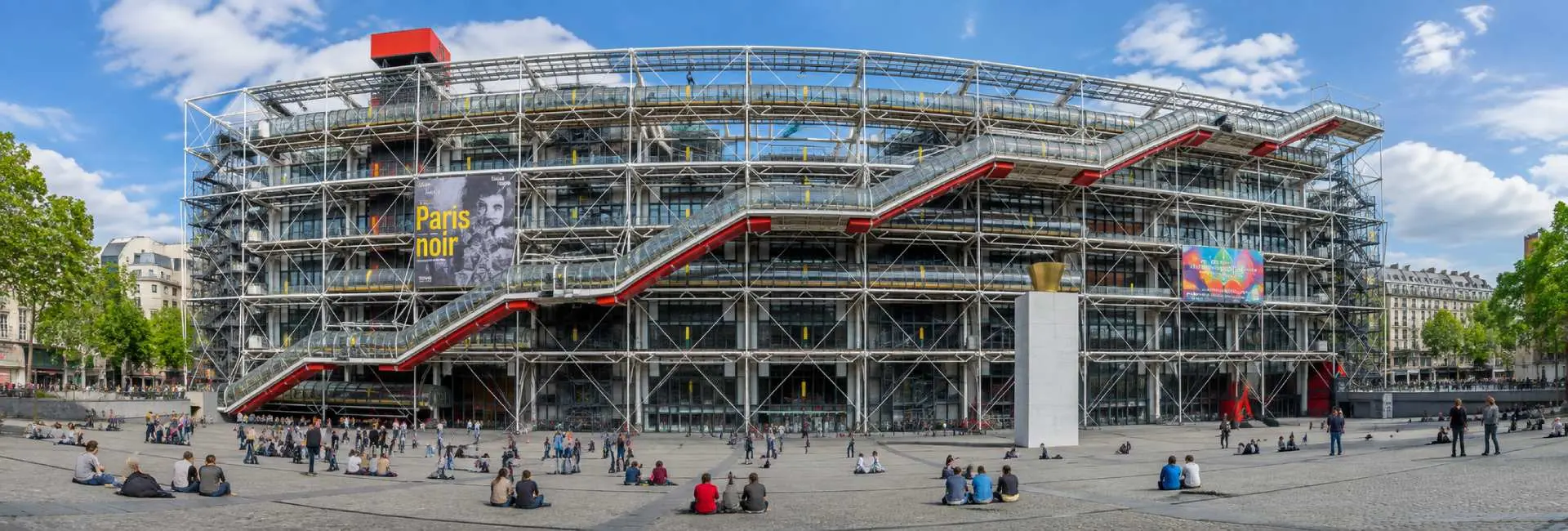
The Centre Pompidou is one of Paris's most instantly recognizable landmarks, sitting in the historic Beaubourg district near Les Halles and the Marais. Rather than hiding its structural bones behind stone or plaster, the building turns them inside out, wrapping its escalators, pipes, and ductwork in bold primary colors on the exterior.
Since opening in 1977, it has grown into a multidisciplinary cultural complex encompassing the Musée National d'Art Moderne, a major public library, a center for music research, and rotating exhibition spaces. It remains one of the most visited cultural sites in the world and a defining example of high-tech architecture.
History
The idea for a new cultural center on the Plateau Beaubourg was first floated by French president Charles de Gaulle in the late 1960s as a home for a public library. His successor, Georges Pompidou, expanded the vision to include a major contemporary art museum and put his name behind the project.
An International Competition
An open architectural competition drew hundreds of submissions from around the world. The winning design came from a young, largely unknown team: Italian architect Renzo Piano, British architect Richard Rogers, and Gianfranco Franchini, working with structural engineers from Arup.
Construction and Opening
Built between the early and mid-1970s, the center opened to the public on January 31, 1977. Its raw, industrial appearance shocked critics and Parisians alike, with some comparing it to an oil refinery or calling it an eyesore next to the city's traditional architecture. Public opinion shifted over time, and the building is now regarded as a modern classic.
Architecture & Design
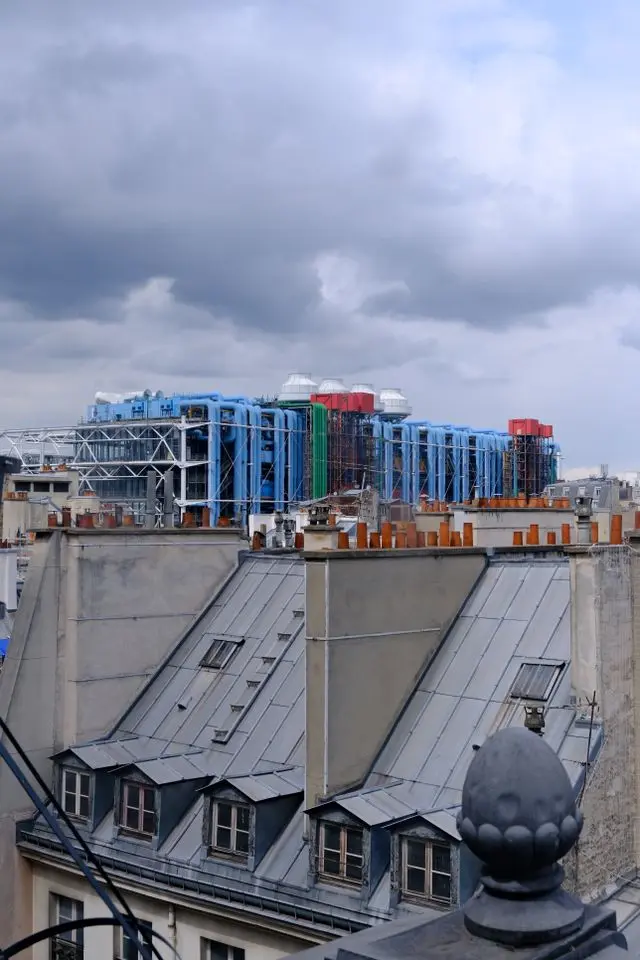
The Centre Pompidou is built as an "inside-out" building: structural steel, mechanical systems, and circulation are all pushed to the exterior, freeing up vast, column-free floors inside for flexible exhibition space. The approach was radical for a major public institution in the 1970s and helped define the high-tech architecture movement.
The Color-Coded Exterior
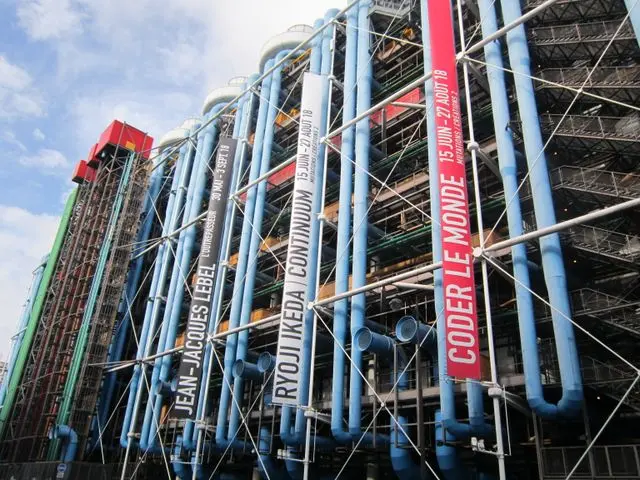
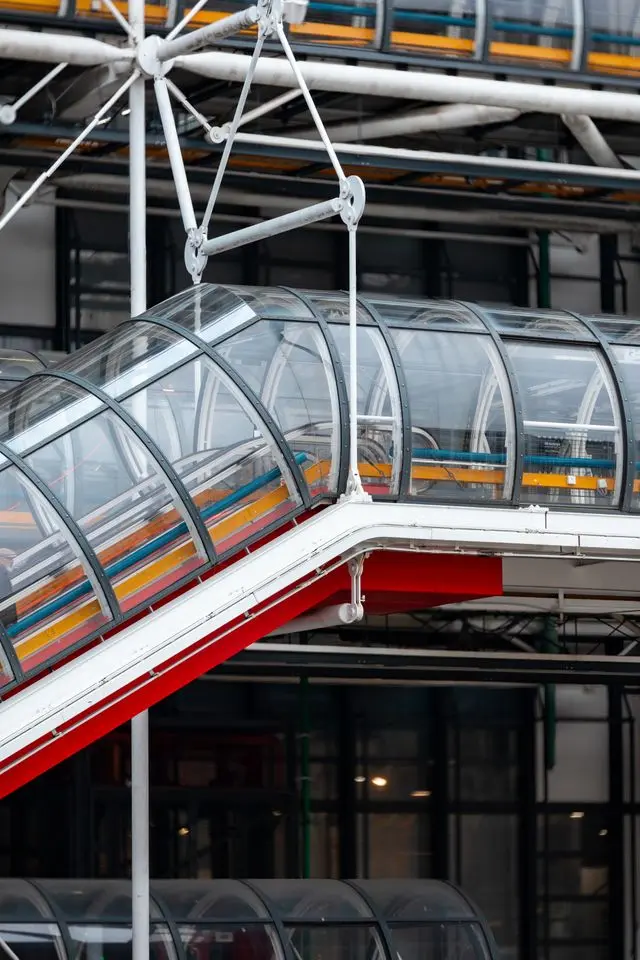
Each exposed system is painted a different color so visitors can read the building like a diagram: blue for air ducts, green for water pipes, yellow for electrical elements, and red for the escalators and lifts that move people through the structure.
The Caterpillar
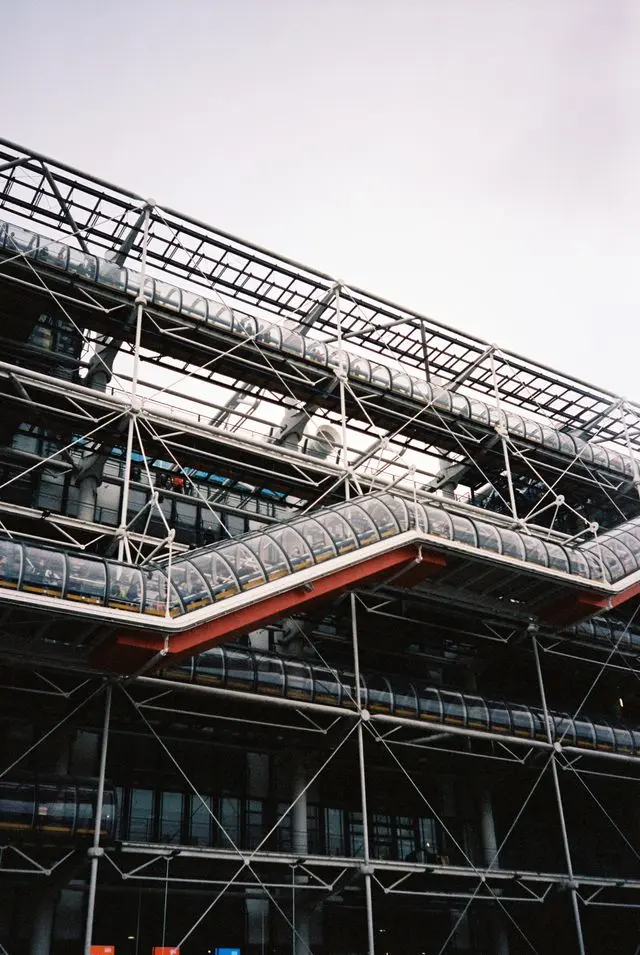
A glass tube nicknamed "the caterpillar" runs diagonally across the building's facade, carrying escalators that zigzag up to the top floor. Riding it offers one of the best panoramic views over the rooftops of Paris.
- Rectangular steel-and-glass superstructure roughly 165 meters long
- Open, flexible interior floors originally designed to be reconfigured for different exhibitions
- Faces a large sloped public piazza that has become a gathering spot in its own right
Inside the Centre: Collections & Facilities
Beyond its facade, the Centre Pompidou functions as several institutions under one roof, built around the idea that visual art, reading, film, and music research all belong in conversation with one another.
Musée National d'Art Moderne
The museum holds one of the largest collections of modern and contemporary art in Europe, spanning movements from Fauvism and Cubism through Surrealism, Pop Art, and contemporary practice, with major holdings of artists such as Matisse, Picasso, and Kandinsky.
Bibliothèque Publique d'Information
A large, free public library historically occupied several floors of the building, giving Parisians open access to books, periodicals, and media in a way that was unusual for a national cultural institution at the time.
IRCAM
The Institute for Research and Coordination in Acoustics/Music, founded alongside the center, is a leading hub for contemporary and experimental music research, linked to the complex but partly housed in an adjoining underground facility.
```The 2025–2030 Renovation
The Beaubourg building closed to the public in autumn 2025 for an extensive, multi-year renovation addressing asbestos removal, fire safety, accessibility, and aging infrastructure, with a planned reopening around 2030. The project aims to restore and modernize the original structure while keeping its distinctive character intact.
Where to Find the Collection Meanwhile
Rather than going dark, the institution has scattered its programming across temporary venues in Paris and beyond, and is expanding into new permanent sites, including a facility near Massy for collection storage and creation.
- Exhibitions and events hosted at partner venues around Paris during the closure
- Touring shows and international outposts extending the collection's reach abroad
- A phased reopening of the historic building expected in 2030
Because these arrangements are evolving, travelers should confirm current exhibition locations and the latest reopening timeline directly with the Centre Pompidou before planning a trip.
Cultural Significance
The Centre Pompidou changed what a museum could look like and how it could function, treating culture as something to be seen, used, and debated rather than kept behind a formal facade. Its design influenced a generation of architects working in the high-tech style.
By combining a major art museum with a free public library and a music research institute in one accessible complex, it also reshaped ideas about who cultural institutions are for, pushing toward openness rather than reverence.
Ways to Experience It
Because the historic building is closed for renovation, "experiencing" the Centre Pompidou currently means following its collection and programming to wherever it has landed.
- Visit touring exhibitions of the modern art collection at partner institutions in France and abroad
- Follow the Centre Pompidou's satellite sites and international pop-ups for temporary shows
- Explore the exterior of the Beaubourg building and piazza, which remain part of the streetscape during construction
- Plan ahead for the 2030 reopening if a visit to the original building is the priority
Visitor Tips
- Check the Centre Pompidou's official site before traveling, since the building itself is closed until around 2030 and programming is spread across temporary venues
- If visiting a touring exhibition elsewhere, book tickets in advance, as major shows can sell out
- Combine a Beaubourg-area visit with the neighboring Marais district, which stays open and walkable throughout the renovation
- Keep an eye on announcements about the Massy facility and international outposts, which may offer new ways to see parts of the collection
Nearby Attractions
The Beaubourg district sits within easy walking distance of some of the most historic parts of Paris, making it a natural base for exploring on foot even while the center itself is under renovation.
- Le Marais, with its narrow medieval streets, boutiques, and Jewish quarter
- Notre-Dame Cathedral and the Île de la Cité, a short walk south
- Les Halles and the Forum des Halles shopping and gardens complex
- The Musée Picasso, located within the Marais
Common Questions about visiting The Centre Pompidou
Is the Centre Pompidou open right now? +
No. The historic Beaubourg building closed in autumn 2025 for a major renovation and is expected to reopen around 2030, though its collection and programming continue at temporary venues in the meantime.
What is the Centre Pompidou known for? +
It's known for its radical "inside-out" architecture, with structural and mechanical systems exposed and color-coded on the exterior, and for housing one of the largest modern art collections in Europe.
Who designed the building? +
It was designed by architects Renzo Piano, Richard Rogers, and Gianfranco Franchini, who won an international design competition in the early 1970s.
Where can I see the collection while the building is closed? +
Exhibitions and works from the collection are touring through partner venues in Paris, elsewhere in France, and internationally, so it's best to check current listings before planning a visit around a specific piece or show.
What is "the caterpillar" at the Centre Pompidou? +
It's the nickname for the glass tube housing the diagonal escalators that run up the building's facade, offering sweeping views over Paris on the way to the top.
Is the Centre Pompidou suitable for families? +
The museum and library have historically drawn a broad audience, including families, though during the renovation period it's worth checking whether a specific temporary venue offers family-friendly programming before visiting.
What else is nearby if I'm in the area? +
The Marais, Notre-Dame Cathedral, Les Halles, and the Musée Picasso are all within easy walking distance of the Beaubourg site.