Table of Contents
Overview
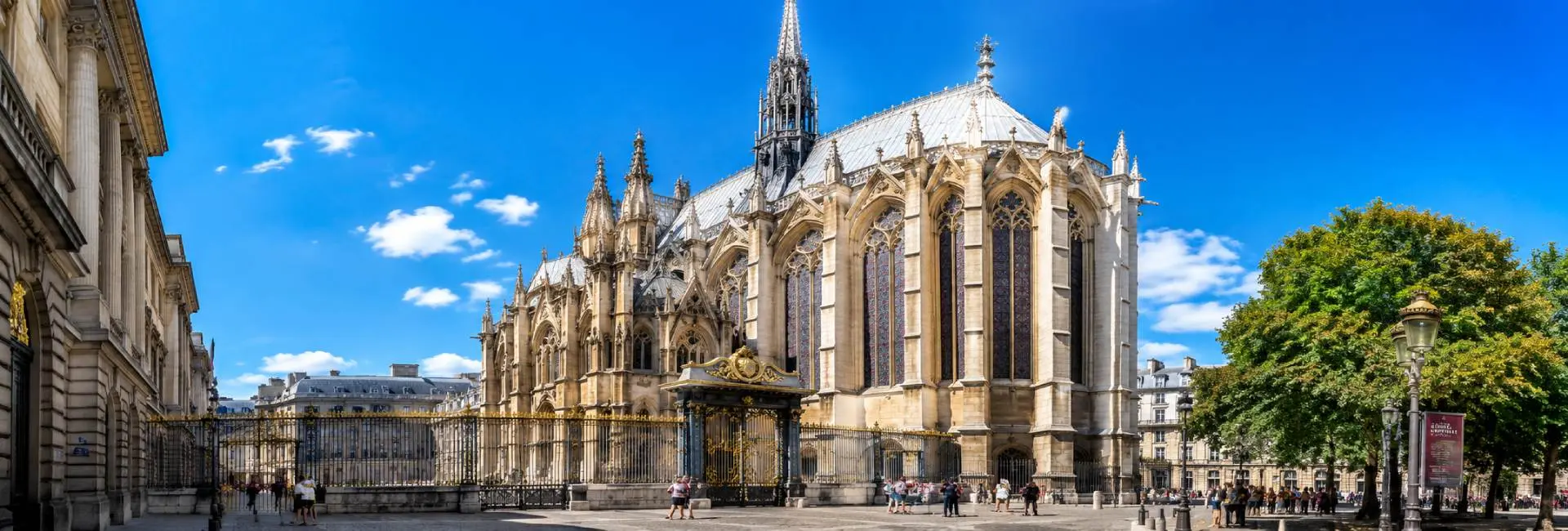
Sainte-Chapelle is a Gothic royal chapel tucked within the Palais de la Cité complex on Paris's Île de la Cité, just steps from Notre-Dame Cathedral. Built in the mid-13th century for King Louis IX, it was designed as a reliquary in stone and glass, created specifically to house the Crown of Thorns and other relics associated with the Passion of Christ.
What draws visitors today is less the chapel's original religious mission and more its architecture: the upper level is almost entirely made of stained glass, with slender stone piers doing the structural work so walls can dissolve into colored light. It is widely considered one of the finest surviving examples of Rayonnant Gothic design in the world.
History
Origins and Purpose
King Louis IX, later canonized as Saint Louis, acquired the Crown of Thorns and other Passion relics from Baudouin II, the Latin Emperor of Constantinople, who had pawned them to Venetian bankers to cover debts. The relics were extraordinarily costly, and Louis IX commissioned Sainte-Chapelle as a fittingly magnificent home for them, intending it to elevate Paris into a "New Jerusalem" and reinforce his own sacred authority as king.
Construction
Construction moved quickly by medieval standards, and the chapel was consecrated in 1248, only a handful of years after work began. Its architect is not definitively documented, though the design is often associated with the royal master mason Pierre de Montreuil, credited with contemporary work at Notre-Dame and Saint-Denis. The result was an engineering feat for its era: soaring glass walls held up by a minimal stone skeleton reinforced with iron.
Decline and Restoration
Sainte-Chapelle suffered during the French Revolution, when it was used for storage and stripped of some of its relics and decoration; its spire was also removed. Neglect continued into the 19th century until a major restoration campaign, closely tied to the architect Eugène Viollet-le-Duc's broader work on Gothic monuments in Paris, rebuilt the spire and recreated damaged elements using historical records. Further conservation work, including a large-scale cleaning and restoration of the stained glass between 2008 and 2015, has kept the chapel's colors vivid for modern visitors.
Recognition & Status
Sainte-Chapelle was officially classified as a historical monument by the French state in 1862, one of the earliest structures to receive that protection. It has also been part of the UNESCO World Heritage Site "Paris, Banks of the Seine" listing since 1991, which recognizes a cluster of landmarks along the river for their exceptional architectural and historical value.
- Classified a French historical monument in 1862
- Included in the UNESCO "Paris, Banks of the Seine" World Heritage Site since 1991
- Managed today by the Centre des monuments nationaux
Architecture & Design
Sainte-Chapelle is a defining example of Rayonnant Gothic architecture, a style that pushed medieval engineering toward ever thinner walls and larger windows. Rather than relying on the massive stone walls of earlier Romanesque or early Gothic buildings, its upper chapel uses a lightweight stone frame and iron reinforcement bars to support glass walls that rise roughly 15 meters high.
The overall footprint is intentionally compact and intimate rather than cathedral-scaled, since the chapel was built as a private royal space rather than a public parish church. That intimacy is part of what makes the effect of the stained glass so striking: the small scale concentrates the color and light rather than diffusing it across a vast nave.
The Two Chapels
Lower Chapel
The lower chapel was originally used by palace staff and lower-ranking members of the royal household. Its ceiling is painted deep blue and scattered with gold fleurs-de-lis, echoing royal heraldry, and its stone columns are more closely spaced, giving it a lower, more enclosed feel than the level above.
Upper Chapel
The upper chapel was reserved for the king, his family, and the royal court, and it is here that the famous stained glass is concentrated. Visitors reach it by a narrow spiral staircase, a deliberate transition from the dim lower level into a space that seems to be built almost entirely of colored light.
The Stained Glass Windows
The upper chapel contains fifteen monumental stained glass windows plus a large rose window, together covering roughly 600 square meters of glass, according to conservation estimates. The panels depict more than a thousand scenes from the Old and New Testaments, arranged to be read like an illustrated Bible, from Genesis through to the Apocalypse in the rose window.
- Fifteen lancet windows plus one rose window in the upper chapel
- Around two-thirds of the glass is original medieval work from the 13th century
- The rose window was added later, in the late 15th century, under King Charles VIII
- Restored between 2008 and 2015 to remove grime and stabilize aging lead and glass
Cultural Significance
Beyond its religious origins, Sainte-Chapelle has long stood as a symbol of the French monarchy's ambition to fuse political and spiritual authority. Louis IX designed the chapel partly as a political statement, positioning Paris as a holy city and himself as a uniquely devout Christian king, an image that contributed to his eventual canonization as a saint.
Today the chapel also functions as a cultural venue. It regularly hosts classical music concerts, typically running from spring through autumn, where the acoustics and candlelit stained glass create a setting distinct from a standard concert hall.
Best Time to Visit
Sunlight is what brings Sainte-Chapelle's windows to life, so visiting on a clear day matters more here than at most Paris landmarks. Late morning to early afternoon generally offers the strongest, most direct light through the upper chapel's south-facing windows.
- Arrive at opening time to see the windows before crowds and tour groups build up
- Sunny days give noticeably richer color than overcast ones
- Spring and early autumn tend to combine good light with smaller crowds than peak summer
- Evening concerts offer a quieter, candlelit alternative to a daytime visit
Visitor Tips
Sainte-Chapelle sits inside the Palais de Justice complex, which means visitors pass through airport-style security before entering, so it's worth building in extra time. Because the chapel is compact, it can also get crowded quickly, especially once tour groups arrive.
- Book tickets online in advance with a timed entry slot to reduce waiting
- Allow time for security screening before the ticketed entrance
- Photography is generally permitted, but flash and tripods disrupt other visitors and are best avoided
- A combined ticket with the neighboring Conciergerie is often available and can be worth it for history-focused visitors
- Current opening hours, ticket prices, and any closures should always be checked against the official site before a visit, since these details change over time
Nearby Attractions
Sainte-Chapelle's location on Île de la Cité puts it within easy walking distance of several of Paris's best-known landmarks, making it easy to combine with a broader half-day of sightseeing in the historic heart of the city.
- Conciergerie – the former medieval royal palace and revolutionary prison, sharing the same complex
- Notre-Dame Cathedral – a short walk east along the island
- Pont Neuf and the Seine riverbanks – for views and a walk along the water
- Latin Quarter – just across the river on the Left Bank, with cafés and bookshops
Common Questions about Sainte-Chapelle
What is Sainte-Chapelle famous for? +
It's known for its upper chapel, where fifteen stained glass windows and a rose window turn the walls into a near-continuous surface of colored light depicting biblical scenes.
How much time should I plan for a visit? +
Most visitors spend 45 minutes to an hour inside, though allow extra time for the security line, which can be lengthy during peak season.
Do I need to book tickets in advance? +
Yes, it's strongly recommended. Sainte-Chapelle uses timed-entry ticketing, and walk-up lines can be long, especially in summer.
Is Sainte-Chapelle included with the Notre-Dame or Louvre ticket? +
No, it's a separate site with its own ticket, though a combined ticket with the neighboring Conciergerie is often available.
What's the best time of day to see the stained glass? +
Late morning through early afternoon on a sunny day generally gives the richest light, since the upper chapel's windows face south.
Is Sainte-Chapelle accessible for visitors with mobility needs? +
The upper chapel is reached by a narrow spiral staircase, which can be difficult for visitors with mobility limitations; it's worth checking current accessibility options with the site directly before visiting.
Is Sainte-Chapelle suitable for kids? +
Yes, though very young children may find the security screening and potential queues more tiring than the visit itself, which is fairly short.
What else is nearby that I can combine with the visit? +
The Conciergerie, Notre-Dame Cathedral, and the Latin Quarter are all within a short walk, making it easy to build a half-day itinerary around the island.