
Table of Contents
Overview
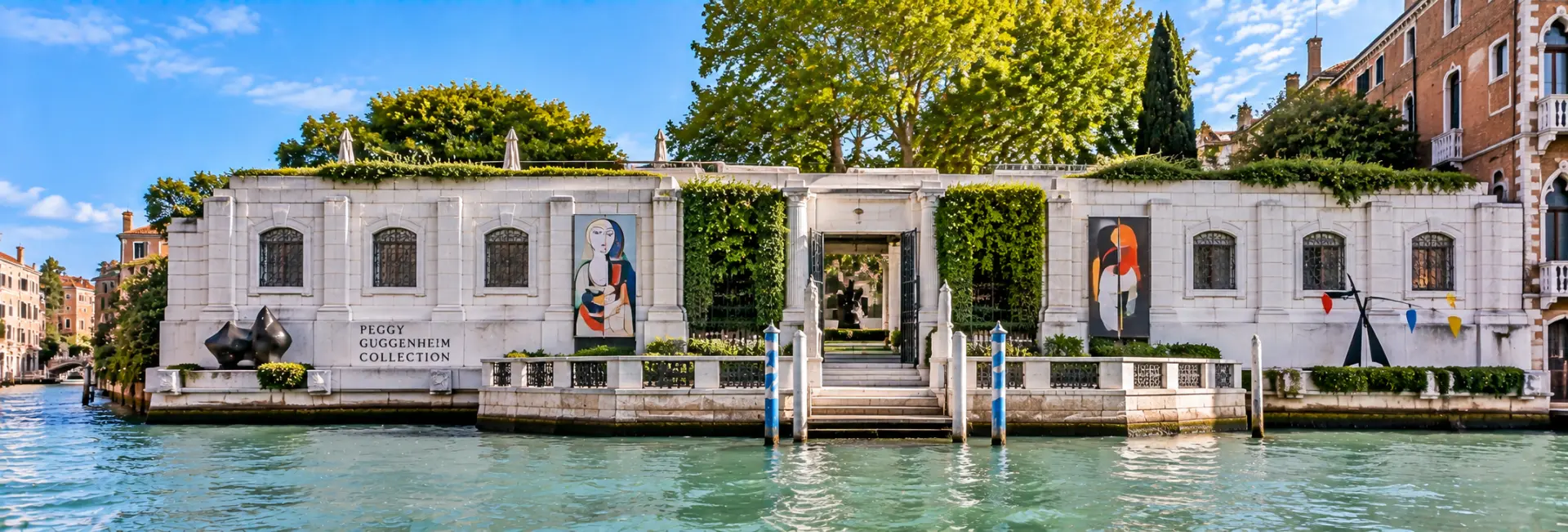
The Peggy Guggenheim Collection sits directly on the Grand Canal in Venice's Dorsoduro district, housed in the low, unfinished 18th-century palazzo where the American collector Peggy Guggenheim lived for three decades. It is one of Italy's most important museums of European and American modern art, built almost entirely around one woman's personal taste and her close friendships with the artists who defined the early and mid-20th century avant-garde.
Unlike a conventional survey museum, the collection still feels like a private home turned gallery. Rooms once used for daily life now hold paintings and sculptures by Picasso, Pollock, Kandinsky, and Miro, arranged with an intimacy that larger institutions rarely manage. A garden behind the palazzo holds sculpture, and Guggenheim herself, alongside her dogs, is buried there.
The museum draws both dedicated art travelers and casual visitors passing along the Grand Canal, and part of its appeal lies in that dual identity: a serious collection of 20th-century masterworks housed inside a building that still carries the traces of someone's actual life, down to the layout of the rooms and the view from the canal-facing terrace where Guggenheim once held court for artists and friends.
History of the Museum
Peggy Guggenheim's Collecting Years
Marguerite "Peggy" Guggenheim began assembling her collection in earnest in the 1930s, first in Paris and then in London, where she opened a gallery and championed then-emerging Surrealist and abstract artists. She returned to the United States during the Second World War and ran a New York gallery, Art of This Century, that became an early showcase for American Abstract Expressionists, including a then little-known Jackson Pollock. The gallery's unconventional installation, with paintings mounted on curved walls and suspended from the ceiling rather than hung in traditional frames, made it as influential for how art was displayed as for the artists it introduced.
Guggenheim's personal connections shaped the collection as much as her eye for talent did. She was married for a time to the Surrealist painter Max Ernst, whose work remains in the collection, and she counted among her close acquaintances many of the artists whose paintings and sculptures now fill the palazzo's rooms. That web of friendships gave her early access to pieces that larger, more institutional collectors of the period often could not obtain.
Settling in Venice
Guggenheim moved to Venice in 1948 after first presenting her collection at that year's Venice Biennale, and in 1949 she purchased the Palazzo Venier dei Leoni on the Grand Canal as her permanent home. She opened the palazzo and her collection to the public on a seasonal basis starting in 1951, giving visitors informal access to the same rooms she lived in. She remained in the palazzo until her death in Venice in December 1979.
The Guggenheim Foundation Era
Guggenheim left the palazzo and her collection to the Solomon R. Guggenheim Foundation, the institution founded by her uncle Solomon R. Guggenheim. The foundation opened the Peggy Guggenheim Collection as a year-round public museum in 1980, and it has since expanded to include additional holdings such as the Gianni Mattioli Collection and the Hannelore B. and Rudolph B. Schulhof Collection, alongside Guggenheim's original acquisitions.
Palazzo Venier dei Leoni
The palazzo takes its name, meaning "Venier of the Lions," from the noble Venier family who commissioned it in 1749 from the architect Lorenzo Boschetti. The building's exact origin for the "lions" name is uncertain, though it is generally tied to the carved lion heads set into the Istrian stone facade at water level rather than to any lion actually kept on the property, a story that also circulates locally.
What makes the building distinctive on the Grand Canal is that it was never finished. Only the ground floor of an originally planned multi-story palace was ever built, a combination of family misfortune and shifting circumstances in the city having halted construction. The result is an unusually low, wide facade among the canal's taller palazzi, giving the building a horizontal profile that sets it apart from its neighbors.
Collections and Highlights
The permanent collection reflects Peggy Guggenheim's personal eye as much as it does any single art-historical movement, spanning Cubism, Futurism, Surrealism, and Abstract Expressionism through works she acquired directly, often from the artists themselves.
- Cubism: works by Pablo Picasso and Georges Braque, reflecting Guggenheim's early interest in the movement's fractured forms
- Surrealism: paintings by Salvador Dali, Rene Magritte, and Max Ernst, whom Guggenheim was married to for several years
- Abstract art: canvases by Wassily Kandinsky, Piet Mondrian, and Joan Miro, spanning several decades of abstraction's development
- Abstract Expressionism: early works by Jackson Pollock, whom Guggenheim commissioned and supported before he achieved wider recognition
Beyond the permanent galleries, the museum regularly hosts temporary exhibitions that pair its own holdings with loans from other institutions, and it incorporates the Gianni Mattioli Collection, a group of early 20th-century Italian Futurist works displayed in rooms that once served as Guggenheim's private quarters.
A number of individual pieces draw particular attention from visitors. Jackson Pollock's large-scale painting Alchemy, created early in his drip-painting period, is among the collection's best-known works and offers a rare chance to see his technique up close in a relatively intimate setting. Elsewhere, sculptures by artists including Alberto Giacometti and Constantin Brancusi are placed throughout the rooms rather than confined to a single gallery, encouraging visitors to move slowly through the palazzo rather than follow a single linear path.
The Nasher Sculpture Garden
Behind the palazzo, a walled garden holds a collection of modern sculpture set among trees and gravel paths, named for the American collectors Raymond and Patsy Nasher, who supported its restoration. The garden offers a quieter counterpoint to the galleries inside, and it doubles as Peggy Guggenheim's final resting place, marked by a simple plaque alongside the graves of several of her dogs.
Ways to Experience It
The museum sits directly on the Grand Canal in Dorsoduro, reachable on foot from the Accademia Bridge or by vaporetto to the nearby Accademia or Salute stops. Its scale is intimate enough to see thoroughly in a single visit without the crowds typical of Venice's largest sights. A small cafe and bookshop on site give visitors a place to pause partway through a visit, and the bookshop stocks titles on Guggenheim's life alongside the artists represented in the collection.
- Self-guided visit: wander the permanent galleries and garden at your own pace, following the layout of Guggenheim's former rooms
- Free daily presentations: museum staff offer short talks in the galleries introducing Guggenheim's life and key works in the collection
- Guided tours: weekend English-language tours of the permanent collection run on a set schedule, covering the museum's history in more depth
- Temporary exhibitions: rotating shows, often drawing on loans from other Guggenheim Foundation institutions, are included with standard admission
- Family activities: a free illustrated booklet is available to guide children through the collection in an age-appropriate way
Best Time to Visit
The museum tends to be busiest in late morning and early afternoon, particularly during peak summer months when Venice as a whole sees its heaviest tourist traffic. Arriving close to opening time, or later in the afternoon before closing, generally means smaller crowds in the galleries and a better chance to view individual works without waiting.
Spring and autumn bring milder weather for the walk along the Grand Canal and time spent in the sculpture garden, while winter visits tend to be quieter overall, in keeping with lower visitor numbers across Venice during the colder months. The museum closes only on Tuesdays and December 25th, so it remains a reliable stop across most of the year. Because the galleries are indoors and climate-controlled, the museum also makes a practical option on days when Venice's weather turns wet or uncomfortably hot for extended walking elsewhere in the city.
Visitor Tips
- Book tickets online in advance during peak season to avoid queuing at the entrance, particularly in summer
- Set aside at least ninety minutes to see the permanent collection, temporary exhibition, and garden without rushing
- Visit the garden even briefly, since it's easy to overlook after the indoor galleries but offers a different, quieter perspective on the collection
- Check the museum's closing day before planning your visit, since it closes on Tuesdays unlike many other Venice museums
- Combine the visit with a walk along Dorsoduro's quieter streets, which see far less foot traffic than the main tourist routes near San Marco
- Keep in mind photography rules can vary by gallery, so check signage before photographing individual works
Nearby Attractions
The museum's Dorsoduro location puts it within easy walking distance of several other major Venice sights along the Grand Canal.
- Gallerie dell'Accademia: Venice's principal museum of pre-19th-century painting, a short walk across the Accademia Bridge
- Basilica di Santa Maria della Salute: a landmark Baroque church at the mouth of the Grand Canal, a few minutes' walk east
- Campo Santa Margherita: a lively square popular with students and locals, a short walk into Dorsoduro's interior
- Zattere waterfront: a long promenade along the Giudecca Canal, well suited to a walk after visiting the museum
FAQs about visiting the Peggy Guggenheim Collection
What is the Peggy Guggenheim Collection known for? +
It is known for its collection of Cubist, Surrealist, and Abstract Expressionist art, assembled personally by Peggy Guggenheim and displayed in the Grand Canal palazzo that was once her home.
How do you get to the Peggy Guggenheim Collection? +
The museum is a short walk from the Accademia Bridge in the Dorsoduro district, and the closest vaporetto stops are Accademia and Salute.
How long do you need to visit? +
Most visitors spend around ninety minutes to two hours covering the permanent galleries, any temporary exhibition, and the sculpture garden.
Is the museum free, or do you need tickets? +
Admission is ticketed, and advance online booking is recommended during peak season to avoid queuing at the entrance.
What days is the museum closed? +
The museum closes on Tuesdays year-round and on December 25th, which differs from the closing days of several other Venice museums.
Is the museum suitable for children? +
Yes, a free illustrated activity booklet is available to help children engage with the collection, and the garden offers an easy outdoor break during a visit.
Where is Peggy Guggenheim buried? +
She is buried in the museum's Nasher Sculpture Garden, alongside several of her dogs, marked by a simple plaque near the garden wall.
What should I combine a visit with? +
The Gallerie dell'Accademia and the Basilica di Santa Maria della Salute are both within easy walking distance and pair naturally with a Peggy Guggenheim Collection visit.
