
Table of Contents
Overview
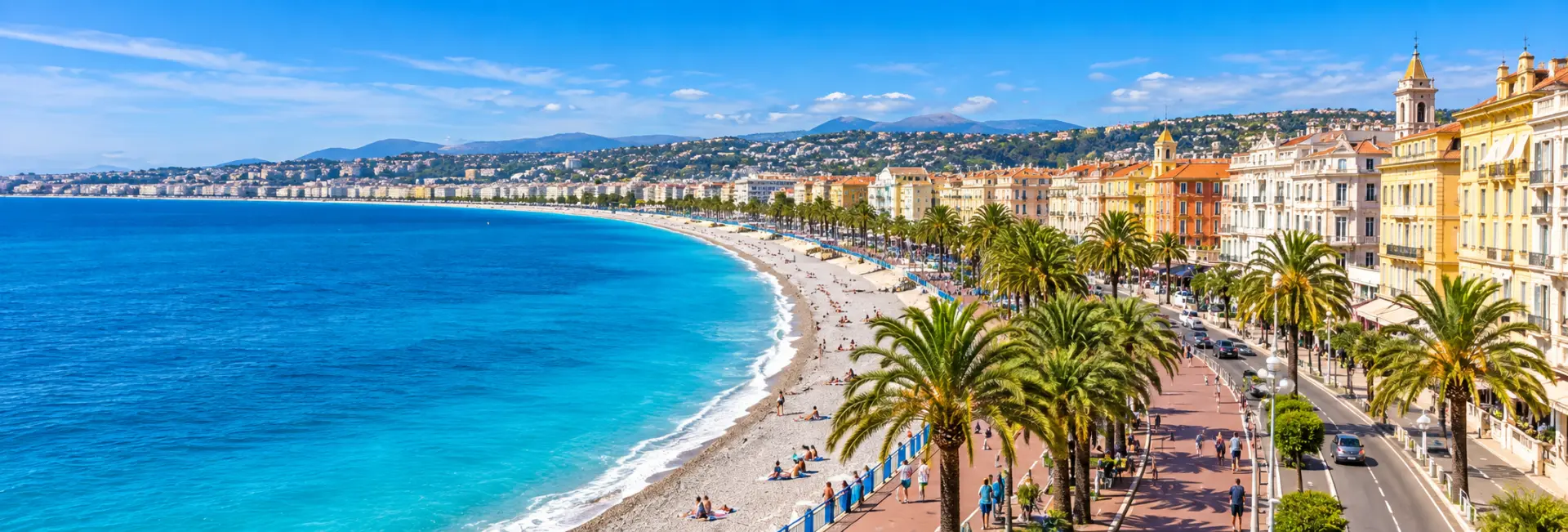
The Promenade des Anglais is the seafront boulevard that defines Nice. It follows the curve of the Baie des Anges for roughly seven kilometres, running from the edge of the airport in the west to the Quai des États-Unis near the old town in the east. Locals simply call it "la Prom", and for most of them it is less a monument than a daily habit.
On any given day you will see joggers, cyclists, in-line skaters, families with strollers, and older couples on their afternoon walk, all sharing the wide pavement beside the sea. On the inland side stand palm trees, Belle Époque hotels, and elegant apartment buildings. On the other side, the Mediterranean opens out in a band of deep blue, with a long pebble beach in between.
It is free, open to everyone, and never quite the same twice: the light, the colour of the sea, and the crowd all change from hour to hour. That mix of grand history and ordinary seaside life is why it remains the best first stop for anyone arriving in the city.
History
A Path Built for the Winter Visitors
From the second half of the 18th century, wealthy English visitors began spending the cold months in Nice, drawn by its mild winters and sea views. At that time the coastline was rough ground without a proper walkway, which made strolling difficult for the growing foreign community.
After a harsh season around 1820 left many local people without work, members of the English community, led by the Reverend Lewis Way, raised money to build a path along the shore. The project gave employment to the unemployed while creating a place to walk beside the sea. Work began in 1822 and the first stretch was finished in 1824.
From Chemin to Promenade
The new path was known in the local Niçard dialect as the "Camin deis Anglés", the English Way, in recognition of the people who had paid for it. When Nice became part of France in 1860 under the Treaty of Turin, the name was rendered in French as the Promenade des Anglais, the name it carries today.
The Belle Époque and After
The walkway sparked a building boom. Grand hotels, villas, casinos, and theatres rose along the shore, and the boulevard became the social centre of the resort town. In the early 20th century it was widened and modernised, and around 1930 the improved promenade was formally inaugurated by a member of the British royal family, Prince Arthur, Duke of Connaught. Much of what you see today, including the broad sea-side pavement and the lamp-lined road, comes from that period.
A Modern Seafront
In recent years, the city has given more room to pedestrians and cyclists, and dedicated bike lanes now stretch along much of the promenade. The route has also become a stage for major events, including finishes and starts of the Tour de France in 2013, 2020, and 2024.
Recognition / Status
The Promenade des Anglais forms part of "Nice, Winter Resort Town of the Riviera", which was added to the UNESCO World Heritage List in 2021. The listing recognises how the city grew into a cosmopolitan resort for winter visitors from across Europe, and the promenade is one of the clearest expressions of that story.
Several things explain its heritage value:
- It began as an English-funded path in the 1820s and became the backbone of the city's seaside development
- It is lined with hotels, villas, and public buildings from the Belle Époque and the early 20th century
- It still works as the shared living room of the city, used by residents as much as by tourists
- It shows how a resort town planned its relationship to the sea, the climate, and the view
Landmarks Along the Promenade
You can walk the whole length, but the busiest and most photogenic stretch lies in the middle, between the Negresco and the Jardin Albert-Ier. Along the way, several buildings are worth noticing.
Hôtel Negresco
The Negresco is the best-known building on the promenade. Built in 1912 for Henri Negresco, it is recognisable from far away by its pink dome and its grand Belle Époque facade. It is a listed historic monument and holds a large collection of art and furnishings, and many visitors stop simply to look at the entrance hall and the exterior.
Palais de la Méditerranée
Opened in 1929, this Art Deco building was created as a casino and theatre complex and is a defining example of the style on the French Riviera. Its sculpted facade stands out from the older Belle Époque buildings and shows how the promenade kept evolving between the wars.
Villa Masséna and the Museums
At number 35, the Villa Masséna was a private mansion built in the 19th century and now houses a museum of the city's art and history, set within a garden that opens onto the promenade. Another former villa nearby houses the Musée des Beaux-Arts, a reminder that the seafront was once lined with private residences.
Parks and Sculptures
Closer to the old town, the Jardin Albert-Ier is one of the oldest public gardens in Nice, created in the middle of the 19th century between the promenade and Place Masséna. Further west you will pass the green space of Parc Phoenix and the Museum of Asian Arts. Along the way, the seafront is also dotted with public art.
Ways to Experience It
Walk It
A full end-to-end walk of seven kilometres is manageable on the flat paving and rewards you with a sequence of very different scenes, from the quieter airport end to the elegant central section and the lively old town side. Many visitors choose just the central stretch for an hour or so.
Sit on the Blue Chairs
The blue chairs scattered along the sea side are among Nice's best-loved symbols. They are free to use, unassigned, and available on a first come, first served basis, and sitting in one at sunrise or sunset with the sea in front of you is one of the simplest pleasures in the city.
Cycle or Skate
Bike rental points and skate hire are common nearby, and the dedicated lanes make it a pleasant ride. It is a classic way to cover the full length without tiring your legs, especially in the morning when the path is quieter.
Spend Time on the Beach
The beach below is made of smooth pebbles, so bring sandals or water shoes. Free public sections sit alongside private beach clubs, where you can rent sunbeds and eat on the shore.
Look Out from Above
For a wider view, climb Castle Hill at the eastern end. From the top you can see the whole sweep of the Baie des Anges and the curve of the promenade, which is especially striking in the late afternoon.
Remembrance on the Promenade
On 14 July 2016, during Bastille Day celebrations, a truck was driven into crowds on the promenade, and 86 people lost their lives. The city has honoured the victims in several ways, and visitors should be aware of these places and treat them with respect.
- The Angel of the Bay - A sculpture by Jean-Marie Fondacaro, unveiled on 14 July 2022 on the promenade at the place where the attack ended. It carries the names of the 86 victims.
- The memorial garden - A quiet memorial space in the grounds of the Villa Masséna, with its own fountain and the names of the victims, reached from number 35 on the promenade.
The city holds commemorations each year on 14 July. If you visit around that date, expect ceremonies and a respectful atmosphere in the area.
Best Time to Visit
Spring and Autumn
These seasons offer the most comfortable conditions for a long walk or bike ride, with mild temperatures, softer light, and fewer people than in high summer. The sea is still blue and the cafes are open, making them ideal for a relaxed visit.
Summer
Summer brings warm sea swimming and a very lively atmosphere, but also heat and crowds, especially in July and August. If you come then, plan walks for early morning or evening and keep the middle of the day for the beach.
Winter
The promenade began as a winter retreat, and it still works as one. Days are often clear and bright, and the walk is far quieter. Carnival events in the area bring colour and crowds in the colder months.
Time of Day
Sunrise and sunset are the most atmospheric times, while the early morning is the favourite hour of local joggers and cyclists. Evenings bring a relaxed, social mood, with people strolling and sitting along the sea wall.
Visitor Tips
- Access is free and open all year. There is no entry fee, and it can be visited every day at any hour.
- Getting there is easy. The airport lies at the western end, and local buses connect the seafront with the city centre and the main train station. From the old town it is a short walk.
- Wear comfortable shoes. The surface is flat, but a full walk adds up to several kilometres.
- Protect yourself from the sun. There is little shade along the sea side, so bring sunscreen, a hat, and water in summer.
- Respect the bike lanes. Cyclists and skaters move quickly, so stay on the walking side and look before crossing.
- Take care of your belongings. As in any busy tourist area, keep bags closed and phones secure, particularly in crowded spots.
- Prepare for the beach. Pebbles are hard on bare feet, so water shoes help, and a towel or mat makes sitting more comfortable.
- Be mindful at memorials. Keep voices low and avoid posing for photos at the memorial sites.
Event schedules, beach club prices, and rental rates change from year to year, so check current information locally before you go.
Nearby Attractions
- Old Town (Vieux Nice) - Narrow lanes, markets, and cafes a short walk east.
- Place Masséna - The city's grand central square with its distinctive checkerboard paving.
- Castle Hill - A hilltop park above the old town with the best views of the bay.
- Promenade du Paillon - A long green corridor of gardens and fountains running inland from the seafront.
- Musée Masséna and Musée des Beaux-Arts - Museums set in 19th-century villas close to the promenade.
FAQs about visiting the Promenade des Anglais
What is the Promenade des Anglais? +
It is Nice's famous seafront boulevard, about seven kilometres long, running along the Baie des Anges from the airport to the old town. It is lined with palm trees, grand hotels, and a pebble beach.
Why is it called the Promenade des Anglais? +
The name means "Walkway of the English." It was paid for by the English community in the 1820s, who funded the first path along the shore, and the name was kept in French after Nice joined France in 1860.
Is it free to visit? +
Yes. The promenade is open to everyone and costs nothing to walk. Private beach clubs and rentals charge fees, but the blue chairs are free to use.
How long does it take to walk the full length? +
The whole promenade is around seven kilometres, which takes roughly an hour and a half to two hours at a relaxed pace. Many visitors only walk the central stretch for an hour or so.
Are the blue chairs free? +
Yes. The blue chairs along the sea side are free and unassigned, so you can sit on any empty one. Early morning and sunset are the best times to find a good spot.
Is the beach sandy? +
No. The beach along the promenade is made of pebbles, so sandals or water shoes are recommended. Free public stretches sit beside private beach clubs with sunbeds.
When is the best time to visit? +
Spring and autumn offer pleasant temperatures and fewer crowds, while sunrise and sunset are the most atmospheric hours at any time of year. Summer is lively but hot and busy.
Can I cycle along the promenade? +
Yes. There are dedicated bike lanes along much of the seafront, and rental points are easy to find nearby. Keep to the correct lane and watch for pedestrians crossing.
What are the main landmarks on the promenade? +
The best-known are the pink-domed Hôtel Negresco, the Art Deco Palais de la Méditerranée, and the Villa Masséna museum. The Jardin Albert-Ier and Castle Hill are close by at the eastern end.
Where is the memorial to the 2016 attack? +
The Angel of the Bay sculpture stands on the promenade near the Palais de la Méditerranée, and a memorial garden with the names of the 86 victims lies in the grounds of the Villa Masséna, reached from number 35 on the promenade.
