
Table of Contents
Overview
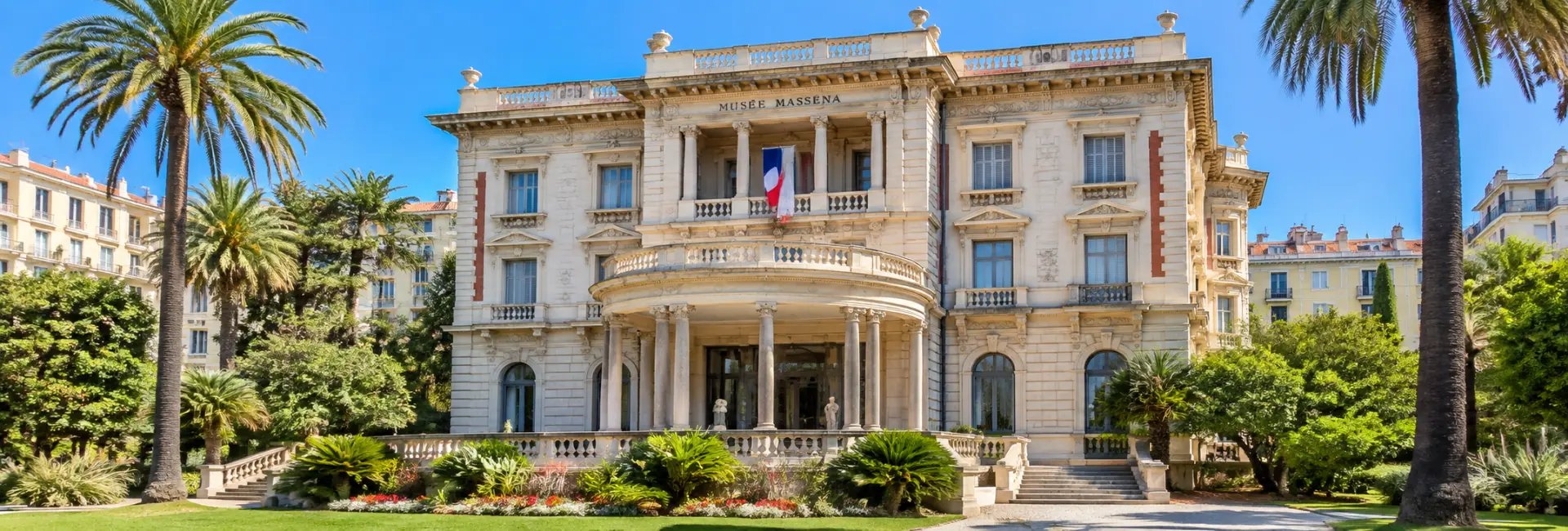
The Musée Masséna, also known as the Villa Masséna, is Nice's museum of local art and history, set in one of the most elegant Belle Époque villas on the Promenade des Anglais. It sits next to the pink-domed Hôtel Negresco, with a historic garden facing the seafront and the museum entrance at the back on Rue de France.
The collections follow the story of the Riviera from the time Nice became part of France to the end of the Belle Époque. Through portraits, landscape paintings, furniture, prints, uniforms and carnival memorabilia, they show how a modest port town turned into one of the most glamorous winter resorts in Europe. Treasures linked to Napoleon and Josephine, including the emperor's death mask, add a touch of drama.
Even if history museums are not usually your thing, the villa itself is worth the visit. Its ground-floor salons are so richly decorated that they count as an exhibit in their own right.
History of the Villa and Museum
A Marshal's Family
The story begins with André Masséna, born in Nice in 1758, the son of a wine merchant. He joined the army as a young man and rose to become one of Napoleon's most successful commanders. He was named a Marshal of the Empire in 1804 and received the title Prince of Essling in 1810. Although he returned to his native city only rarely, he stayed loyal to it and acted as a protector of its interests.
Building a Winter Palace
In 1898, the marshal's grandson Victor Masséna, prince d'Essling, decided to build a grand pleasure villa by the sea in Nice and use it as a winter residence. The family admired the Villa Rothschild in Cannes and held it up as a model for their architects. Work took until 1901, and the villa was designed with large receptions in mind.
From Family Home to Museum
After Victor's death in 1910, his son André passed the property to the City of Nice in 1919, on two conditions: that the villa become a museum of local history and that the garden be open to the public. The Musée Masséna opened in 1921. A major restoration campaign carried out by the city between 1999 and 2008 revived the villa's Belle Époque decoration and gave the collections a fresh presentation. Funding from the Stavros Niarchos Foundation helped restore the villa's rich collection of Empire-period bronzes and lighting.
Architecture & Interiors
The villa was designed between 1898 and 1901 by the Danish architect Hans-Georg Tersling, one of the leading architects on the Riviera during the Belle Époque, working with Aaron Messiah. The style is neo-classical with a strong Italian accent, inspired by the villas of the First Empire period, and the layout was planned for entertaining on a grand scale.
The ground floor is the showpiece. The entrance hall has a classical feel, with a decorative frieze and a statue of Napoleon dressed as a Roman emperor, which sets the tone for the Napoleonic theme running through the building. The neighboring salons are filled with First Empire furniture and objects, so the rooms feel like a preserved residence rather than an empty gallery.
The upper floors were adapted as exhibition spaces, but the villa still keeps its sense of grandeur: wide staircases, tall rooms, and windows that open toward the garden and the bay.
Collections & Exhibits
Napoleonic Treasures
Among the best-known objects are Napoleon's death mask, made by Dr Arnolt, and Josephine's diadem, crafted from mother-of-pearl, gold, pearls and colored stones and given to the empress by Murat. Other items connected to the imperial couple help bring the Napoleonic era to life, a fitting theme given the villa's family history.
The Story of Nice
The historical galleries present the changes the city went through from the end of the 18th century to 1914. They cover the French Revolution and Empire, the years of the Sardinian Restoration and the period that followed Nice's annexation to France in 1860. Smaller rooms branch off to explore the Masséna family, the growth of the city, the daily life of its residents and the tradition of Carnival.
Painters and Portraits
The museum's paintings give a sense of how the region looked and felt in the 19th century. Landscape painters such as Joseph Fricero, Antoine Trachel and Alexis Mossa are represented, and a portrait of Marshal Masséna by Louis Hersent, painted in 1811 after the city council commissioned it, hangs in the great gallery.
Belle Époque Souvenirs
Prints, maps, photographs and travel ephemera help tell the story of the visitors who flocked to Nice every winter. Elegant menus, train tickets and snapshots of promenading holidaymakers give a human, often quirky view of life on the Riviera.
The Cessole Library
The villa also houses the library of Chevalier Victor de Cessole, a research collection on the history of the County of Nice and neighboring regions. It is mainly a resource for researchers rather than a visitor gallery, but it shows how deeply the building is tied to the study of local heritage.
Must-See Highlights
With the collection spread over several floors, these are the pieces and spaces most worth looking for:
- Napoleon's death mask, one of the museum's most talked-about objects
- Josephine's mother-of-pearl diadem, a gift from Murat
- The ground-floor salons, with their sumptuous interiors and First Empire furniture
- Louis Hersent's portrait of Marshal Masséna in the great gallery
- Landscapes by Fricero, Trachel and Alexis Mossa that show the Riviera before the building boom
- The rooms devoted to Carnival and daily life in Nice
- Belle Époque travel souvenirs such as menus, maps and railway tickets
- The restored Empire bronzes and lighting fixtures
The Historic Garden
The garden is almost a second museum. It was laid out in the late 19th and early 20th century in the style of the landscape architect Édouard André, and it faces the Promenade des Anglais right next to the Negresco. It carries the French Jardin remarquable label, which recognizes gardens of special interest.
Keeping it open to the public was one of the conditions of the Masséna family's gift to the city, and strolling along its shaded paths is one of the most relaxing things you can do in this part of Nice. The villa seen from the garden, with its pale facade and classical lines, is also one of the best photo opportunities in the area.
A memorial to the victims of the 14 July 2016 attack stands in this garden, which is officially named the Jardin de la Légion d'Honneur. It is a place for quiet reflection, so visitors are encouraged to be respectful.
Ways to Experience It
The villa works equally well as a quick cultural stop or a leisurely half-day outing:
- Self-guided visit: follow the historical rooms in order, then finish in the ground-floor salons and the garden
- Temporary exhibitions: the museum regularly stages shows on aspects of Riviera life, from photography to the city's gardens
- Special programs: concerts, workshops, family activities and heritage events are added to the calendar throughout the year
- Garden stroll: wander the grounds before or after your visit and then continue onto the seafront promenade
- Multi-museum pass: the municipal museums share a pass, so pairing the villa with another Nice museum is easy
Most visitors spend about an hour to ninety minutes inside, plus extra time for the garden.
Best Time to Visit
By Season
The museum is air-conditioned, which makes it a welcome break from the heat on summer afternoons. In spring and early autumn the garden is at its most pleasant, with mild weather and soft light. If you visit in the Carnival season in winter, the museum's displays on Nice's carnival tradition will feel especially timely.
By Day and Time
The museum is closed on Tuesdays, and it opens an hour later in winter than in summer, so plan around the calendar. Morning visits are usually calmer, and a late-afternoon stop lets you finish with the garden in warm light before a stroll along the seafront.
Visitor Tips
- The museum is closed on Tuesdays, with summer hours starting at 10:00 and winter hours starting at 11:00, and it closes at 18:00 in both seasons.
- Tickets can be bought online through the city's museum ticket office, and a multi-day pass covers all of the municipal museums.
- Entry is free for visitors under 18, students and several other groups with proof, and residents of the Nice metropolitan area can use the free Nice Museums Pass.
- The museum is listed as accessible to visitors with reduced mobility, but confirm your specific needs with the staff before you go.
- Remember that the museum entrance is on Rue de France, behind the villa, while the garden opens onto the Promenade des Anglais.
- Check the official agenda for temporary exhibitions and events, which can add extra things to see.
- If you plan to see the Musée des Beaux-Arts as well, note that it is closed on Mondays, while the Masséna is closed on Tuesdays, so the two can be paired on most days.
Nearby Attractions
The villa sits in one of the most visited parts of Nice, so there is plenty to see within an easy walk:
- Hôtel Negresco, the famous pink-domed hotel right beside the garden
- The Promenade des Anglais, the city's celebrated seafront boulevard
- Place Masséna and the old town, named after the marshal and known for its markets, churches and lively streets
- The Musée des Beaux-Arts Jules Chéret, another Belle Époque villa filled with paintings and sculpture
- The Russian Orthodox Cathedral, built in 1912 to serve the Riviera's Russian community
FAQs about visiting the Musée Masséna
Who was Masséna? +
André Masséna was a marshal under Napoleon who was born in Nice in 1758. His grandson Victor built the villa, which later became the museum.
What is the museum known for? +
It is known for its Belle Époque villa, its Napoleonic relics such as the death mask and Josephine's diadem, and its collections about the history of Nice and the Riviera.
How long does a visit take? +
Allow about an hour to ninety minutes for the museum, and extra time if you want to explore the garden or see a temporary exhibition.
Which days is the museum open? +
It is open every day except Tuesday. Opening time shifts seasonally, with an earlier start in summer, so check the schedule for your dates.
Is the garden open to everyone? +
Yes, the garden has been open to the public since the villa was given to the city. Its opening times can differ from the museum's, so check locally.
Is entry free? +
Entry is free for visitors under 18, students and some other groups with proof. Residents of the Nice metropolitan area can use the free Nice Museums Pass, and everyone else pays a standard ticket or uses a multi-museum pass.
Is it suitable for children? +
Yes, especially for older children, who often enjoy the Napoleonic objects, the carnival displays and the garden. Under-18s enter free.
How does it compare to the Musée des Beaux-Arts? +
The Masséna focuses on local history and the Belle Époque lifestyle, while the Beaux-Arts concentrates on painting and sculpture from the 12th to the 20th century. Both are in historic villas and both are part of the municipal museum pass.
