
Table of Contents
Overview
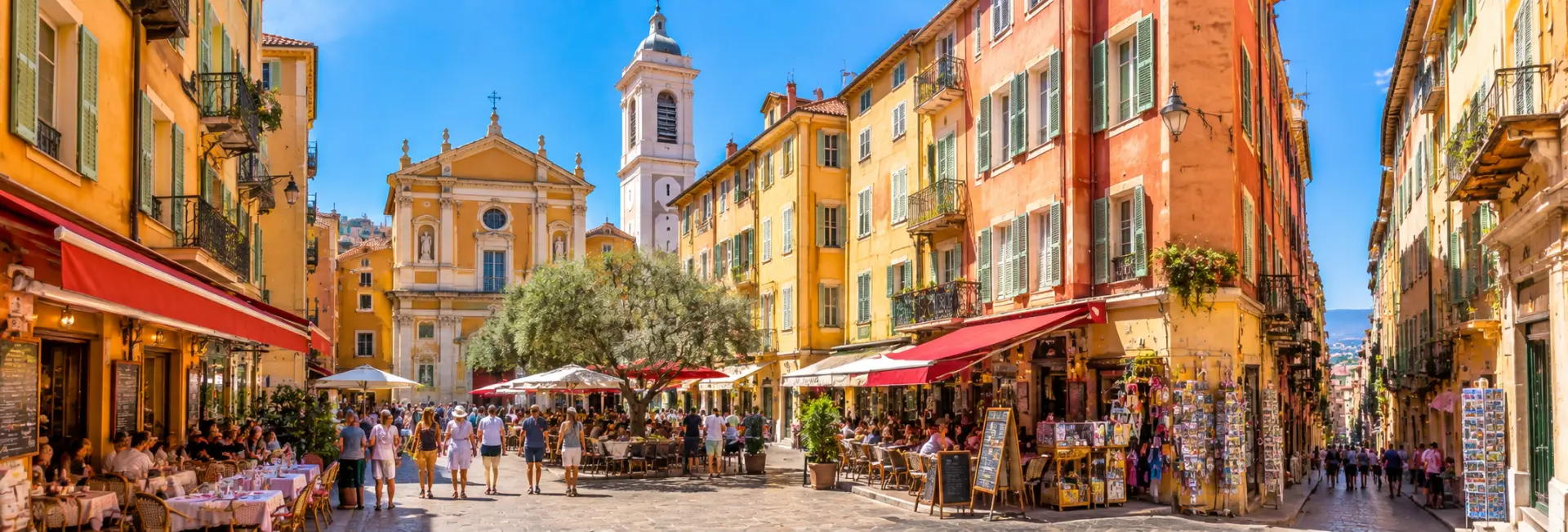
Vieux Nice is the historic heart of the city, a compact maze of narrow lanes, ochre and rust-coloured buildings, and small squares tucked between the sea and Castle Hill. Locals sometimes call it Babazouk, and the nickname suits a district that feels more like a village than part of a big resort.
The atmosphere is distinctly Mediterranean and strongly Italian in flavour. Shuttered windows, laundry strung across alleys, and the smell of food drifting from small restaurants give the streets an everyday energy that visitors can easily join. Unlike the grand seafront nearby, this is a place of small pleasures: a market stall, a hidden chapel, a scoop of ice cream in a sunlit square.
The quarter is small enough to cover on foot in a few hours, yet dense enough to reward a full day. Its highlights include the flower and food market on the Cours Saleya, the Baroque cathedral on Place Rossetti, a palace full of historic musical instruments, and a long list of churches and chapels with richly decorated interiors.
History
From the Hill to the Lower Town
The earliest settlement of Nice stood on Castle Hill. From around the 13th century, a long period of relative peace encouraged people to move down the slope into the area now known as the Old Town. The lower town grew in a tight pattern of streets, with the long Rue Droite serving as an old north-south axis through the medieval quarter.
Noble Houses and Baroque Churches
As the district prospered, noble families built palaces and sponsored churches, and the Baroque style took hold from the 17th century. Many of the quarter's finest buildings date from this period, including the cathedral, built between 1650 and 1699, and the Palais Lascaris, completed in 1648 for a noble family of the area.
Under the House of Savoy
For centuries, Nice was ruled by the House of Savoy rather than by France, which explains the strongly Italian look of the old quarter. The influence shows in the colour palette of the facades, the layout of the squares, the style of the churches, and much of the local food. Nice became part of France in 1860, but the Italian character of the Old Town survived the change.
A Quarter That Kept Its Identity
When the English winter visitors began building the seafront and the new districts to the west, the Old Town remained the traditional centre of daily life. The markets, the squares, and the local dialect traditions continued, and today Vieux Nice still serves as the cultural and social core of the city.
Recognition / Status
Vieux Nice lies within the area covered by "Nice, Winter Resort Town of the Riviera", which UNESCO added to the World Heritage List in 2021. The listing recognises the city's unusual development as a cosmopolitan winter resort, and the Old Town is an important part of that story as the older, Baroque city from which the resort grew.
Several individual buildings within the quarter also have their own protected status. The Palais Lascaris, for example, has been listed as a historic monument since 1946 and is officially recognised as a museum of France. Together, these designations reflect the fact that the Old Town is not just scenic but also an important record of Baroque and Piedmontese influence on the Riviera.
Architecture & Streetscape
Colour and Light
The first thing most visitors notice is the colour. Facades in warm yellows, oranges, and reds line the lanes, often with green or faded blue shutters. The narrow streets create deep pools of shade, while the squares open into bright patches of sun, so the district constantly shifts between cool and warm light.
Baroque Detail
The Baroque heritage appears in carved doorways, painted ceilings, and the sculpted interiors of churches. The cathedral dome is covered in glazed tiles in bright colours, a decoration that is typical of Nice and appears on several other buildings in the area.
Hidden Courtyards and Passages
Many buildings conceal courtyards, staircases, and small chapels behind unassuming entrances. It is worth looking through open doorways and arches as you walk, since some of the most beautiful details are tucked away from the street.
Key Areas
Cours Saleya
This long, open, south-facing square is the social heart of the quarter. By day it hosts the flower and produce market, and by evening the same space fills with restaurant tables. Its flower market dates back to 1897, when growers brought cut flowers to be sent by train across Europe, and a few sellers still keep the tradition going. At the far end of the market, a building once home to the painter Henri Matisse stands as a reminder of the artists who loved this light.
Place Rossetti
The most picturesque square in the Old Town, Place Rossetti is framed by tall ochre buildings and dominated by the cathedral. It is a gathering place for cafes, ice cream stands, and people watching, and it is easy to use as a landmark when you lose your way in the surrounding lanes.
Rue Droite and the Palace Streets
This straight, historic thoroughfare cuts through the middle of the quarter and passes the Palais Lascaris, small shops, and old workshops. Walking it gives you a sense of how the medieval town was organised.
Place Saint-François and Place du Palais de Justice
Place Saint-François hosts a morning fish market where vendors sell the catch of the day. A little further on, Place du Palais de Justice shows off the district's Neoclassical side, with weekend markets for books, crafts, and antiques on selected Saturdays.
Notable Landmarks
Cathédrale Sainte-Réparate
Nice's cathedral is dedicated to Saint Reparata, the city's patron saint. According to legend, she was a young Christian martyr whose body was set adrift in a boat that angels guided to the Nice shore, which is said to explain the name of the Baie des Anges. The outside is fairly restrained, but the interior is bright, colourful, and richly decorated, with around ten side chapels once maintained by wealthy families and guilds.
Palais Lascaris
Built in 1648 on Rue Droite, this palace is the best surviving example of Nice's aristocratic Baroque. A monumental staircase with frescoes and tapestries leads to lavishly decorated salons. Since the 1940s it has been a museum, and it holds a collection of more than 500 historic musical instruments, many of them left to the city by a local collector.
Chapelle de la Miséricorde
Facing the Cours Saleya, this chapel is considered by some historians to be the finest Baroque work on the Riviera. Its interior is a dazzling display of decoration and is well worth a look if you can find it open.
Other Churches and Chapels
The quarter holds many more religious buildings, including the Église du Gesù, the Annunciation church known as Sainte-Rita, and a number of small penitent chapels. Even a short detour into one of them usually reveals ornate altars and painted ceilings.
Ways to Experience It
Browse the Markets
The Cours Saleya market is the classic way to start. Flowers, fruit, vegetables, spices, and local products fill the stalls most mornings, and on Mondays the space switches to antiques. In summer, an evening craft market also sets up in the same square. Market days and hours can change, so it is wise to check before you go.
Eat Like a Local
The Old Town is the best place to try the city's traditional food. Look for socca, the thin chickpea pancake that has been sold at a famous stall on the Cours Saleya since the 1920s, as well as small trattorias in the side streets and ice cream parlours around Place Rossetti. Many restaurants set tables out on the squares in the evening.
Join a Guided Walk
Guided walking tours usually last about two hours and cover the market, the cathedral, the main squares, and some hidden corners, with stories about the history and legends of the quarter. They are a good choice if you want help finding small chapels and explaining the architecture.
Wander Without a Plan
Perhaps the best approach is simply to get lost. The lanes are short, the area is small, and sooner or later any street leads back to a main square.
Climb Castle Hill
From the eastern edge of the quarter, a path with stairs, and a lift near the seafront, leads up Castle Hill. The park at the top offers wide views over the red rooftops of the Old Town and across the bay.
Best Time to Visit
Time of Day
Morning is the best time for the markets, when the stalls are full and the light is soft. Early morning and the late afternoon are also good for photographs, with fewer people in the cathedral square. In the evening, the squares fill with diners, and the atmosphere turns lively and social.
Time of Week
The markets follow a weekly pattern, with produce and flowers on most days and an antiques market on Monday. Weekend mornings are busiest, so choose a weekday if you want to move around more freely.
Time of Year
Spring and autumn offer the most comfortable temperatures for walking the lanes. Summer is bright and busy, with late evening activity that suits those who enjoy warm nights, while winter is quieter and mild, with a calmer pace and a more local feel.
Visitor Tips
- Explore on foot. Most of the quarter is pedestrian, and the lanes are far too narrow for cars to be of any use.
- Allow time. Plan at least half a day to enjoy the market, cathedral, and one or two museums or chapels without rushing.
- Use the squares as landmarks. If you get lost, head for Place Rossetti or the Cours Saleya, both easy to recognise.
- Dress respectfully in churches. Cover shoulders and knees, and be quiet during services.
- Check opening times. Churches, chapels, and museums often close at midday or on certain days, and market schedules vary, so confirm the latest information locally.
- Watch your belongings. Crowded market stalls and narrow lanes are favourite spots for pickpockets, so keep bags closed and phones secure.
- Eat away from the busiest corners. Restaurants right on the main squares are convenient, but the side streets often offer better value and more local dishes.
- Wear comfortable shoes. The paving is old and sometimes uneven, and there are plenty of steps and slopes.
The Old Town sits right behind the seafront, so it combines easily with a walk along the Promenade des Anglais. It is also close to Place Masséna, the Promenade du Paillon, and the foot of Castle Hill.
FAQs about visiting Vieux Nice
What is Vieux Nice? +
Vieux Nice is the Old Town of Nice, a historic quarter of narrow lanes, pastel buildings, Baroque churches, and lively squares. It sits between the seafront and Castle Hill.
What is Vieux Nice best known for? +
It is best known for the Cours Saleya flower and food market, the Baroque cathedral on Place Rossetti, and its atmospheric alleys lined with small restaurants and shops. The Italian-influenced architecture and food also set it apart from other parts of the city.
How much time do I need? +
A brisk walk through the main sights takes about two hours, but half a day is more comfortable if you want to visit the market, the cathedral, a museum, and stop for lunch. A full day is easy to fill if you also add Castle Hill.
Is it free to visit? +
Yes, walking through the Old Town and its markets costs nothing. Some museums and special sites charge an entrance fee, while many churches can be entered free of charge, so check locally.
When is the market open? +
The flower and produce market is usually open on most mornings, with flowers sold into the afternoon, and an antiques market replaces it on Mondays. Schedules can change, so confirm times before you go.
What should I eat in the Old Town? +
Try socca, the traditional chickpea pancake, along with local specialties served in small trattorias and ice cream around Place Rossetti. The side streets generally offer the best value and the most local atmosphere.
Is the cathedral worth a visit? +
Yes. The outside is modest, but the Baroque interior is colourful and full of light, and the square in front of it is one of the most photogenic in Nice. The dome's glazed tiles are particularly striking.
What museums are in the Old Town? +
The Palais Lascaris is the main one, with its Baroque interiors and large collection of historic musical instruments. Several other museums and galleries lie within a short walk, including those near the seafront.
How do I get to Vieux Nice? +
It is a short walk from the Promenade des Anglais and from Place Masséna. Most of the quarter is pedestrian, so it is best to arrive on foot or by public transport and leave any car outside.
Is Vieux Nice suitable for children and visitors with limited mobility? +
Children usually enjoy the markets, ice cream, and the quarter's village feel. The lanes are narrow and sometimes uneven, with steps in places, which can make strollers and wheelchairs harder to manage, especially in busy periods.
