
Table of Contents
Overview
The Musée national Marc Chagall is a French national museum on the hill of Cimiez, in the northern part of Nice. It was designed around a single idea: to give a permanent home to the great cycle of paintings that Marc Chagall created on themes from the Bible, known as the Biblical Message.
Unlike many museums that grew from older collections, this one was planned with the artist himself. Chagall followed the construction closely and contributed works made specifically for the building, including a large mosaic, a set of stained glass windows and a tapestry. The result feels less like a gallery and more like a quiet house of colour and light.
Today it holds the largest public collection of Chagall's work in France, and it is one of the most calm and contemplative art stops on the French Riviera. Even visitors who know little about the artist tend to leave struck by the intensity of his blues, reds and golds.
History of the Museum
A Gift to the Nation
The museum began with a donation. In 1966 Chagall and his wife, Valentina Brodsky, gave the French state the seventeen large canvases of the Biblical Message, painted between 1956 and 1966. With the support of the writer and then culture minister André Malraux, it was decided that a purpose-built museum would house them, and the city of Nice offered land on Cimiez hill for the project.
Opening in the Artist's Lifetime
The museum opened on 7 July 1973, Chagall's 86th birthday, and he attended the inauguration. It was named the Musée national Message Biblique Marc Chagall and became the first monographic national museum in France to open while its subject was still alive. In his opening speech, Chagall described a place of universality and dialogue between traditions.
Growth After Chagall's Death
Chagall died in 1985 in Saint-Paul-de-Vence. In 1988 the museum received a large part of a donation made by his heirs in lieu of inheritance duties, which brought about 300 works to the national collections, along with biblical paintings deposited by the Centre Pompidou. In 2008 the museum was renamed Musée national Marc Chagall, with the family's consent, to reflect that it now presents his entire career rather than only the biblical cycle.
Architecture & Building
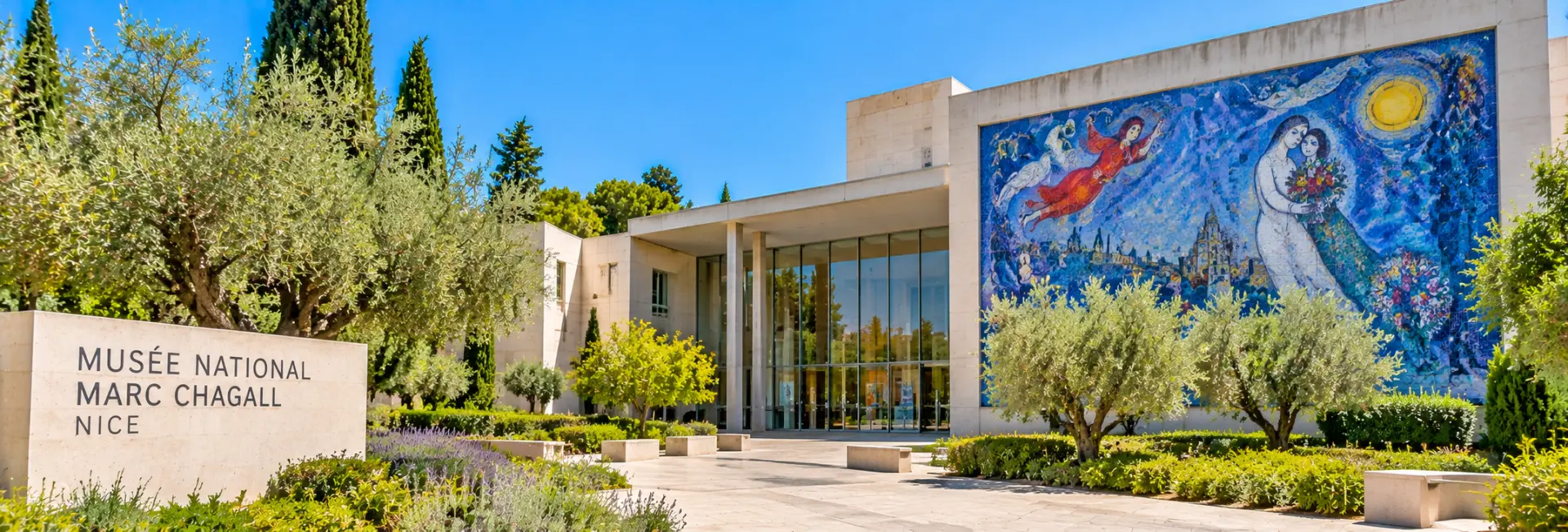
The building was designed by the architect André Hermant, who worked closely with Chagall between 1966 and 1973. Chagall wanted a home for his paintings that felt spiritual rather than monumental, so the museum is low, open and built on a single level. Its calm modernist lines have earned it a national label recognising remarkable contemporary architecture.
Light and Flow
The museum is bright and open, and its layout leads visitors from the big biblical canvases toward the smaller works and the concert hall. Chagall followed the project in detail, and even had a say in the order in which his paintings were hung.
The Garden
The garden is an essential part of the design. Landscaped by Henri Fisch, it follows Chagall's wishes for Mediterranean plants in cool tones, with olive trees, lavender and white or blue flowers. Because the building is single-storey, it blends quietly into the greenery rather than dominating the hillside.
Works Made for the Building
Chagall created several pieces specifically for the museum: the mosaic of the Prophet Elijah above a shallow pool, the stained glass windows of the concert hall, and a tapestry titled Mediterranean Landscape. These are not decorations added later but integral parts of the architecture.
Collections & Exhibits
The permanent collection is organised around the Old Testament cycle and extended by hundreds of other works, including paintings, gouaches, drawings, washes and pastels on both religious and everyday themes. Together they show how Chagall moved between folk memory, dreams and spiritual reflection.
The Biblical Message
This is the core of the museum: seventeen large paintings that Chagall considered a lifelong project. Twelve are shown in the main hall and illustrate the books of Genesis and Exodus. Five more hang in a smaller, hexagonal room and take their theme from the Song of Songs.
Drawings, Gouaches and Studies
Smaller works and preparatory studies show how ideas developed from sketch to finished canvas. They also reveal the playful side of his imagery: floating figures, animals, musicians and lovers drifting through colourful skies.
Stained Glass and Mosaic
Beyond painting, the museum shows how Chagall worked in glass and stone. The three stained glass windows in the concert hall, made in Reims with the master glassmaker Charles Marq, depict the days of Creation in deep blues.
Temporary Exhibitions
The museum has a tradition of exhibitions on spiritual and cultural themes, along with shows exploring particular techniques such as tapestry, sculpture and the relationship between Chagall and music. Check the current programme before visiting.
Must-See Highlights
- The main hall of the Biblical Message, where twelve monumental canvases illustrating Genesis and Exodus surround the viewer in colour.
- The hexagonal Song of Songs room, a smaller, intimate space devoted to a book of love poetry from the Old Testament.
- The Creation of the World stained glass windows in the concert hall, where deep blue tones dominate.
- The mosaic of the Prophet Elijah, which overlooks a pool and reflects in the water on bright days.
- The Mediterranean Landscape tapestry, a reminder of how Chagall enjoyed moving between media.
- The garden, whose planting was chosen with the artist and which makes a gentle end to the visit.
Pay Attention to Colour
Chagall was known for vivid, intense colour. Spending a few extra minutes in each room helps you notice how the palette shifts from one scene to the next, and how the glass and mosaic echo the paintings.
Ways to Experience It
Self-Guided Visit
The museum is compact enough to explore independently, and the layout is easy to follow. Most visitors move from the main biblical hall to the Song of Songs room, then to the concert hall and finally to the garden.
Audio Guides and Tours
Audio guides are available, including versions designed for children in French and English. Guided visits led by the museum's lecturers are offered at certain times, so ask at the desk or look up the programme online.
Family and Youth Activities
The museum runs creative family visits that use storytelling, movement, drawing and sound, aimed at children from about four to twelve. Separate guided visits are offered for older children from twelve. Reservation is often needed, so check the museum's calendar.
Concerts and Special Events
The stained-glass concert hall is used for performances, and the museum also hosts events from time to time. If your trip is flexible, a concert in this setting adds a different dimension to the visit.
Slow Down in the Garden
The garden is a pleasant place to sit after the galleries, and a small seasonal café has been available in the grounds in the past, so check on arrival.
Best Time to Visit
Weekday mornings shortly after opening are generally the quietest time to see the main hall. Late afternoon can also be calm, though the museum closes earlier in some months, so check the time before you go.
By Season
Spring and autumn offer pleasant temperatures for walking in the garden and combining the museum with other sights on Cimiez hill. In summer the museum is a cool escape from the heat, although the garden is best enjoyed earlier in the day. Winter is quiet and often the easiest season for taking your time.
Weekly Rhythm
The museum is closed on Tuesdays, so plan your visit for another day. It also closes on a few public holidays, so confirm the calendar for your dates.
Visitor Tips
- The museum is closed on Tuesdays and on a few public holidays. Check opening hours before you go, because they change between summer and winter and the museum closes earlier in some months.
- Ticket sales stop about thirty minutes before closing, so arrive with enough time to see the main rooms.
- Admission is by paid ticket, and prices can differ depending on whether a temporary exhibition is running. Confirm current rates on the official website.
- The museum accepts the French Riviera Pass. As a national museum it is not covered by Nice's municipal museum pass, so do not assume the two are interchangeable.
- Booking online for family activities and guided visits is advisable, since places can be limited.
- The site is accessible to strollers, and audio guides for children are available.
- Reach the museum by city bus line 5, which has a stop named for the museum, or by taxi from the centre.
- Allow at least ninety minutes, with extra time for the garden and any temporary exhibition.
Nearby Attractions
The museum sits at the foot of Cimiez hill, a green and historic district with several other places worth a visit.
- The Musée Matisse, in a Genoese villa among olive trees, a natural pairing for an art-focused day on the hill.
- The Roman archaeological site of Cimiez, with remains of an amphitheatre and baths.
- The Cimiez monastery and its gardens, with views over the city.
- Vieux Nice and the seafront, reachable by bus for the rest of the day.
If you want to see more of Chagall's story, a half-day trip to Saint-Paul-de-Vence takes you to the village where he spent his later years and is buried.
FAQs about visiting Musée Marc Chagall
What is the Musée Marc Chagall in Nice? +
It is a French national museum on Cimiez hill that holds the largest public collection of Chagall's work in the country, built around the seventeen paintings of the Biblical Message.
What are the main things to see? +
The highlights are the large biblical paintings in the main hall, the Song of Songs room, the stained glass windows in the concert hall, the Elijah mosaic by the pool and the garden.
How long should I allow? +
Around ninety minutes is enough for the permanent collection. Add time if there is a temporary exhibition or if you want to relax in the garden.
When is the museum open? +
It is generally open daily except Tuesdays, with some public holiday closures and earlier closing in certain months. Check the official site for current hours before you go.
How much does it cost? +
Admission is by paid ticket and prices vary with exhibitions, so check the current rates online. The museum accepts the French Riviera Pass.
Is the museum included in the Nice museum pass? +
No, the municipal museum pass does not cover it because it is a national museum. Use the French Riviera Pass or buy a separate ticket.
How do I get there? +
City bus line 5 stops at the museum, and taxis are an easy alternative from the centre. Walking is possible but involves a steady climb.
Is it suitable for children? +
Yes, the museum offers audio guides for children and creative family visits for children aged about four to twelve. The site is accessible to strollers.
What else is nearby? +
The Musée Matisse, the Roman site of Cimiez and the monastery gardens are all on the same hill, making a half-day or full day of culture easy to plan.
