
Table of Contents
Overview
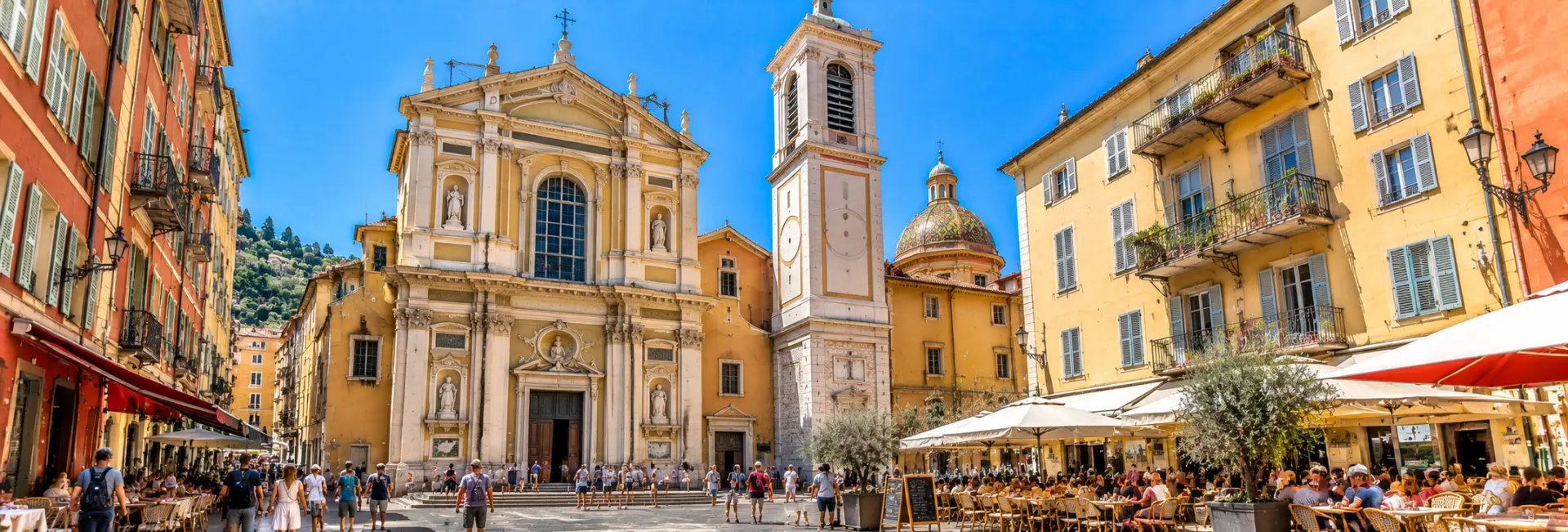
The Cathédrale Sainte-Réparate is the main church of Nice and the seat of its Catholic diocese. It stands on the Place Rossetti in the heart of Vieux Nice, where its pink and ochre facade and tiled dome rise above the café terraces and the narrow streets around it.
Its full title is the Basilica-Cathedral of Sainte-Marie and Sainte-Réparate, a name that recalls an older cathedral that once stood on Castle Hill. The present building is a rare example of an almost entirely Baroque cathedral in France, and the diocese itself describes it as the only one of its kind in the country.
For visitors, it offers two things at once: a working place of worship with a living tradition, and one of the finest examples of Baroque art and architecture in the old town. It is a short walk from the flower market of Cours Saleya, which makes it an easy addition to a morning in Old Nice.
The setting adds to the experience. Place Rossetti is one of the most popular squares in the old town, with restaurant terraces facing the cathedral steps and a well-known ice cream shop nearby. Many visitors take a quiet look inside first and then sit down in the square to enjoy the view of the facade, which glows warmly in the afternoon light.
History
From the Hill to the Town
Nice's earlier cathedral, Sainte-Marie, stood on Castle Hill, but as the hill took on a more military role in the 16th century, church life shifted down into the lower town. The seat of the bishop moved to a church dedicated to Saint Réparate, which already held the relics of the city's patron saint. This was the cathedral's first step toward its present status.
Building the Baroque Cathedral
In 1649 Bishop Didier Palletis decided the existing church was too small for a city of Nice's importance and commissioned the local architect Jean-André Guibert, often called Guiberto, to design a larger one. Work began around 1650 and the cathedral was consecrated in 1699, when it was placed under the protection of Saint Réparate. In 1690 the saint's remains had been moved into the new building, laid in the same spot as the older chapel that once honoured her.
Later Additions
The cathedral kept evolving after the first stage was complete. A bell tower rose beside it between 1731 and 1757, and a new Baroque facade, following Guiberto's original design, was added between 1825 and 1830. In 1898 the bishop commissioned further work, including side chapels beside the choir and a large decorative scheme inside, completed in 1903. The cathedral has been a classified historic monument since 1906, and a long restoration beginning in 2009 renewed both its exterior and interior.
Architecture & Design
The cathedral follows a Baroque plan inspired by Roman churches of the 17th century, with a broad nave, side chapels and a crossing topped by a dome. Its look is drawn from both Rome and Genoa, reflecting how closely Nice was tied to Italian courts and trade routes during the period it belonged to the Savoyard state.
The Facade
The front of the cathedral is a gentle, balanced composition of pilasters, niches and curved lines in warm, sunlit colours. It was added in the 1820s, which means it is younger than most of the building behind it, but it respects the older design and fits naturally with the pastel houses around the square.
The Dome
The most recognisable feature from outside is the dome, topped by a lantern and covered with thousands of glazed tiles in a Genoese manner. Seen from the Castle Hill viewpoint or from the Place Rossetti, it glints in sunlight and has become one of the signature shapes on the Old Town skyline.
The Interior
Inside, the decoration relies on stucco, marble, painted canvases and gilded details rather than a heavily vaulted ceiling, giving the space a measured, sober character compared with the richer Baroque churches of Rome. Light enters from the dome and windows, and the nave leads the eye toward the high altar.
Cultural & Religious Significance
The cathedral is dedicated to Saint Réparate, a young Christian martyr who is the patron saint of Nice. According to tradition, she was a girl of about fifteen who died around the year 250 in Caesarea of Palestine, during the persecutions under the emperor Decius. Her body was placed in a boat and set adrift on the sea.
Local legend says angels guided the boat across the Mediterranean to the shore at Nice, and the story is often cited as the origin of the name Baie des Anges, the Bay of Angels. Whether taken as faith, folklore or both, it is deeply woven into how the city sees itself.
The Feast of Saint Réparate
Each autumn the city honours its patron with a feast that includes a procession through the Old Town, a solemn Mass and a concert in the cathedral. In the procession, a statue of the saint is carried from the sea toward the cathedral, repeating the story of her arrival by water. The event is free to watch and is one of the most meaningful local traditions you can see in the old town.
A Link to Savoy and to Nice's History
Monograms of the princes of the House of Savoy appear in the nave and choir, a reminder of the centuries when Nice was tied to Piedmont rather than to France. The cathedral also has a place in the story of the city's famous sons: the future Napoleonic marshal André Masséna was baptised here.
Notable Features
The High Altar and Relics
Above the main altar, a large painting shows the Glory of Saint Réparate. The saint's relics rest in the cathedral, giving the building its role as the spiritual centre of the city's devotion to her.
The Ten Chapels
Around the nave are ten side chapels, many originally funded and cared for by wealthy families or craft guilds who competed to decorate them. Their subjects include:
- The Madonna of the Seven Sorrows and the Crucifixion
- Saint Rose of Lima and Saints Alexander and Bartholomew
- The Holy Sacrament and Saint Rosalie with the Virgin
- Saint Joseph and Saint Réparate
- The Four Crowned Martyrs and Saint John the Baptist
Organs and Music
The cathedral has three organs, and music plays an active role in its services and concerts. If your visit coincides with a rehearsal or a recital, it is worth pausing to listen, since the acoustics of the Baroque nave suit both organ and choir.
The Bell Tower
The bell tower, built in the 18th century beside the main building, adds a vertical accent to the Old Town streets and rings over the neighbouring squares.
Visiting Etiquette & Tips
The cathedral is an active parish and diocesan church, so visiting is a little different from entering a museum. A few simple habits make the experience smoother for you and for worshippers.
- Dress modestly, with shoulders and knees covered, as a sign of respect inside a place of worship.
- Keep voices low and move quietly, especially when services or prayers are taking place.
- Avoid flash photography and do not photograph people who are praying.
- Expect some areas to be closed off during Mass or special ceremonies, and plan around them.
- Check opening hours locally before you go, since the cathedral generally closes for a break around midday and times can change for services and holidays.
- Entry to the main church is generally free, and a small donation toward the upkeep of the building is welcome.
Allow thirty to sixty minutes to look around properly. Bring a little time as well to see the facade and dome from the square, since the exterior is as much part of the experience as the interior.
Best Time to Visit
Mornings are usually the quietest and brightest time to visit, and light from the dome and windows shows the stucco and marble at their best. Late afternoon is a good second option, when the sun warms the facade and the Place Rossetti begins to fill with people.
Seasonal Notes
Spring and autumn are comfortable for combining a visit with a stroll through the Old Town. The feast of Saint Réparate in early autumn is the best moment if you want to see the cathedral in its ceremonial role. Summer brings heavy foot traffic to the surrounding streets, while winter is calmer and often leaves the church almost to yourself.
Services and Events
Sunday mornings and religious holidays are busy with worshippers, and parts of the church may not be open to sightseers. Concerts and organ recitals are held from time to time, so look for notices at the entrance.
Nearby Attractions
The cathedral sits in one of the most walkable parts of Nice, with several major sights only a few minutes away.
- Place Rossetti, the square in front of the cathedral, known for its restaurant terraces and a famous local ice cream shop.
- Cours Saleya, the flower and produce market square, about a short walk to the south.
- Chapelle de la Miséricorde, a Baroque chapel on Cours Saleya with an elliptical nave.
- Palais Lascaris, a Baroque palace in the Old Town that is now a museum.
- Castle Hill, with gardens, viewpoints and a waterfall, rising at the eastern edge of the old town.
- The seafront and Promenade des Anglais, reachable in a few minutes through the old streets.
Tram Line 1 stops at Cathédrale - Vieille Ville, which makes the area easy to reach from the rest of the city.
FAQs about visiting Cathédrale Sainte-Réparate
What is the Cathédrale Sainte-Réparate known for? +
It is the main church of Nice and a notable example of Baroque architecture, with a glazed-tile dome, ten richly decorated chapels and a long link to the city's patron saint.
Where is it located? +
The cathedral stands at 3 Place Rossetti in Vieux Nice, a short walk from Cours Saleya and the seafront.
Is it free to visit? +
Entry to the church is generally free, though donations toward its upkeep are appreciated. It is always worth confirming locally if you plan a visit around a special event.
When is it open? +
It is usually open daily with a break around midday, but hours vary on Sundays and holidays and during services. Check the cathedral's official information shortly before your visit.
How long should I allow? +
Thirty to sixty minutes is enough to see the nave, the chapels and the high altar, with a few extra minutes outside for the facade and dome.
Is there a dress code? +
Yes, modest dress is expected, with shoulders and knees covered, as it is an active place of worship.
Who is Saint Réparate? +
She is the patron saint of Nice, a young martyr of the 3rd century whose body, according to legend, was carried to the coast of Nice by angels, giving the Bay of Angels its name.
How do I get there by tram? +
Take Tram Line 1 to the Cathédrale - Vieille Ville stop, then walk a few minutes into the Old Town to Place Rossetti.
Can I take photos? +
Photography for personal use is usually fine, but flash and photos of people praying should be avoided, and rules may change during services.
