
Table of Contents
Overview
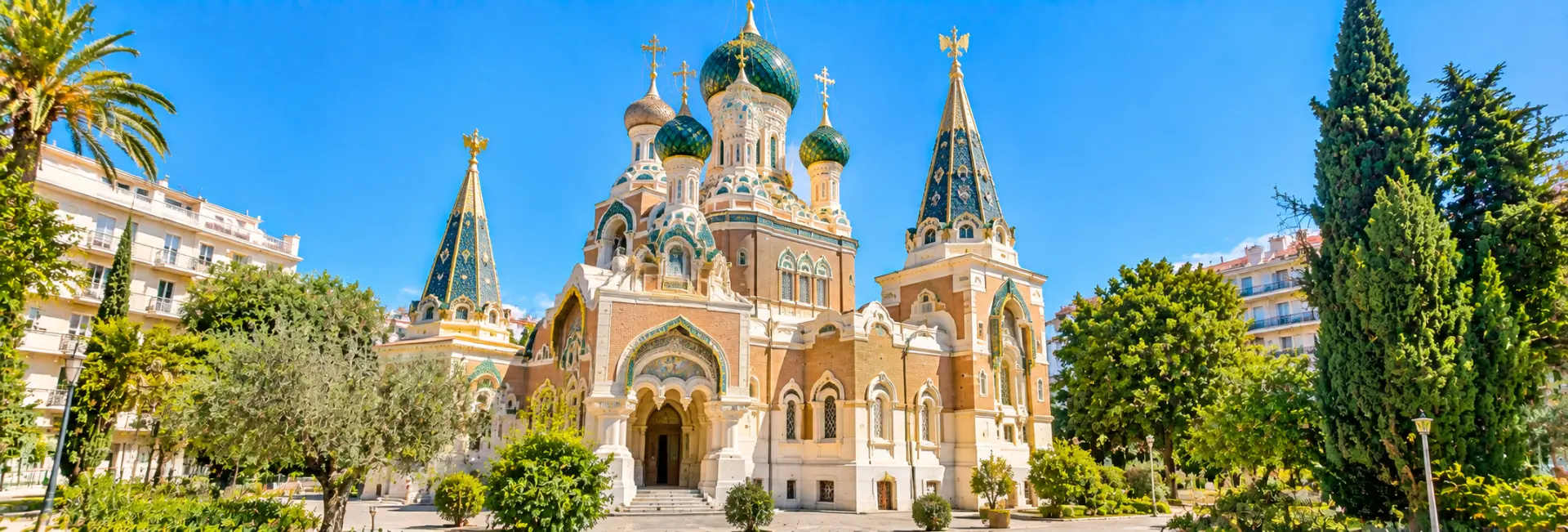
The Russian Orthodox Cathedral of Saint Nicholas is one of the most unexpected landmarks in Nice. Tucked away on Avenue Nicolas II, a short private street off the Boulevard du Tzarévitch, it rises from a leafy garden with a cluster of golden onion domes that look as if they belong in Moscow rather than on the French Riviera.
It is generally described as the largest Orthodox cathedral in Western Europe, and it was built in the early 20th century for the Russian community that wintered on the Côte d'Azur. Inside, a rich scheme of icons, frescoes and carved woodwork gives the building the warm, glowing atmosphere typical of Orthodox churches.
For visitors, it offers a very different side of Nice from the pastel Baroque of the Old Town or the Belle Epoque promenade. It is both an active place of worship and a monument to a vanished world of imperial travellers, which makes it an unusual and memorable stop.
History
Russians on the Riviera
From the middle of the 19th century, Nice became a favourite winter retreat for Russian aristocrats and members of the imperial family. The first Russian Orthodox church in the city, dedicated to Saint Nicholas and Saint Alexandra, was inaugurated around 1859 on Rue Longchamp. As the Russian colony kept growing, that church soon proved too small.
A Prince's Death
In April 1865 the heir to the Russian throne, Tsarevich Nicholas Alexandrovich, died of meningitis in Nice while staying at the Villa Bermond. His father, Tsar Alexander II, later bought the villa and had a memorial chapel built on the site, designed by the architect David Grimm. The cathedral was eventually raised in the park of the same villa, close to that chapel.
Building the Cathedral
Work began in 1903 under Mikhail Preobrazhensky, a professor of architecture at the Imperial Academy of Fine Arts in Saint Petersburg. The project was made possible by the support of Tsar Nicholas II, who authorised construction on land that belonged to the imperial family. The cathedral was consecrated in December 1912, only a few years before the fall of the Russian monarchy.
An Architect with Experience
Preobrazhensky was already known for another Russian church in Europe, the Orthodox church in Florence, before he took on the Nice commission. That earlier project helped convince the imperial family that he could create a building in the Russian tradition far from home.
Ownership and Dispute
After the revolution of 1917, the cathedral was run by a local religious association, and for decades the parish was affiliated with a church jurisdiction outside Moscow. In the 21st century the Russian Federation claimed ownership of the property, and after a long legal process French courts ruled in its favour. The cathedral now belongs to the Russian state, and its parish is linked to the Russian Orthodox Church.
Architecture & Design
The cathedral is built in a style often called neo-Russian, inspired by the five-domed churches of the Moscow region in the late 16th century. It is also sometimes compared with the great churches of Moscow and Saint Petersburg, though on a smaller scale. The domes themselves are made of reinforced concrete, a modern building technique hidden beneath a very traditional look.
Exterior
The outside is a bold composition of warm-coloured walls, decorative gables and bright ceramic tiles, crowned by onion domes topped with gold. The garden around the building softens the effect and gives the cathedral a quiet, almost fairy-tale setting amid Nice's villas and palm trees.
A Different Skyline
Most of central Nice is built in the style of Baroque and Belle Epoque townhouses, so the cathedral stands out sharply against its surroundings. Its domes are visible from several nearby streets, and many visitors first notice them before they have even found the entrance.
Interior
The floor plan follows the shape of a Greek cross, and the interior is lit softly, with gold and deep colours catching the light. Walls and ceilings carry frescoes and painted decoration, and the carved wooden fittings add to the sense of richness. A belle epoque taste for floral motifs shows alongside the traditional Orthodox imagery.
Cultural & Religious Significance
The cathedral is dedicated to Saint Nicholas, one of the most beloved saints in the Orthodox tradition. It also stands as a memorial to Tsarevich Nicholas, the young heir whose death in Nice prompted the Russian presence here to become permanent. For many Orthodox visitors, it remains an important spiritual centre on the Riviera.
A Landmark of Russian Nice
Nice was once home to a large and influential Russian community. The writer Anton Chekhov stayed in the city on several visits and wrote part of his famous play Three Sisters here. Other traces of that world include the Château de Valrose, now part of the university, and a Russian cemetery. The cathedral is the most visible survivor of this era.
A Living Place of Worship
The cathedral is not only a monument but a working church with regular services. Visitors may hear chanting during liturgies, and the rituals follow the Orthodox calendar. Respectful behaviour is expected, and it is worth remembering that you are entering a space that is sacred to its congregation.
National Recognition
The cathedral has been classified as a historic monument by France's Ministry of Culture, and it also holds the label for notable 20th-century heritage. This recognition places it alongside the city's most important architectural treasures.
Notable Features
The Iconostasis
The most striking element inside is the iconostasis, the screen of icons that separates the nave from the sanctuary. Here it is made of worked and chiselled metal and decorated with icons by the painter Leonid Pianovsky, who also contributed other icons to the building.
Icons and Frescoes
Icons appear throughout the building, and one of the best known is the icon of Our Lady of Kazan, to the right of the choir, adorned with fine silver work and precious stones. Many other images of saints and scenes from the Bible cover the walls.
The Tsarevich Chapel
The small memorial chapel built on the spot where the heir died is still part of the visit. It is quieter and more intimate than the cathedral, and it explains why the site matters to the Russian story in Nice.
The Crypt Treasury
Below the main church, a crypt displays liturgical objects and other treasures, available as an extra part of the visit.
The Gardens
The grounds around the cathedral, once part of the Villa Bermond park, offer a calm place to walk and a good view of the domes from different angles.
Visiting Etiquette & Tips
Because the cathedral is an active place of worship, a few rules apply, and staff may refuse entry to visitors who ignore them.
- Dress modestly. Shoulders and knees should be covered, and men are not allowed to enter without a shirt.
- Speak quietly and avoid disturbing worshippers, especially during services.
- Ask staff about rules for photography inside, as these can change.
- Expect an entrance fee for sightseeing visits, with free entry for young children. Current tourism listings give an adult price of around ten euros, with a separate supplement for the crypt treasury, so confirm rates before you go.
- Guided tours of the cathedral and the Tsarevich chapel are offered in several languages and last about thirty-five minutes.
- The cathedral is included in the French Riviera Pass.
- Check opening hours in advance, because the cathedral generally closes for part of the day and hours can change around services and religious holidays.
The cathedral is a little outside the centre of town, about a half-hour walk from the main shopping avenue, so it is often easiest to arrive by bus or taxi.
Best Time to Visit
Mornings and early afternoons tend to be the calmest times to explore, and daylight brings out the gold and the colours of the tiles. If you want to experience the cathedral as a place of worship, check the service schedule, since services give the interior a very different atmosphere though they may limit access.
By Season
Spring and autumn are the most pleasant seasons, with comfortable temperatures for walking in the gardens. Summer can be hot, so the cool interior is a welcome break. Winter is quiet and recalls the period when Russian visitors came to the city for the mild climate.
Religious Calendar
Orthodox holidays, including Easter and Christmas according to the Orthodox calendar, are celebrated with special services. These are moving occasions, but they are busy, and access for sightseeing may be limited.
Nearby Attractions
The cathedral sits in a quiet residential part of the city, so it works best as part of a wider day of exploring.
- The Tsarevich chapel, in the same grounds as the cathedral, marks the spot where the heir died.
- The Château de Valrose, a former Russian-owned estate now used by the university, is another reminder of the Russian era.
- The city centre, including the shopping streets and Place Masséna, is a bus or taxi ride away.
- The Promenade des Anglais and the seafront can be reached by local transport for a stroll after your visit.
- The Old Town and the Cathédrale Sainte-Réparate offer a contrast between Baroque and Orthodox traditions.
Planning a half-day that links the Russian cathedral with the Old Town and the seafront gives a good picture of how different cultures shaped Nice.
FAQs about visiting the Russian Orthodox Cathedral in Nice
What is the Russian Orthodox Cathedral in Nice? +
It is the Cathedral of Saint Nicholas, built between 1903 and 1912 for the Russian community on the Riviera and generally described as the largest Orthodox cathedral in Western Europe.
Where is it located? +
It stands on Avenue Nicolas II, off Boulevard du Tzarévitch, in a leafy area west of the city centre.
Can tourists go inside? +
Yes, visitors are welcome outside services, though the cathedral is an active place of worship and entry can be refused if the rules are not respected.
How much does it cost? +
Tourism listings give an adult price of around ten euros for visits, free for children under twelve, with a small extra charge for the crypt treasury. Prices change, so check before you go.
What are the opening hours? +
It is generally open daily with a break around midday, but times vary and services may restrict access. Confirm hours on the official website before your visit.
Is there a dress code? +
Yes, modest dress is required. Shoulders and knees should be covered, and men may not enter without a shirt.
How long should I spend there? +
Plan for about forty-five minutes to an hour, including the guided visit, the Tsarevich chapel and a short walk through the gardens.
Why is there a Russian cathedral in Nice? +
Nice was a favourite winter destination for Russian nobility and the imperial family in the 19th century. The cathedral was built for that community and as a memorial to the heir who died in the city in 1865.
How do I get there? +
The cathedral is about a half-hour walk from Avenue Jean Médecin, but bus and taxi routes make it easy to reach from the centre.
