
Table of Contents
Overview
Place Masséna is the main square of Nice and the place where the city's different parts come together. It sits between the Old Town to the east, the Promenade des Anglais and the sea to the south, and the shopping streets of the modern centre to the north. Locals use it as a meeting point, a crossroads, and a stage for the city's biggest celebrations.
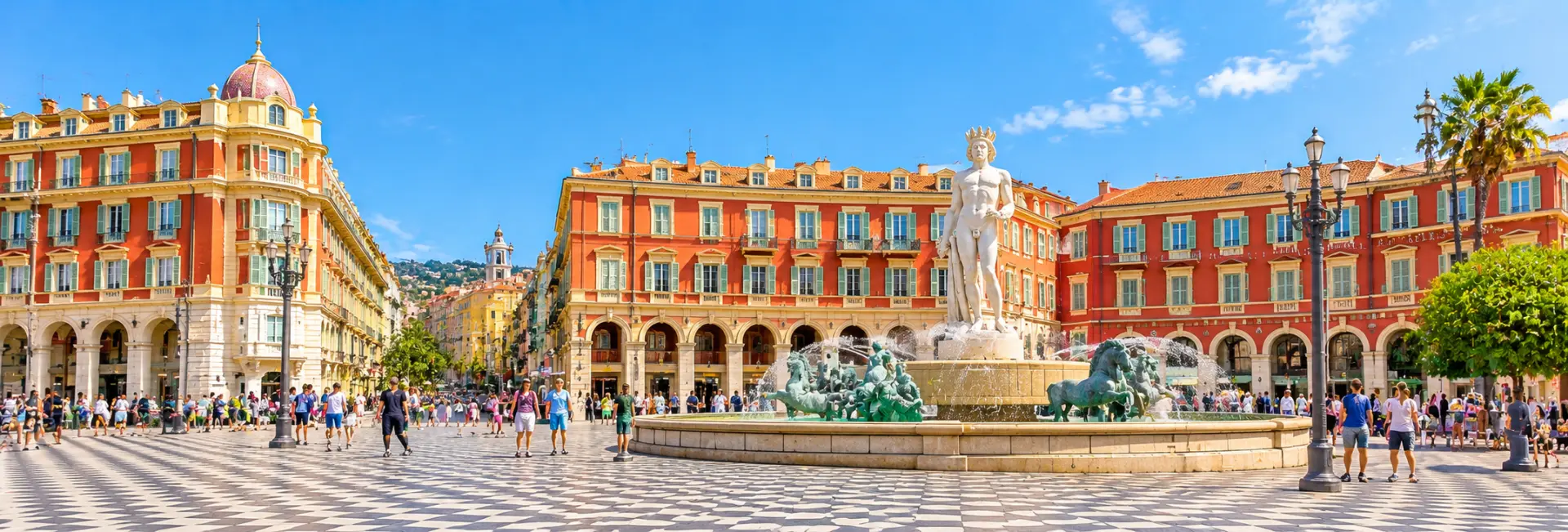
The square is easy to recognise. Tall buildings in warm red and ochre tones, with arcades at street level, frame a wide black and white chequered pavement. At the southern end stands the Fountain of the Sun, topped by a large white statue of Apollo, and above the tram line seven figures on tall poles glow in changing colours after dark.
It is a place to see rather than to tick off. Most visitors pass through it several times during a stay, stopping for a coffee under the arcades, crossing to the Old Town, or heading to the seafront. Open at all hours and free to enter, it is also one of the most convenient starting points for exploring the city.
History
Two Squares Divided by a River
The square began as two separate spaces. On the Old Town side, a semicircular neoclassical square called Place Charles-Albert was laid out in the 1820s. On the other side of the Paillon, a river that once flowed through the heart of the city, a larger square was designed by the architect Joseph Vernier in the 1840s. For a long time, the only link between the two was a bridge, which locals nicknamed the Pont Neuf.
Covering the Paillon
The Paillon could swell and flood, which held back the growth of the city towards the west. In the 1860s the river was gradually covered over, and the two spaces were joined into a single large public square, rectangular at the northern end and semicircular at the south. Around the same time, Nice had become part of France, and the new square took on its role as the symbolic centre of the modern city.
A Name from the Napoleonic Era
The square carries the name of André Masséna, born in Nice in 1758, who rose to become a marshal of France under Napoleon. Before it received this name in official records in the 1850s, the space was known by earlier labels such as Place du Faubourg and Place Carrée.
Modern Changes
The square has changed with the city. The demolition of the old Masséna Casino in 1979 opened up the space, and a major redesign in the 2000s, carried out when the tramway was built, removed most traffic and returned the square to pedestrians. The redesign brought the chequered paving, the return of the Sun Fountain, and the artwork that now defines the square at night.
Recognition / Status
Place Masséna lies within the historic centre of Nice, whose heritage was recognised by UNESCO in 2021 when it added "Nice, Winter Resort Town of the Riviera" to the World Heritage List. The square represents the city's 19th-century growth as it expanded beyond the old walls and the Paillon, and its Italian-influenced architecture is a reminder of the period when Nice belonged to the Kingdom of Sardinia.
Its value as a landmark rests on several points:
- It is the central civic space of Nice, used continuously since the 19th century
- Its arcaded, red-ochre buildings show the Piedmontese and neoclassical influences of the period
- It combines historic fabric with contemporary public art
- It hosts the city's largest public events, from Carnival to year-end celebrations
Architecture & Design
Red Ochre Facades
The buildings around the square are tall, symmetrical, and painted in deep red and orange tones, with green shutters and regular rows of windows. The effect is more Italian than French, which reflects the long period when Nice was ruled from Turin and when many of the city's architects and builders came from Piedmont.
Arcades
The ground floors of the main buildings open onto arcades, which shelter shops and cafe terraces from the sun and rain. The covered walkways give the square a formal, theatrical quality and make it comfortable to stroll in any weather.
The Chequered Pavement
The black and white paving is one of the square's best-known features. It was added in the 2000s redesign led by the urban planner Bruno Fortier and gives the large open space a strong visual pattern, making it look especially striking when seen from above or from the hillside nearby.
Open Space
The square is wide, clear of traffic, and lined with palms and other trees. The tram runs through it quietly, and the surrounding streets lead off in several directions, which makes it feel like a hub of the city rather than a closed enclosure.
Notable Features
The Fountain of the Sun
The Fontaine du Soleil stands at the southern end of the square. Its centrepiece is a white marble statue of Apollo, about seven metres tall, who is shown as the god of the sun. Five bronze figures around the base represent Earth, Mars, Mercury, Saturn, and Venus. The fountain was designed by the sculptor Alfred Janniot and inaugurated in 1956.
The statue has had an eventful life. Its nudity caused complaints when it first appeared, and the fountain was later taken down and moved. It returned to the square in 2007, when the redesign made it a focal point again, and it now serves as the best-known symbol of Place Masséna.
Conversation à Nice
Along the tram line stand seven large figures on tall poles. Created in 2007 by the Catalan artist Jaume Plensa, the work is called Conversation à Nice, and the seven figures represent the seven continents. Each figure sits or kneels in a thoughtful pose, and after dark they light up in changing colours, so that the sculptures seem to speak to each other across the square.
The Arcaded Buildings
Beyond the artworks, the buildings themselves are part of the attraction. Walking slowly under the arcades lets you see the details of the facades, the carved doorways, and the old shop fronts, and you can compare how the square looks from different corners.
Ways to Experience It
Stroll and People-Watch
The simplest way to enjoy the square is to walk across it, pause by the fountain, and sit at a cafe terrace under the arcades. Early in the day it is calm, while in the evening it fills with people meeting friends or heading out for dinner.
Watch the Statues Light Up
Come after sunset to see Conversation à Nice come to life. The seven figures change colour slowly, and the light plays over the red facades, which makes the square especially photogenic at night.
Join the Big Events
Place Masséna is the main venue for many of Nice's public events. The Nice Carnival uses the square and its surroundings, and end-of-year celebrations and concerts also take place here during the year, so it is worth checking what is on during your visit.
Use It as a Starting Point
The square connects naturally with the city's main sights. From here you can walk into the Old Town, head down to the seafront, follow the green corridor of the Promenade du Paillon, or take the tram to other districts and the port.
Shop and Eat Nearby
The surrounding streets, including the pedestrian lanes and Avenue Jean Médecin, are full of shops, bakeries, and restaurants, so it is easy to combine sightseeing with a meal or some browsing.
Best Time to Visit
Time of Day
Morning is the calmest time and gives soft light on the facades. Late afternoon and early evening bring a lively mood, with terraces filling up. After dark, the illuminated statues give the square a different character, so it is worth seeing at least once at night.
Time of Year
Spring and autumn are the most pleasant seasons, with comfortable temperatures for sitting outside. Summer is busy and warm, with a festive feel in the evenings, and the arcades provide welcome shade. Winter brings the Carnival and holiday decorations, which make the square especially colourful.
Event Periods
If you want to see the square at its most animated, visit during Carnival or the end-of-year celebrations. If you prefer a quieter experience, avoid event weeks, as crowds are large and some areas may be closed off.
Visitor Tips
- Entry is free. The square is a public space and open at all hours, every day of the year.
- Arrive by tram. Tram line T1 stops at the square, and several bus lines also serve it, so there is no need to drive.
- Allow a short visit. Half an hour is enough to see the main features, though you may want longer to sit at a cafe or explore the nearby streets.
- Come back at night. The statues are lit after dark, so a second look in the evening adds a lot.
- Look up. The arcade details, shutters, and painted facades reward a slow look.
- Watch for trams. The line crosses the square, so pay attention when you walk across the tracks.
- Keep belongings secure. As in any busy central area, keep bags closed and phones out of easy reach.
- Check event dates. Large events can close parts of the square or change access, so check the city's calendar before you visit.
Cafe prices, event schedules, and tram routes can change, so confirm the latest details locally.
Nearby Attractions
- Vieux Nice (Old Town) - The lanes, markets, and Baroque churches begin just east of the square.
- Promenade du Paillon - A long green corridor of lawns, fountains, and playgrounds, built over the old river.
- Jardin Albert-Ier - One of the oldest public gardens in the city, between the square and the seafront.
- Promenade des Anglais - The famous seafront boulevard, within a few minutes' walk.
- Opéra de Nice - The city's opera house, in the lanes at the edge of the Old Town.
- Castle Hill - A short walk from the square, with views back over the whole city.
FAQs about visiting Place Masséna
What is Place Masséna? +
It is the main central square of Nice, known for its red-ochre arcaded buildings, black and white chequered paving, the Fountain of the Sun, and seven illuminated statues.
Who is the square named after? +
It is named after André Masséna, a marshal of France under Napoleon who was born in Nice in 1758.
What are the statues on the poles? +
They form an artwork called Conversation à Nice, created in 2007 by the Catalan artist Jaume Plensa. The seven figures represent the seven continents and light up in changing colours at night.
What is the big statue in the fountain? +
It is Apollo, the god of the sun, at the centre of the Fountain of the Sun. The marble statue stands about seven metres tall and is surrounded by five bronze figures representing planets.
Is it free to visit? +
Yes. Place Masséna is a public square and is open at all times, with no entrance fee.
How long do I need? +
Half an hour is enough to see the highlights, but it is pleasant to stay longer for a coffee or to use the square as a base for exploring nearby areas.
How do I get to Place Masséna? +
Tram line T1 has a stop at the square, and several bus lines also serve it. It is a short walk from the Old Town and the Promenade des Anglais, and about fifteen minutes on foot from the main train station.
When is the best time to see it? +
Daytime gives the clearest view of the architecture and paving, while evening is best for the illuminated statues. Carnival and year-end events add extra atmosphere but also bring larger crowds.
Is the square accessible for wheelchairs and strollers? +
Yes. It is flat, pedestrian, and open, with smooth paving, although you should take care when crossing the tram tracks.
What is nearby? +
The Old Town, the Promenade du Paillon, Jardin Albert-Ier, the Promenade des Anglais, and the Opéra de Nice are all within a short walk.
