Table of Contents
Overview
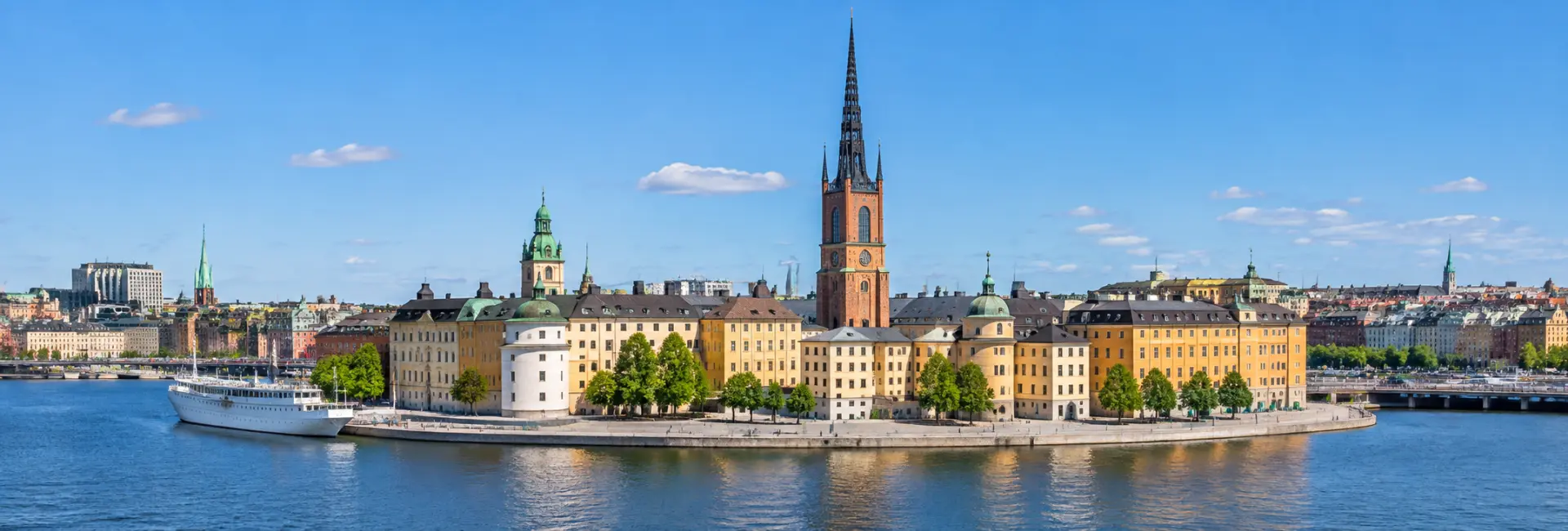
Riddarholmen, or "the Knights' Islet," is a small, quiet island that forms the western edge of Gamla Stan, Stockholm's old town. Where the main island buzzes with shops and restaurants, Riddarholmen keeps a hushed, almost administrative calm, its cobbled streets lined with 17th-century palaces that now house courts and government offices rather than nobility.
Its centerpiece is Riddarholmen Church, the burial place of Swedish monarchs for more than three centuries, but the island's real draw is its atmosphere: an open-air museum of aristocratic architecture with some of the best waterfront views in the city, usually enjoyed without the crowds that fill the rest of Gamla Stan.
History
A Medieval Monastery
Riddarholmen's oldest building, Riddarholmen Church, began as the church of a Franciscan monastery founded around 1270 on land donated by King Magnus Ladulås. The church itself was completed around 1300, and Ladulås chose it as his own final resting place after his death in 1290, setting a precedent that would shape the island's identity for centuries.
Reformation and Royal Burials
The Swedish Reformation of 1527, carried out under King Gustav Vasa, led the Crown to confiscate the monastery's property, part of a broader effort to weaken the church's power and fund national defense. From 1634, Riddarholmen Church became the official royal burial site, a role it held until 1950, giving the island a solemn, ceremonial significance that set it apart from the rest of the old town.
An Age of Noble Palaces
As Sweden rose to become a European great power in the 17th century, the Crown granted land on Riddarholmen to the higher nobility, who built palaces here in the Renaissance style during the 1630s and 1640s. Later in the century, some of these palaces were expanded in the grander Baroque style by leading architects of the day, including Jean de la Vallé and Nicodemus Tessin the Elder, who designed the Wrangel Palace. That palace briefly served as the royal family's residence for 57 years after a fire destroyed the Tre Kronor Castle in 1697.
From Noble Residences to State Institutions
By the 18th century, the Crown had begun reclaiming the island's palaces, converting them into buildings for state administration and Sweden's highest legal institutions, a function several still serve today. Into the 20th century, Riddarholmen also served a very different practical role as a shipping point on Lake Mälaren, with one of the city's largest steamboat harbors operating on its western side until around 1950.
Recognition & Status
Riddarholmen forms an integral part of Gamla Stan, one of the best-preserved medieval town centers in Europe, and its palaces and church are protected as buildings of national historical significance. Riddarholmen Church in particular holds a unique status as the resting place of nearly every Swedish monarch from Gustav II Adolf, who died in 1632, to Gustaf V, who died in 1950, with Queen Christina the sole exception among monarchs of that era.
Today, no one lives permanently on Riddarholmen. The island's grand buildings now house government offices and courts, including the Svea Court of Appeal in Wrangel Palace, making it a rare example of an aristocratic quarter that transitioned almost entirely into public institutional use rather than private residences.
Notable Landmarks
Riddarholmen Church
The church's most recognizable feature is its cast-iron spire, added in the 19th century after lightning destroyed the original wooden tower in 1835. Inside, visitors can walk among royal tombs and coats of arms belonging to knights of the Royal Order of the Seraphim, a distinctly Swedish blend of solemn history and heraldic detail.
Birger Jarls Torg and the Palaces
The island's central square, Birger Jarls Torg, is anchored by a 19th-century statue of Birger Jarl, traditionally credited as the founder of Stockholm. Around the square stand three of Riddarholmen's grandest palaces: Wrangel Palace to the west, incorporating a medieval defensive tower and a portal designed by Tessin the Elder, and the somewhat less elaborate Stenbock and Hessenstein Palaces on the east side.
Evert Taubes Terrass
At the island's western tip, this open terrace offers one of Stockholm's most photographed views, looking out across Riddarfjärden bay toward Stockholm City Hall, a vista frequently used as a backdrop by television journalists reporting from the capital.
Ways to Experience It
Riddarholmen rewards slow, aimless walking more than any single ticketed activity. Most visitors treat it as an extension of a Gamla Stan walk, crossing over to see the church and palaces before returning to the busier main island.
- Walking the cobbled streets around Birger Jarls Torg to take in the palace facades
- Touring Riddarholmen Church during its open summer months to see the royal tombs
- Attending a concert or an Order of the Seraphim bell ringing at the church, held periodically throughout the year
- Watching the sunset from Evert Taubes Terrass, with City Hall silhouetted across the water
- Dining aboard the Mälardrottningen, a historic yacht permanently moored off the island and converted into a hotel and restaurant
Best Time to Visit
Riddarholmen Church is open to visitors only during the summer season, so a visit focused on seeing the royal tombs is best planned between roughly May and September. Outside those months, the church can still be experienced from the outside, or visited during an occasional concert or ceremonial bell ringing.
Late afternoon and early evening are especially rewarding times to visit the island's western waterfront, when the light over Riddarfjärden and City Hall is at its most photogenic, particularly in the warmer months when sunset comes late.
Visitor Tips
Riddarholmen is compact enough to see thoroughly in under an hour, making it an easy add-on to a longer day exploring Gamla Stan rather than a separate destination requiring its own trip.
- Reach the island on foot from Gamla Stan, or via the pedestrian bridge from Norrmalm across Norra Järnvägsbron
- The nearest metro stop is Gamla Stan station, a short walk away
- Check seasonal opening times before planning a visit specifically to see inside the church, since it closes outside summer
- Wear comfortable shoes, as the island's streets are cobbled throughout
- Visit toward evening for the best light over Riddarfjärden from the western terrace
Nearby Attractions
Riddarholmen's small size and central location make it easy to combine with several other landmarks in and around Gamla Stan.
- Gamla Stan - Stockholm's main old town island, connected directly to Riddarholmen by bridge
- Stockholm Royal Palace - a short walk away in the heart of Gamla Stan
- Storkyrkan - Stockholm's cathedral, also within easy walking distance
- Riddarhuset (House of Nobility) - a historic building close to Riddarholmen, tied to the same era of Swedish aristocratic history
FAQs about visiting Riddarholmen
What is Riddarholmen known for? +
It's a small islet next to Gamla Stan known for Riddarholmen Church, the burial place of most Swedish monarchs from the 17th century to 1950, and for its cluster of 17th-century noble palaces.
Is Riddarholmen Church open year-round? +
No, it's generally open to visitors only during the summer months, from around May to September, though it can also be seen during occasional concerts or ceremonial events at other times of year.
How long does a visit to Riddarholmen take? +
Most visitors can see the main square, palaces, and waterfront terrace in under an hour, making it easy to combine with a longer visit to Gamla Stan.
Does anyone live on Riddarholmen? +
No, the island has no permanent residents today; its historic palaces now house government offices and courts rather than private homes.
What's the best view on Riddarholmen? +
Evert Taubes Terrass, at the island's western tip, offers a well-known panoramic view across Riddarfjärden bay toward Stockholm City Hall.
How do I get to Riddarholmen? +
It's a short walk from Gamla Stan metro station, connected to the rest of Gamla Stan by bridge, with an additional pedestrian route from Norrmalm via Norra Järnvägsbron.
Which Swedish monarchs are buried at Riddarholmen Church? +
Nearly every monarch from Gustav II Adolf, who died in 1632, to Gustaf V, who died in 1950, is buried there, along with earlier kings such as Magnus Ladulås, with Queen Christina as the notable exception.
What's nearby if I want to see more of Stockholm's old town? +
The Royal Palace, Storkyrkan, and the House of Nobility are all within easy walking distance in the adjoining Gamla Stan district.