
Table of Contents
Overview
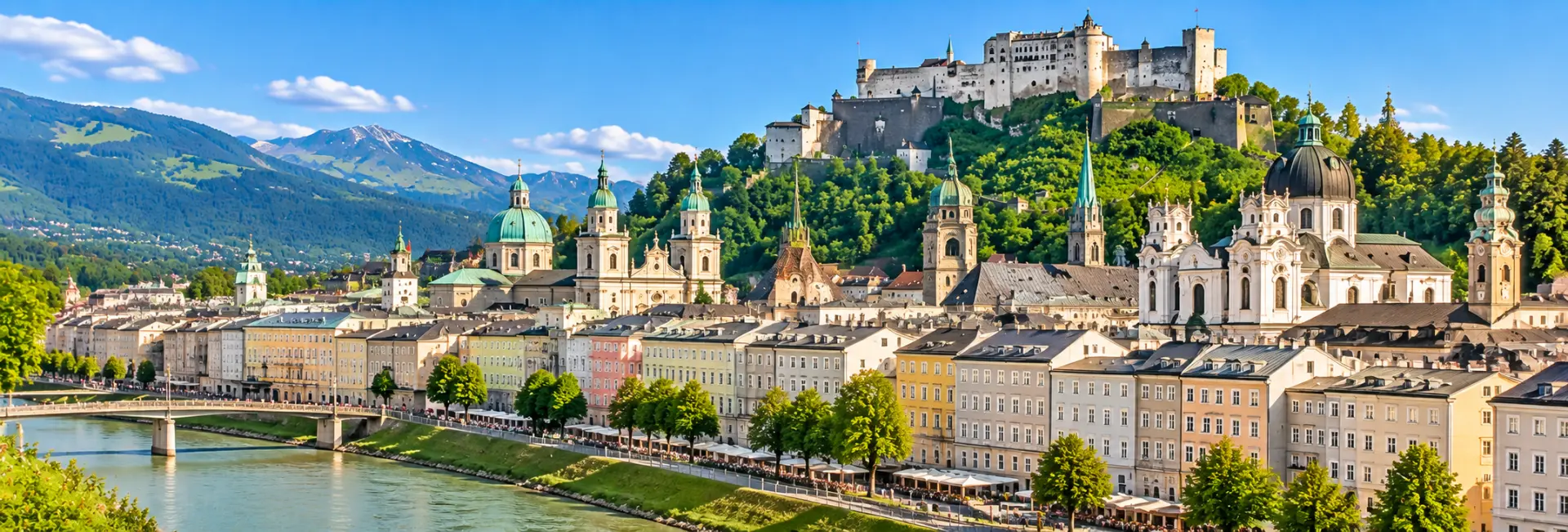
Salzburg's Altstadt is a compact, almost entirely walkable quarter squeezed between the Salzach River and the steep cliffs of the Mönchsberg. Within a few hundred metres you pass baroque churches, arcaded courtyards, grand ceremonial squares, shuttered townhouses and narrow lanes hung with ornate iron shop signs. Above it all, the fortress watches from its hilltop.
The district is famous as the birthplace of Wolfgang Amadeus Mozart, but its appeal goes well beyond a single name. For centuries Salzburg was ruled by prince-archbishops who poured wealth from the salt trade into stone, and the result is a rare city centre where Church power, Italian-influenced design and everyday Austrian life sit side by side.
Most visitors spend a full day here, and many stay longer. The old town rewards slow wandering as much as it rewards ticking off sights.
History
From Roman Town to Bishop's Seat
People settled this river crossing long before the baroque era, and a Roman town stood in the area. Christian missionaries later established a presence on the site, and monasteries and a cathedral gave the settlement spiritual weight. The city's name points to its economic lifeblood: salt, mined in the nearby hills and transported along the river, funded much of what visitors see today.
The Archbishops Rebuild the City
The defining transformation came around 1600, when Prince-Archbishop Wolf Dietrich von Raitenau set out to reshape his capital in the spirit of the Italian cities he admired. Dozens of medieval buildings were cleared to create new open spaces, and the grand square in front of the cathedral was laid out from 1587 onward. Later archbishops continued the work, adding palaces, churches and fountains.
The scale of the clearance was remarkable. Around fifty-five medieval buildings made way for the main square alone, which was planned along the lines of an Italian ideal city by the architect Vincenzo Scamozzi. Five new squares eventually appeared under Wolf Dietrich's rule, and together they still define how the centre feels: open, theatrical and built to impress.
Mozart, Music and Modern Salzburg
Mozart was born here in 1756, and his name became inseparable from the city's identity. Church rule ended in the early nineteenth century, and Salzburg later passed to Austria. In 1920 the city founded its summer festival, which turned the old town into a stage and cemented its place as a capital of classical music.
Recognition and Status
The Historic Centre of the City of Salzburg was added to the UNESCO World Heritage List in December 1996. The listing rests on three criteria: the city's role in the exchange of European architectural ideas between the German and Italian worlds, its outstanding baroque ensemble, and its association with Mozart and the wider heritage of music.
Protection is also built into local law. A conservation act dating from 1967 safeguards the old town, which has helped keep modern development from overwhelming its historic character. The area on the left bank of the river is the oldest and most protected part, while the newer quarter across the water is more recent but still rich in history.
Film and Festival Fame
The old town is also a well-known screen location. Scenes from the 1965 musical The Sound of Music were shot around Residenzplatz and its fountain, and fans of the film often build their visit around these spots.
Each summer the Salzburg Festival turns squares and halls into open-air and indoor stages, with the large cathedral square hosting a long-running annual play. Come autumn and Advent, local traditions such as a September fair and a Christmas market keep the squares busy, showing that the heritage listing protects a living city and not a museum piece.
Architecture and Streetscape
Italian Ambitions, Alpine Setting
The old town's look blends Italian-style planning with local building traditions. Broad squares, domed churches and sculpted fountains give parts of the centre a southern flavour, which is why Salzburg is sometimes nicknamed the Rome of the North. Yet the steep roofs, tall narrow houses and mountain backdrop keep it unmistakably Alpine.
Lanes, Passages and Courtyards
The streets here are narrow and lined with tall facades that often hide deep, quiet courtyards behind street-level shops. Look for pedestrian passageways that cut between lanes, many of which lead into peaceful inner yards and cafe terraces.
Features to Watch For
- Wrought-iron guild signs hanging above shop entrances, especially along Getreidegasse
- Painted and stuccoed facades in soft pastel shades
- Domes and twin towers rising above the rooftops
- Stone fountains in the middle of the largest squares
Key Areas of the Old Town
Residenzplatz and Domplatz
These linked squares form the ceremonial heart of the district. Residenzplatz, shaped between the archbishops' old and new residences, is dominated by a lavish baroque fountain, while the adjoining cathedral square provides the stage for open-air performances in summer and seasonal markets in winter.
Getreidegasse
The most famous lane in Salzburg is a few hundred metres long and packed with shops, cafes and decorated signs. It follows an old trade route, and the historic buildings along it are tall, narrow and often joined by tiny inner courtyards.
Alter Markt and Kranzlmarkt
This smaller square is a pleasant place to rest, with historic cafes and a quieter atmosphere than the busiest lanes. It sits close to the start of Getreidegasse and is a good meeting point.
Universitätsplatz and Hagenauerplatz
Further west, a university square with a regular food market and a graceful baroque church gives a more local feel, while the surrounding streets are good for browsing small shops.
The Riverside
The Salzach is lined with promenades and bridges that offer picture-perfect views of the rooftops and the fortress.
Notable Landmarks
- Salzburg Cathedral: A grand baroque church where Mozart was baptised, with a monumental facade and a spacious interior.
- The Residenz and Neue Residenz: The former archbishops' palaces, one of which holds the city museum and a bell tower with a carillon.
- Mozart's Birthplace: The yellow townhouse on Getreidegasse where the composer was born, now a museum devoted to his life and family.
- St. Peter's Abbey: One of the oldest monasteries in the German-speaking world, with a historic church and a famous cemetery set against the cliff.
- The Franciscan Church: A quiet church mixing Gothic and baroque elements, tucked close to the cathedral district.
- The Festival Halls: A cluster of venues along the cliff face that host the summer festival.
- Hohensalzburg Fortress: The hilltop castle that anchors the skyline and is reachable on foot or by funicular from the edge of the old town.
It helps to treat these landmarks as chapters in one story rather than separate stops. The cathedral and residences show how the archbishops projected power, St. Peter's Abbey reveals the older monastic roots of the city, and Mozart's birthplace brings the focus down to the scale of a single family living on one of the busiest lanes in town.
Many of these sites sit within a few minutes' walk of each other, so it is easy to dip into one, step back out into the street and carry on. If time is short, prioritise the cathedral, Residenzplatz and Getreidegasse, then add the abbey or a museum depending on your interests.
Ways to Experience It
Walk It Yourself
The old town is small enough that a simple loop on foot covers most highlights. Start at the cathedral squares, follow Getreidegasse to Mozart's birthplace, then continue to the university square and finish by the river.
Guided Walking Tours
Local guides bring the history, architecture and musical stories to life, and themed options range from general introductions to film and music tours.
Museums, Concerts and Churches
Several museums, church interiors and music venues are packed into a small area. A chamber concert in a historic hall is a very fitting way to spend an evening.
Coffee, Food and Markets
Traditional cafes serve pastries and coffee in old-fashioned rooms, while market stalls and inns provide a taste of regional cooking. In the run-up to Christmas, festive markets fill the main squares.
Views From Above
A lift runs up the Mönchsberg cliff on the edge of the old town, and from the top you can look down over the domes and rooftops. The fortress offers an even higher vantage point.
Best Time to Visit
Seasons
Spring and early autumn offer comfortable temperatures and good light for walking. Summer is lively, with the festival season bringing music, crowds and higher prices. Winter is quieter and atmospheric, especially during the Advent markets, though days are short and the weather can be cold and damp.
Time of Day
- Early morning is calm, with empty lanes and soft light
- Midday is busiest, particularly around Getreidegasse
- Evening brings a pleasant glow, concerts and dining
If you can, plan your main walk for a weekday morning, and keep indoor sights such as museums for the middle of the day.
Visitor Tips
- Allow at least one full day for a relaxed visit, or two if you want to add museums and the fortress.
- Wear comfortable shoes, as the historic streets are paved with stone and some are uneven or sloped.
- Most of the old town is pedestrian-only, so leave the car outside the centre and walk in.
- Consider a city card if you plan to see several paid attractions, but compare it with the cost of the sights you actually want.
- Keep an eye out for event closures. Festivals, markets and performances can block squares or change opening hours.
- Shops are generally closed on Sundays, while museums and cafes tend to keep longer hours.
- Look up from the shop windows, as some of the most interesting details are above eye level.
- Step-free access is possible on many main routes, but older buildings and slopes can be difficult for wheelchairs and strollers.
FAQs about visiting Salzburg Old Town
How long do I need in Salzburg Old Town? +
One full day is enough to see the main squares, the cathedral and Mozart's birthplace at a comfortable pace. Two days lets you add museums, the fortress and a concert.
Is Salzburg Old Town a UNESCO World Heritage Site? +
Yes. The historic centre was inscribed on the UNESCO list in December 1996, recognised for its baroque architecture, its role as a church capital and its link to Mozart.
Is the Old Town free to explore? +
Walking through the streets and squares costs nothing. Entry fees apply to attractions such as museums, the fortress and some church areas.
What are the must-see places in the Old Town? +
Most visitors head for Residenzplatz, the cathedral, Getreidegasse and Mozart's birthplace, then add St. Peter's Abbey and a view over the rooftops.
What is the best time of year to visit? +
Late spring and early autumn are comfortable and bright, while summer is lively but crowded and winter has a magical Christmas market atmosphere. Early mornings are quietest all year.
Is the Old Town suitable for children and people with limited mobility? +
It is generally family-friendly and pedestrian-only, so children can roam safely. Cobbled sections and slopes can be tiring, and some historic buildings have limited step-free access.
How do I get to the Old Town? +
It is within walking distance of the main railway station and several bus lines, and most visitors cross one of the river bridges on foot. Cars are heavily restricted inside the historic centre.
What should I combine with a visit to the Old Town? +
Pair it with Hohensalzburg Fortress above the city and Mirabell Palace and Gardens across the river, both easily reached on foot.
