
Table of Contents
Overview
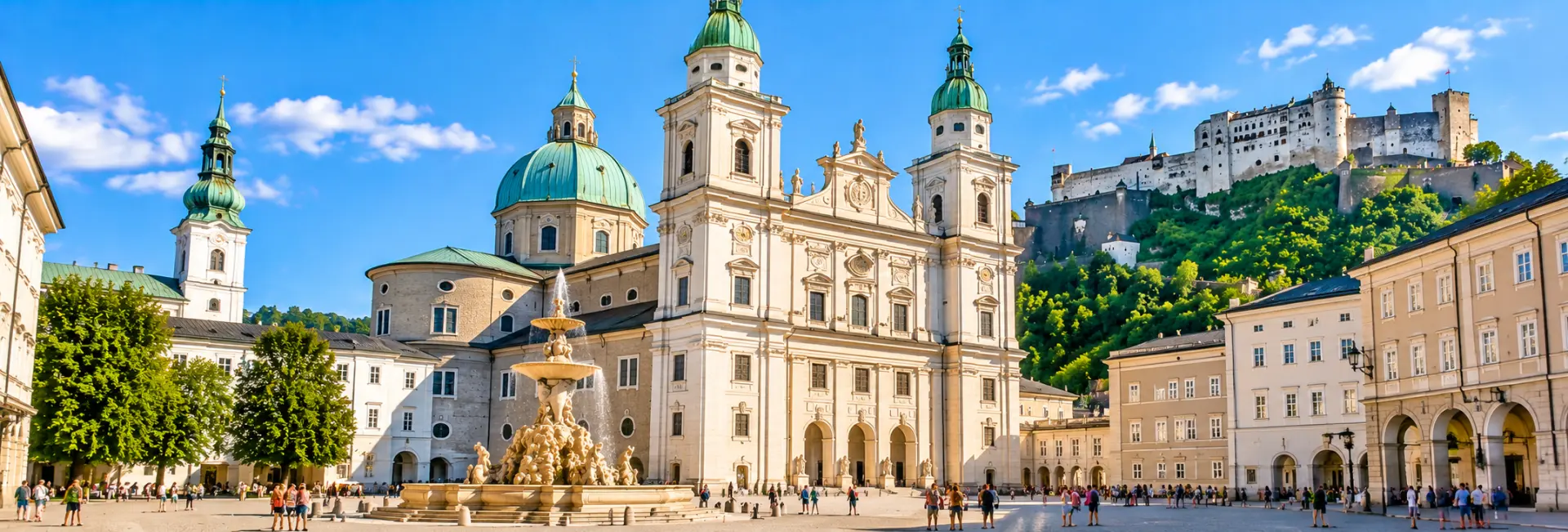
Salzburg Cathedral rises at the heart of the old town, its pale stone facade and twin towers closing off one end of the great square that bears its name. Dedicated to Saint Rupert and Saint Virgil, the two figures most closely linked with the founding of the city and its church, it is the seat of the Archdiocese of Salzburg and one of the most important religious buildings in Austria.
The cathedral is often described as the first major early Baroque church built north of the Alps, and its design influenced church building across the region. Inside, a bright, high nave, richly decorated ceilings and a collection of historic organs reward visitors who step in from the busy streets.
It is also a living place of worship, a concert venue and a backdrop for open-air theatre, so a visit can feel quite different depending on the day and the season.
History
The First Cathedral
The story begins in the eighth century, when Bishop Virgil built the first cathedral on the site of the earlier Roman settlement. It was consecrated in 774 and dedicated to Saint Rupert, the missionary bishop traditionally regarded as the city's founder.
Fire and Rebuilding
The medieval cathedral suffered repeated fires, including a major blaze in 1167 that devastated much of the city. Over the centuries it was rebuilt and enlarged, becoming one of the great churches of the German-speaking world.
The Baroque Vision
Around 1600, Prince-Archbishop Wolf Dietrich von Raitenau wanted to replace the old building with a monumental new cathedral and commissioned the Italian architect Vincenzo Scamozzi to draw up plans. His successor, Markus Sittikus, scaled the project down and appointed Santino Solari as master builder. The foundation stone was laid in 1614, and Prince-Archbishop Paris Lodron consecrated the new cathedral in September 1628, while war raged elsewhere in Europe.
The timing of the project is part of its story. Construction continued through the early years of the Thirty Years' War, yet Salzburg stayed largely out of the fighting under Lodron's careful rule, which allowed the cathedral and the squares around it to be completed in peace. The result was a confident statement of Church power, built in the new Italian style at a moment when much of Europe was in turmoil.
Wartime Damage and Restoration
On 16 October 1944, during the first air raid on Salzburg, a bomb crashed through the dome and damaged part of the interior. The cathedral was carefully rebuilt and reopened in 1959. The three consecration dates, 774, 1628 and 1959, are recorded on the cathedral's gates.
Architecture and Design
The Facade
The front of the cathedral is a calm, symmetrical composition in light stone, flanked by two towers. A broad flight of steps rises from the square to three portals, and four large statues stand above them: the apostles Peter and Paul, shown with a key and a sword, and the patron saints Rupert and Virgil, one holding a salt barrel and the other a model of a church.
The Interior
Inside, the nave is tall and luminous, with a barrel-vaulted ceiling decorated by stucco work and painted scenes from the life and passion of Christ. The paintings were created by artists from the circle around Solari and are a major part of the church's visual impact. A crossing beneath the dome opens the space and draws the eye towards the high altar, which features a painting of the Resurrection.
Design Highlights
- A long nave with side chapels and a dramatic crossing under the dome
- Stucco and fresco decoration that blends Italian influence with local craft
- Portal doors and gates by modern artists, with the three consecration years marked on the gates
- Open arcades linking the cathedral to the neighbouring Residenz and abbey
The arcades, commissioned in the 1600s, frame the square and give it the feel of a grand outdoor room.
Rebuilt, Not Replaced
After the 1944 bombing, the rebuilding work aimed to restore the cathedral to its original shape rather than reinvent it. The dome was reconstructed and the damaged parts of the interior were repaired, so what you see today is a faithful version of the seventeenth-century design. Modern touches, such as the new gates and some contemporary art, sit alongside the older fabric without overwhelming it.
Cultural and Religious Significance
Mother Church of the Archdiocese
As the cathedral of Salzburg's archbishops, the building has been central to religious life for over a millennium. Feast days, processions and major services still revolve around it, and the annual celebration of Saint Rupert in September is one of the notable dates in the city's calendar.
Mozart and Music
The cathedral has deep ties to music. Wolfgang Amadeus Mozart was baptised here on 28 January 1756, the day after his birth, in a medieval bronze font that is still on view. As a young man he served as a court musician in Salzburg, and sacred works connected with the city's churches were performed within these walls. Joseph Mohr, who wrote the words of the carol Silent Night, was also baptised in the same font.
Theatre on Domplatz
Since 1920 the square in front of the cathedral has been the setting for the Salzburg Festival's annual production of Jedermann, a morality play. The cathedral facade serves as a natural stage backdrop, and the performances have made the square one of the most recognisable cultural venues in Europe.
Notable Features
The Baptismal Font
This medieval bronze font stands among the cathedral's most treasured objects, supported by lions and carrying a long history of use. Its association with Mozart draws many visitors, who come simply to stand beside it.
The Organs
The cathedral is renowned for its organs, which are positioned in several places around the church and can be used together for large-scale music. Mozart is known to have played in the building, and organ performances today give a sense of the sound world he would have known.
The Crypt and Relics
Beneath the church lies a crypt that holds the burial place of former bishops, and a chest with relics of Rupert and Virgil is preserved in the cathedral. Together they link the present building with the deep early history of the diocese.
Art and the Cathedral Museum
A museum connected to the cathedral displays treasures gathered over some thirteen centuries of church history, while contemporary art installations inside the church add a modern layer to the baroque setting.
A Suggested Route Inside
A simple way to take in the church is to enter beneath the facade statues, pause at the back of the nave to absorb the height and the painted ceiling, then walk slowly towards the crossing and the high altar. From there, look for the font, the side chapels and the organ galleries, and finish by stepping back outside to see how the facade and arcades frame the square. This sequence takes only a little time but shows how the exterior and interior were designed to work together.
The Bells
Several bells hang in the towers and can be heard across the old town on feast days and for special services.
Visiting Etiquette and Tips
- Remember that this is a working church. Speak quietly, dress modestly and avoid walking through during services unless a visitor path is open.
- Check the schedule for services, rehearsals and concerts, as access to parts of the church can be limited at those times.
- Entry to the main church is generally free, though guided tours, the museum and some special visits require a ticket or reservation.
- Photography is usually allowed for personal use, but flash and tripods may be restricted. Follow any signs and staff instructions.
- Try to attend a short organ concert if one is offered during your visit. These performances often take place at midday and give the building a voice.
- Allow thirty to sixty minutes for a basic visit, longer if you add the museum or a guided tour.
- Look up as well as around. Much of the best decoration is on the ceiling and above the arches.
- The main entrance involves steps, so check in advance for step-free options if you need them.
Best Time to Visit
Seasons
The cathedral is open throughout the year, and each season brings a different character. Summer is busy, with festival crowds and open-air theatre on the square outside. Autumn and spring tend to be calmer and offer comfortable weather for walking the old town. In the Advent season the surrounding squares host a Christmas market, which makes the area atmospheric but also crowded.
Time of Day
- Early morning is the quietest period and good for photographs of the facade without crowds
- Midday often has organ music and a lively crowd in the square
- Late afternoon light warms the stone and gives a golden glow to the towers
Opening times change around services and events, so confirm the current schedule before you plan your visit.
Nearby Attractions
The cathedral stands beside Residenzplatz, where the archbishops' palace and a monumental fountain complete one of the grandest squares in the city. The Residenz and its museum are a short walk away, and the neighbouring St. Peter's Abbey offers a quieter retreat with a historic church and a famous cemetery set against the cliff.
Mozart's Birthplace on Getreidegasse is only a few minutes' walk through the old town lanes, and Hohensalzburg Fortress looms above, reachable by funicular or on foot. Across the river, Mirabell Palace and its gardens offer another classic Salzburg stop.
A good plan is to start the day at the cathedral, follow the old town streets to Mozart's house, and finish with a climb or ride up to the fortress for views over the rooftops and towers.
FAQs about visiting Salzburg Cathedral
Is Salzburg Cathedral free to enter? +
Entry to the main church is generally free, although guided tours, the cathedral museum and some special events may require a ticket. Check the official site for current details.
How old is Salzburg Cathedral? +
The first cathedral on the site was consecrated in 774, but the present building dates from the early seventeenth century and was consecrated in 1628. It was rebuilt after wartime bomb damage and reopened in 1959.
Why is the cathedral famous for Mozart? +
Mozart was baptised here on 28 January 1756, in the bronze font that still stands in the church. He later worked as a musician in Salzburg, and music connected with the cathedral was part of his working life.
How long should I spend there? +
Plan on 30 to 60 minutes for a standard visit. Add extra time if you want to see the museum, join a tour or hear an organ concert.
Can I attend a concert or service? +
Yes. The cathedral hosts regular services and offers organ music at certain times. Visitors are welcome to attend as long as they respect the setting, and the schedule is published by the cathedral.
Is the cathedral accessible for visitors with limited mobility? +
The entrance involves steps from the square, and some areas such as the crypt may be harder to reach. It is best to contact the cathedral beforehand to ask about step-free access.
What is the best time of day to visit? +
Early morning is usually the calmest, while midday can be busy but may include music. Late afternoon light is lovely for photographs of the facade.
What can I see nearby? +
The Residenz, St. Peter's Abbey, Mozart's Birthplace and Hohensalzburg Fortress are all within a short walk, making the cathedral an easy starting point for a day in the old town.
