
Table of Contents
Overview
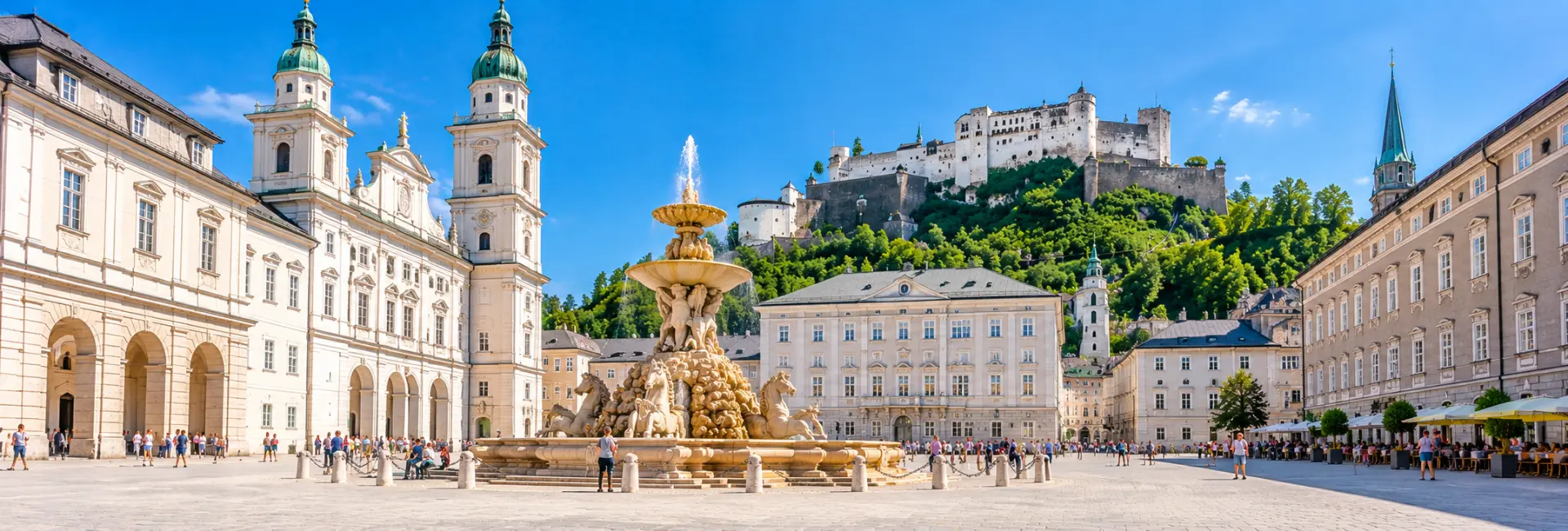
Residenzplatz is the great ceremonial square at the centre of Salzburg's Old Town, and it is the place where the city's baroque personality is easiest to feel. Wide, open and almost theatrical, it is bounded by the cathedral to the south, the former palace of the prince-archbishops to the west, the tall bell tower of the Neue Residenz to the east and a continuous row of townhouses to the north.
In the middle stands the Residenzbrunnen, a towering marble fountain with rearing horses, muscular giants and a water-spouting figure at its crown. Around it, horse-drawn carriages wait for passengers, street musicians perform and visitors stop to take in the full sweep of the architecture.
Few squares in Europe combine so many layers of Salzburg's story in one view. Church power, palace life, civic pride, music and seasonal festivity all play out on the same stones, which is why most walking tours of the city pass through here at least once.
History
A Medieval Neighbourhood Cleared for a Grand Plan
Before the square existed, this part of the city was a tight knot of medieval lanes, houses and a cemetery attached to an old monastery. In 1587, Prince-Archbishop Wolf Dietrich von Raitenau decided to replace them with broad, Italian-style open spaces. Around fifty-five buildings were demolished to make room, and the old cemetery was given up.
The layout followed Mannerist plans drawn up by the Italian architect Vincenzo Scamozzi, who was also involved in the rebuilding of the cathedral. Residenzplatz was the largest of five squares created under Wolf Dietrich, and it was originally known simply as the Hauptplatz, or main square.
Palaces of the Prince-Archbishops
The name comes from the Residenz, the palace where the rulers of the church state lived and received guests. A bishop's residence is first documented in this area around 1120, and the building grew grander with each generation of archbishops. Across the square, the Neue Residenz was begun in 1588 as a more private home for the ruler and later expanded into the large complex seen today.
When the prince-archbishopric came to an end in 1803, the Habsburgs took over the Residenz. In 1816, Emperor Franz I received the oath of allegiance of the Salzburg estates in its Knights' Hall, a moment that marked the region's integration into Austria. Emperor Franz Joseph later stayed here during visits and received Wilhelm I in 1865 and Napoleon III in 1867.
Recognition / Status
Residenzplatz lies at the core of the Historic Centre of the City of Salzburg, which was added to the UNESCO World Heritage List in December 1996. UNESCO described the Old Town as an outstanding example of a European church-ruled city-state that has kept its dramatic townscape and its large number of important ecclesiastical and secular buildings.
Few places illustrate that description better than this square. Church and palace stand side by side, and the whole space was shaped by archbishops who wanted their city to rival the grand piazzas of Italy.
The square is often described as the largest and most beautiful of the five squares laid out under Wolf Dietrich. Its fountain is widely regarded as one of the most significant baroque monuments in Europe and, according to several sources, the largest of its kind outside Italy.
The Residenzbrunnen
A Fountain Built to Impress
The Residenzbrunnen was commissioned by Prince-Archbishop Guidobald von Thun, a ruler known for his enthusiasm for fountains. The work is attributed to the Italian sculptor Tommaso di Garona, who built it between 1656 and 1661 using marble from the nearby Untersberg mountain. The aim was to show off the wealth and artistic ambition of the archbishopric.
What the Sculptures Show
- Four snorting horses appear to burst out of a rocky base at the lowest level.
- Giants rooted in the rock lift the large lower basin on their shoulders.
- Three dolphins balance the scalloped upper basin above them.
- A Triton at the very top blows a jet of water into the air through his conch-shell trumpet.
Water from the Mountain
The builders originally planned to feed the fountain with spring water from the Untersberg through the city's main canal. It was only in 1962 that the fountain was connected to the municipal water network, which still draws largely on Untersberg sources, just as the baroque designers had intended.
Fans of the film The Sound of Music will recognise the fountain from the carriage ride scene in which Maria and the children sing as they pass by.
Buildings Around the Square
- Salzburg Cathedral (south): The cathedral closes the square on one side, and its grand facade turns the whole space into a kind of outdoor stage. It is reached directly from Residenzplatz and its neighbour, Domplatz.
- Alte Residenz (west): The former palace of the prince-archbishops can be visited as part of the DomQuartier tour. Its state rooms and the Residenzgalerie, founded in 1955, display European paintings from the sixteenth to the nineteenth century. The palace has belonged to the Province of Salzburg since 1974, and it is still used for receptions and international conferences.
- Neue Residenz (east): This Renaissance-style building with a prominent bell tower houses the Salzburg Museum and the tower of the Glockenspiel.
- Townhouses (north): The row of burgher houses includes number 2, where the baroque painter Johann Michael Rottmayr stayed while creating ceiling frescoes in the Residenz around 1690. Its late Gothic window frames from about 1500 were only uncovered in 1930, and number 3 has a notable baroque doorway.
Inside the Residenz courtyard you will also find the Hercules Fountain, a smaller and quieter counterpart to the large fountain outside.
Events and Seasonal Life
The Christkindlmarkt
Every Advent, the square and the neighbouring Domplatz become the setting for the Salzburg Christkindlmarkt, one of the oldest Christmas markets in the German-speaking world. Its roots reach back to 1491, when it began as a market for second-hand goods, and the version known today has existed since 1974. Traditional wooden stalls, an illuminated "starry sky" overhead and the cathedral backdrop give it a distinctive look.
The programme includes choirs, traditional tower-brass performances and a nativity exhibition in the Residenz courtyard. Traditional Krampus and Perchten processions also take place in December.
The Glockenspiel
The carillon in the Neue Residenz tower rings out above the square every day at 7:00, 11:00 and 18:00. Its 35 bells came from Antwerp in the late seventeenth century, and the melodies, some of them arrangements of works by Mozart, drift across the whole Old Town.
Other Gatherings
Because it is so large and so central, the square is also used for open-air events during the year, including summer screenings of Salzburg Festival recordings, depending on the programme.
Ways to Experience It
- Walk around the fountain: Look closely at the horses and giants from different angles, and notice how the water reaches the Triton at the top.
- Listen for the bells: Time your visit for 11:00 or 18:00 and look up at the tower of the Neue Residenz.
- Tour the Residenz: Join the DomQuartier circuit to see the state rooms and the Residenzgalerie, which are linked with the cathedral and other museums on a single route.
- Enter the cathedral: The doors are a few steps from the fountain.
- Take a carriage ride: Horse-drawn Fiaker wait on the square and offer a relaxed introduction to the Old Town.
- Browse the Advent market: If you come in December, combine mulled wine and handmade gifts with the architecture.
- Join a walking tour: Many guided routes use the square as a meeting point because it is easy to find.
Best Time to Visit
The square is open to the sky and can be enjoyed at any time, but the character shifts through the day. Early morning offers calm and clear views of the facades, with few other people around. Midday brings crowds, carriages and the Glockenspiel, while late afternoon light warms the marble of the fountain and the cathedral front.
Seasonally, spring and autumn provide the most comfortable walking weather, with softer crowds than high summer. Summer is lively, with terrace seating, street performers and long daylight hours. Advent is the most atmospheric period, when the Christkindlmarkt fills the square with stalls, lights and music, although it is also the busiest time.
Winter outside the market season is quieter and often crisp, and a clear day with the fortress visible above the rooftops can be one of the most photogenic moments of the year.
Visitor Tips
- Entering the square is free, and the surface is open and level, which suits wheelchair users and families with strollers.
- The Old Town is largely pedestrian, so arrive on foot. From the main railway station the walk takes roughly 25 minutes.
- For a memorable photograph, step back from the fountain far enough to include the cathedral facade and the fortress above the rooftops.
- Expect heavy crowds in Advent, in summer midday and during the Salzburg Festival, so visit early or late if you prefer quiet.
- Palace visits and tower tours operate on their own timetables. Check the DomQuartier and Salzburg Museum websites for current hours, ticket prices and closures.
- If you plan to visit several museums, a Salzburg Card may offer savings.
- Market dates, opening hours and event programmes change from year to year, so confirm them on the official Christkindlmarkt site before planning around them.
- Keep an eye on your belongings in busy periods, as in any popular tourist area.
Nearby Attractions
The square sits at the heart of the Old Town, so many headline sights are only a few minutes away on foot.
- Salzburg Cathedral and Domplatz: Directly beside the square and part of the same ceremonial ensemble.
- Mozartplatz: A short step away through the opening beside the Neue Residenz, home to the Mozart monument and the Salzburg Museum.
- DomQuartier: A museum route connecting the Residenz, the cathedral and other historic spaces.
- Getreidegasse and Mozart's Birthplace: The famous shopping street and the house where the composer was born lie close by.
- Hohensalzburg Fortress: The hilltop castle above the roofs can be reached by funicular or on foot.
- Mönchsberg: The city mountain offers sweeping views and is reached by a short lift ride from the Old Town.
FAQs about visiting Residenzplatz
What is Residenzplatz known for? +
Residenzplatz is known for its huge baroque fountain, the Residenzbrunnen, and for the palaces and cathedral that surround it. It is one of the most important squares in Salzburg's UNESCO-listed Old Town.
Is Residenzplatz free to visit? +
Yes, the square is a public space with no entry fee. You only pay if you tour the Residenz through the DomQuartier, visit the Salzburg Museum or join a Glockenspiel tower tour.
When was the Residenzbrunnen built? +
The fountain was built between 1656 and 1661 on the order of Prince-Archbishop Guidobald von Thun. Its design is attributed to the Italian sculptor Tommaso di Garona.
How did Residenzplatz get its name? +
The square is named after the Residenz, the palace where Salzburg's prince-archbishops lived and entertained. Before that it was called the Hauptplatz, meaning main square.
When does the Christmas market take place at Residenzplatz? +
The Salzburg Christkindlmarkt is held on Residenzplatz and Domplatz during Advent, usually from late November until the start of January. Exact dates and hours change each year, so check the official market website.
How much time do I need at Residenzplatz? +
About 20 to 30 minutes is enough to see the fountain and the surrounding facades. Allow two hours or more if you want to tour the Residenz or visit the cathedral and museums nearby.
How do I get to Residenzplatz? +
It lies in the pedestrian centre of the Old Town, so the last part of any journey is on foot. From Salzburg's main station the walk takes around 25 minutes, and city buses stop near the edge of the historic centre.
Can I see the Sound of Music locations at Residenzplatz? +
Yes, the fountain appears in the film during the carriage ride in which Maria and the children sing as they pass.
