
Table of Contents
Overview
Mirabell Palace and its gardens form one of the most graceful corners of Salzburg. Set on the right bank of the Salzach River, just a few minutes' walk from the old town bridges, the complex combines a baroque palace with a formal garden laid out in clipped hedges, marble statues, flower beds and splashing fountains.
The palace began as a gift to a ruler's partner, grew into a showpiece of archbishop-era Salzburg, and today works as the seat of the city's mayor and administration. Visitors cannot wander through most of its offices, but they can climb its celebrated staircase, admire the Marble Hall when it is open, and stroll freely through the gardens, which cost nothing to enter.
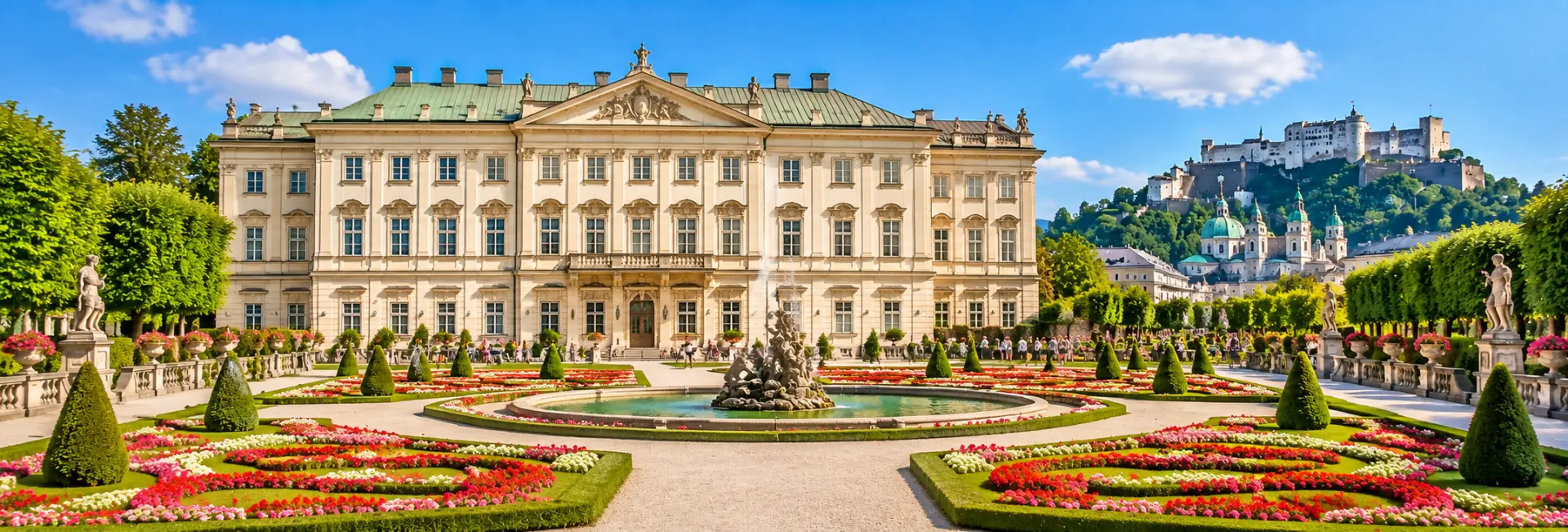
Few places in the city are so easy to enjoy. The gardens frame one of Salzburg's classic views, with the palace in the foreground and the fortress rising on its hill in the distance, which is why the spot is a favourite for photographers, couples and film fans alike.
History
A Palace Built for Love
In 1606, Prince-Archbishop Wolf Dietrich von Raitenau had a residence built outside the old town walls for Salome Alt, his partner, with whom he had fifteen children. He named it Altenau, and it was an unusual project for a churchman of his rank. His own downfall came soon afterward, when he lost power and was imprisoned at Hohensalzburg.
A New Name
His successor, Markus Sittikus, took over the building and sent the family away. He renamed it Mirabell, blending two Italian words meaning wonderful and beautiful, and the new title has stayed ever since.
Baroque Makeover
In the early eighteenth century the palace was reshaped by the architect Johann Lukas von Hildebrandt, who gave it the lavish baroque character it became known for. The sculptor Georg Raphael Donner created the famous staircase during this period.
Fire and Rebuilding
A major city fire in 1818 destroyed much of the palace, including a number of ceiling paintings. The staircase and the Marble Hall survived, while the rest was rebuilt in a simpler neoclassical style. The gardens were opened to the public in 1854, and they have remained a shared green space for residents and visitors ever since.
Architecture and the Angel Staircase
From outside, the palace looks calmer than its baroque origins might suggest. The post-fire reconstruction smoothed many of the decorative flourishes, leaving a balanced facade that sits comfortably behind the formal gardens. The real drama is inside.
The Angel Staircase
The grand staircase, often called the Angel Staircase, is the architectural star of the palace. Its marble steps and balustrade are crowded with cherubs and putti, and the whole composition curves upward in a way that feels more like a stage set than a stairway. It is free to see, and it is one of the best-loved interior spots in Salzburg.
What Makes It Special
- A sweeping marble design that survived the 1818 fire intact
- Playful sculpted figures that give the staircase its nickname
- A rare chance to see baroque craftsmanship in a working municipal building
Because the upper floors hold city offices, access is limited to the staircase, the chapel area and the Marble Hall, but these alone justify the visit.
The Marble Hall
The Marble Hall was once the banqueting and ballroom space of the prince-archbishops. Marble columns, rich stucco work and painted ceilings create an atmosphere of old-world splendour, and it is frequently described as one of the most beautiful wedding venues in the world.
Mozart Connections
The hall has musical history too. Leopold Mozart and his talented children, Wolfgang Amadeus and Maria Anna, known as Nannerl, are known to have performed in the palace during the eighteenth century, which gives the room a special resonance for classical music lovers.
Concerts and Ceremonies
Today the hall hosts civil weddings, official receptions and a regular programme of chamber concerts. Its acoustics are excellent, and the setting makes an evening performance a memorable experience.
Visiting access is restricted on certain days and during events, so it is wise to check the current schedule before you go. Weddings in particular can close the room to the public at short notice.
The Mirabell Gardens
The Grand Parterre
The oldest surviving part of the garden is the Grand Parterre, a formal layout of symmetrical flower beds edged in low hedges and framed by a marble balustrade. Sculptural groups drawn from classical mythology stand around its edges, and the whole design is arranged to look its best from the palace steps and from the avenue leading toward the old town.
The Pegasus Fountain
At the centre sits the Pegasus Fountain, topped by a copper winged horse made in 1661. The statue originally stood near the cathedral square before it was moved to the garden, where it became the centrepiece of the parterre.
The Dwarf Garden
One corner of the grounds is given over to a group of grotesque marble dwarfs, carved from stone quarried on the Untersberg and dating from the baroque period. It is among the oldest collections of its kind in Europe and delights visitors with its quirky character.
Hedge Theatre, Roses and Orangery
The garden also contains a hedge theatre, a trimmed green stage that dates back to the early eighteenth century, as well as a rose garden and an orangery. The tunnel-like tree walks and shaded avenues provide welcome relief on hot days.
Cultural Significance and Status
Mirabell sits inside the Historic Centre of the City of Salzburg, which is a UNESCO World Heritage Site, and it counts among the city's most visited attractions. Its mix of political, musical and horticultural history makes it a true cultural landmark, not just a pretty park.
The Sound of Music
For many travellers, the gardens are best known as a filming location for the 1965 musical The Sound of Music. In one of the film's best-known scenes, Maria and the von Trapp children dance around the Pegasus Fountain and through the garden's arches while singing the song Do-Re-Mi. Fans still arrive to recreate the moment, and the garden is a stop on most themed tours of the city.
A Living Civic Space
Unlike many palaces that have become pure museums, Mirabell is still part of daily city life. Officials work inside, couples marry in the Marble Hall, and locals walk their dogs and eat lunch on the garden benches.
Ways to Experience It
Wander the Gardens
The simplest option is also the best for many visitors: enter the gardens, follow the paths past the fountain, the dwarfs and the rose beds, and let yourself take in the views at your own pace. There is no entry fee, and no booking is required.
Climb the Staircase
Step inside the palace to see the Angel Staircase and, when it is open, the Marble Hall. Allow time to look at the carved details, which are easy to miss if you rush.
Attend a Concert
Chamber music performances take place in the Marble Hall, offering a refined evening activity in a setting associated with the Mozart family. Tickets are sold separately and are worth reserving in busy seasons.
Join a Themed Tour
Walking tours, bicycle tours and Sound of Music excursions often include a stop here, which can be useful if you want the film's backstory or a local guide's insight.
Best Time to Visit
Seasons
Late spring through early autumn is when the gardens look their finest, with beds in bloom, fountains running and the hedge theatre and dwarf garden open. Summer brings the largest crowds, while early autumn often offers warm days with softer light. In winter the gardens are quiet and frosty, though some features are closed and the flowerbeds are bare.
Time of Day
- Early morning is peaceful and ideal for photographs without crowds
- Late afternoon gives warm light on the palace facade
- Midday can be busy with tour groups, especially in summer
Garden and palace hours vary by season and by area, so confirm the current times before you visit.
Visitor Tips
- Plan about 30 to 40 minutes for a quick walk past the main features, and an hour or more if you want to explore the Dwarf Garden, rose beds and quieter corners.
- Check Marble Hall opening times in advance, as the room is closed during weddings and events.
- Arrive early in high season to enjoy the Pegasus Fountain without a crowd.
- Respect the flower beds and keep to the paths, since the gardens are carefully maintained.
- Bring a camera and look for the angle that places the fortress behind the palace and parterre.
- If you plan to attend a concert, book ahead and allow roughly two hours for the evening.
- The main paths are largely level and suitable for strollers and wheelchairs, although some gravel sections may be uneven.
Nearby Attractions
The palace is a short walk from the Mozart Residence on Makartplatz, where the family lived for several years, and from the Mozarteum, a music university and concert venue with deep roots in the city's musical tradition.
Cross the Salzach River by the nearby bridge and you reach the old town, with its narrow lanes, cathedral and Getreidegasse, as well as Mozart's Birthplace. The Kurgarten and the shopping streets of the new town are also within easy reach.
Many travellers combine the palace with a visit to Hohensalzburg Fortress, since the two sit on opposite sides of the river and the fortress is visible from the gardens. Together they make a good pairing for a full day of Salzburg sightseeing.
FAQs about visiting Mirabell Palace and Gardens
Is it free to visit Mirabell Gardens? +
Yes, the gardens are open to the public without an entry fee, and the Angel Staircase can also be seen for free. Concerts in the Marble Hall are ticketed separately.
What is Mirabell Palace famous for? +
It is known for its baroque Angel Staircase, the Marble Hall, the formal gardens with the Pegasus Fountain and the Dwarf Garden, and its role in the film The Sound of Music.
Can I go inside Mirabell Palace? +
Partly. The staircase and chapel area are open to visitors, and the Marble Hall is accessible at certain times, but most rooms are working city offices and are closed to the public.
How long should I spend there? +
A quick walk through the main garden takes about 30 to 40 minutes. Allow an hour or more if you want to see the Dwarf Garden, the rose beds and the palace interior.
When is the best time to visit? +
Late spring to early autumn is the most colourful, with fountains running and all garden features open. Early morning is the quietest time, while summer afternoons tend to be busy.
Is Mirabell suitable for children and wheelchair users? +
Yes, families generally enjoy the open space, fountains and the playful Dwarf Garden. Main paths are mostly flat, although gravel in places can slow down strollers and wheelchairs.
Where were the Sound of Music scenes filmed? +
The Do-Re-Mi scene was filmed around the Pegasus Fountain and in other parts of the Mirabell Gardens. Other locations in the film are spread around Salzburg, so many people join a themed tour to see them all.
What can I combine with a visit to Mirabell? +
It pairs naturally with the Mozart Residence, the Mozarteum, the old town across the river and Hohensalzburg Fortress, all within a short walk or ride.
