
Table of Contents
Overview
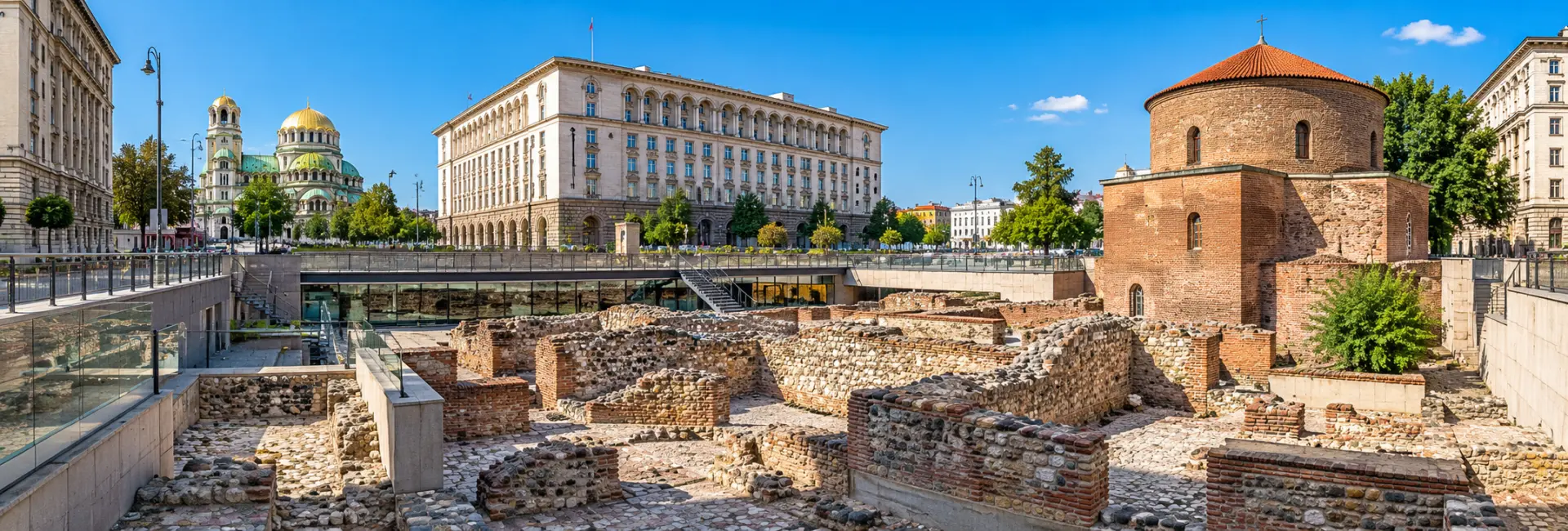
The Serdica Archaeological Complex is the place where modern Sofia opens a window onto its Roman past. Right in the city centre, around the Serdika and Serdika II metro stations and beneath Nezavisimost Square, the remains of a large district of ancient Serdica lie exposed: paved streets, courtyards, houses, baths and the curved apse of an early Christian church.
What makes the site special is how closely it sits to everyday life. Commuters step off the metro, climb through a foyer with ancient walls beneath glass, and emerge onto stone streets that were walked on more than fifteen hundred years ago. There is no separate museum district to travel to, so the ruins fit easily into any city stroll.
The complex is more than a single ruin. It combines open-air remains, displays inside the metro system and an underground exhibition space, so it rewards both a quick look and a slower visit. The sections below explain the history behind it, what you can actually see and how to plan your time.
History of Roman Serdica
From Thracian Settlement to Roman City
The city takes its name from the Serdi, a Thracian tribe that lived in this part of the Balkans. After a short period under Macedonian influence in the fourth century BC, the area came under Roman control in the late first century BC. The settlement was reorganised as a Roman town and became an administrative centre in the province of Thrace.
A City That Flourished
Under Emperor Trajan, Serdica gained a high civic status and was officially praised as the most brilliant city of the Serdi. Over the following centuries it grew into one of the important cities of the Balkans, with a street grid, public baths, large townhouses and defensive walls with monumental gates. Constantine the Great is traditionally said to have regarded the city as his own Rome, a reputation that reflects how significant it had become in the fourth century.
The Christian Era and the Decline
As Christianity spread through the empire, churches began to appear within the city. One of them, a basilica built toward the end of the fourth century, is among the highlights visible today. In the middle of the fifth century the city suffered heavily during the Hun invasions, and many buildings were destroyed by fire. Life continued here in later periods, but the grand Roman city was never fully restored, and its streets gradually disappeared beneath newer layers of settlement.
Discovery and Excavation
Archaeologists knew that Roman remains lay under central Sofia, and parts of the ancient walls and an eastern gate had been exposed earlier. The real scale of the buried city only became clear when the metro was extended in the early 2010s. Between 2010 and 2012, construction of the second metro line led to large-scale excavations around what is now Serdika II station.
The work was carried out by two teams of specialists, one from the National Archaeological Institute with Museum of the Bulgarian Academy of Sciences and one from the Sofia History Museum. They uncovered an area covering the course of eight ancient streets, along with a Christian basilica, several large buildings with mosaic floors, courtyards, baths, public toilets and the water supply and sewage systems that served them.
Most of the visible remains date from the fourth to the sixth centuries AD, although in places they sit on top of older structures that go back as far as the first century. The preservation of some structures surprised even the experts, particularly wooden elements, which almost never last this long.
The site was developed as part of the wider Sofia Largo project and opened to the public as an in situ, open-air attraction in April 2016. The restoration methods used on the ruins prompted public discussion at the time, which is common with large archaeological presentations, and the complex has since become a regular part of Sofia sightseeing.
What You Can See
Roman Streets and Drainage
The most striking feature is the network of paved Roman streets, with raised pavements, steps into doorways and drains running underneath. Two principal axes organised the city, the cardo maximus running north to south and the decumanus maximus running east to west, linking its main gates. Walking along their lines gives a clear sense of how orderly the ancient town was.
Houses, Baths and Mosaics
The excavated buildings include large residences arranged around courtyards, some with decorated mosaic floors. Bath complexes show how bathing was a central part of public life, and a reconstructed hypocaust, a system of channels under the floor that carried hot air to warm rooms, makes the engineering easy to understand. Even the public toilets and sewers are preserved well enough to explain how water was managed.
The Early Christian Basilica
The apse of the basilica, built around the end of the fourth century, curves through the northern ticketing area of the metro station. It was probably destroyed in the mid fifth century and does not appear to have been rebuilt, so what you see is a rare, undisturbed snapshot of early church architecture in the city.
Walls and Gates
Near Nezavisimost Square you can see the remains of the eastern gate of Serdica, part of the defensive circuit that dates from the later second century AD. The gate shows how the city defended itself and how people entered it from the east.
The Metro Station Exhibits
The metro stations themselves are part of the experience. On the platforms of Serdika II, glass cases take the place of advertisements and display objects from Sofia's long past, from Neolithic pottery to carved column capitals. Labels and maps appear in Bulgarian and English, and together the cases act as a compact introduction to the history of the city.
The ticketing foyers hold some of the most memorable details. In one place, glass panels in the floor let you look down on the remains of a first-century dwelling whose walls were made of oak and beech beams woven with vine twigs and then covered in clay. Elsewhere, the charred ends of wooden supports show where buildings burned when the city was attacked.
It is easy to underestimate this part of the site, because most people exit the station and head straight for the open-air ruins. Taking a few minutes to look at the foyer and platforms adds context that makes the streets above far more meaningful.
The Largo Zone and the Ancient Serdika Exhibition
The complex is described in two main zones. The Largo zone lies beneath Nezavisimost Square, where excavated remains are integrated into a space that can host cultural events and temporary exhibitions. Here you can follow parts of the main Roman streets and look at the layering of stone, brick and rubble that built up over the centuries.
The second zone, usually called Ancient Serdika, is an underground exhibition area beneath Maria Luiza Boulevard, next to the TsUM department store. It lets visitors look at deeper archaeological layers and displays finds from the city in a more traditional museum setting. The whole complex is managed by the Sofia Regional History Museum.
The surroundings add a striking contrast. The ruins are ringed by large 1950s socialist classical buildings, including the former Party House and the TsUM department store, so a few steps can take you from the Roman Empire to the mid-twentieth century.
Ways to Experience It
- Combine it with a metro ride: step off at Serdika II and let the platform displays and station foyers guide you into the site.
- Walk the open-air streets: follow the Roman street lines above and below ground level, using the information panels in Bulgarian and English.
- Visit the Ancient Serdika exhibition: go underground beneath Maria Luiza Boulevard for the deeper layers and exhibited finds.
- Join a guided walk: several city tours include the complex and add the stories behind the gates, churches and streets.
- Build a Roman Sofia route: link the ruins with the eastern gate, the ancient rotunda church nearby and the city's history and archaeology museums.
A short visit can take half an hour, while a full tour that includes the exhibition and the surrounding sites easily fills a couple of hours.
Best Time to Visit
Because much of the experience takes place in or beside the metro, the site works well in any season. In winter and during wet weather, the covered parts and the underground exhibition make it a good choice when outdoor sightseeing is less pleasant. In late spring and early autumn, the open-air streets are at their best, with comfortable temperatures for walking around the ruins and nearby squares.
Time of Day
Early morning is the calmest period and makes it easier to photograph the streets without crowds. Commuter hours around the metro stations are busy, so if you want a quiet look at the foyer exhibits, aim for mid-morning or mid-afternoon on a weekday. Evenings can be atmospheric in the Largo area, especially when events are held there.
Visitor Tips
- Check access details: opening hours and ticket rules for the Ancient Serdika exhibition can differ from the open-air Largo area and may change, so confirm them with the Sofia Regional History Museum before you go.
- Read the panels: the information boards in English and Bulgarian explain features that are easy to overlook, such as drains, doorway steps and wall construction.
- Look down: some of the most interesting remains sit under glass panels in the floor of the station foyers.
- Wear comfortable shoes: stone surfaces and stairs can be uneven or slippery when wet.
- Do not touch the remains: stay on the marked routes so the ancient structures are preserved for others.
- Do not confuse the metro stations: Serdika and Serdika II are separate stops, and the Roman remains are concentrated around Serdika II, close to Nezavisimost Square.
- Do not confuse it with the shopping centre: the Serdika Center mall is a separate place, some distance from the historic centre.
Nearby Attractions
The complex sits at the centre of Sofia's historic core, so many other attractions are within a few minutes' walk.
- Church of St George Rotunda: a fourth-century church tucked into the courtyard behind the Presidency, regarded as Sofia's oldest surviving building.
- Sofia History Museum: housed in the former Mineral Baths building, it helps tie together the story of the city from antiquity to the present.
- National Archaeological Museum: set in a former mosque, it shows off Thracian treasures and other ancient finds.
- St Nedelya Church and Square: a lively civic space close by, at the start of Vitosha Boulevard.
- Vitosha Boulevard: Sofia's main pedestrian street for shopping, cafes and strolling, only a short walk to the south.
- Alexander Nevsky Cathedral: the city's best-known landmark, reachable on foot from the Largo area.
FAQs about visiting the Serdica Archaeological Complex
What is the Serdica Archaeological Complex? +
It is an archaeological site in the centre of Sofia that displays the remains of the Roman city of Serdica, including paved streets, houses, baths and an early Christian basilica, around the Serdika II metro station and Nezavisimost Square.
How were the ruins discovered? +
They were uncovered between 2010 and 2012 during construction work for the second metro line, when archaeologists found a large part of the ancient city beneath the modern streets.
Is the Serdica Archaeological Complex free to visit? +
The open-air Largo area has generally been accessible without a ticket, while the Ancient Serdika exhibition beneath Maria Luiza Boulevard may have an entry fee, so it is worth confirming current rules before you visit.
How do I get to the Serdica Archaeological Complex? +
The easiest route is the Sofia Metro to Serdika II station, where the ruins are built into and around the station. The site is also a short walk from Vitosha Boulevard and St Nedelya Square.
How much time should I allow? +
A quick look at the open-air streets and station foyers takes about half an hour, while a visit that includes the exhibition and nearby gates and churches can easily take two hours.
What are the main things to see? +
The highlights are the paved Roman streets, the mosaic-floored houses and baths, the apse of the early Christian basilica and the glass-cased displays on the metro platforms.
Is it suitable for children and people with limited mobility? +
Children usually enjoy walking on the ancient streets and looking at the displays, and the metro-based areas are easy to reach. Some surfaces and stairs can be uneven or slippery, so those with mobility needs may want to check the access routes ahead of time.
What else should I combine with the visit? +
Good pairings include the Church of St George Rotunda, the Sofia History Museum, the National Archaeological Museum and a stroll along Vitosha Boulevard.
