
Table of Contents
Overview
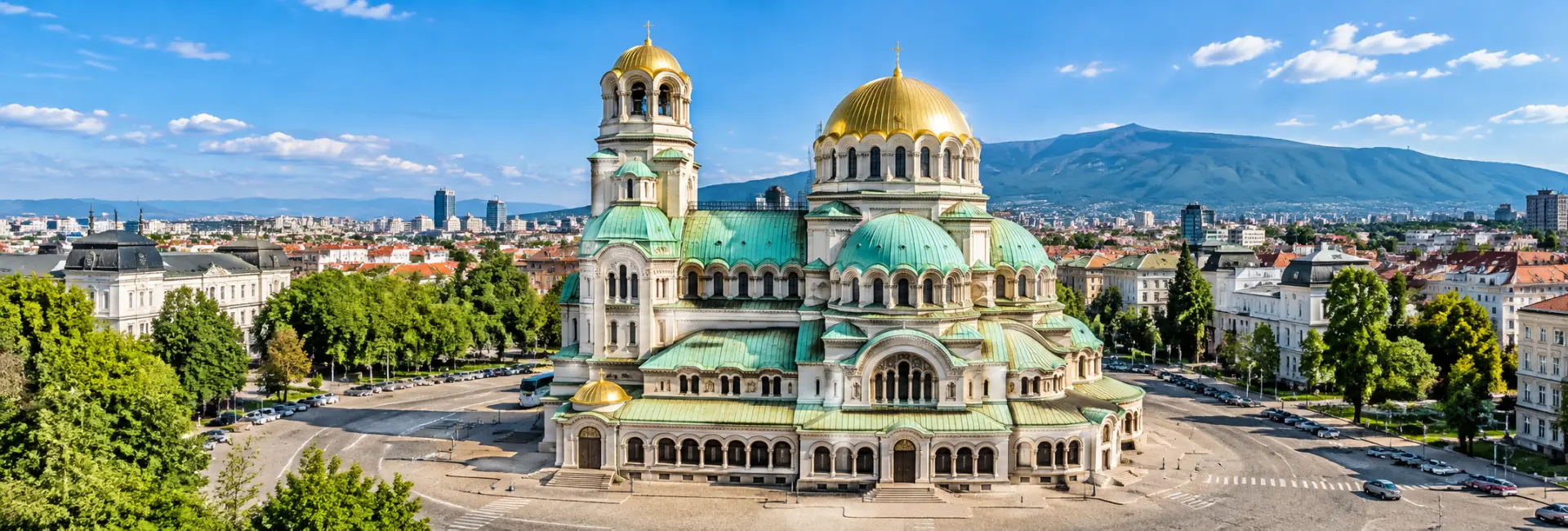
Alexander Nevsky Cathedral is the image most people picture when they think of Sofia. Its cluster of gilded domes and its tall bell tower rise above the surrounding streets, and on a clear day the glint of gold is visible from far across the city centre. It is the seat of the Bulgarian Patriarch and one of the largest Eastern Orthodox cathedrals anywhere in the world.
The building is more than a place of worship. It was conceived as a memorial, a stone expression of gratitude for the sacrifices that led to Bulgaria's freedom from Ottoman rule in 1878. That dual identity, part living church and part national monument, gives the cathedral a quiet gravity that sets it apart from ordinary sightseeing stops.
Visitors can step inside the main hall for free, admire a richly decorated Neo-Byzantine interior, and then descend to the crypt, where one of the most impressive collections of Orthodox icons in Europe is displayed. Whether you have thirty minutes or half a morning, the cathedral rewards the time you give it.
History
A Memorial Born from Liberation
The idea of a great monument church took shape soon after the Russo-Turkish War of 1877 to 1878, which ended centuries of Ottoman rule in Bulgaria. The Bulgarian politician Petko Karavelov is credited with proposing it as a tribute to the Russian soldiers who died in the conflict. The cathedral was dedicated to Saint Alexander Nevsky, the medieval Russian prince who was the patron saint of Tsar Alexander II, the ruler whose army brought liberation.
There was early debate over where it should stand. The old capital of Veliko Tarnovo was considered, but Prince Alexander of Battenberg argued for Sofia, the newly chosen capital. The foundation stone was laid in 1882, and funding came from the state budget alongside voluntary donations from ordinary Bulgarians and prominent citizens.
Decades of Delay and Design Changes
Building did not begin in earnest for more than twenty years. The first design, drawn up in the mid 1880s by the architect Ivan Bogomolov, was later set aside. The Russian architect Alexander Pomerantsev, a professor at the Academy of Arts in Saint Petersburg, reworked the plans extensively, assisted by Alexander Smirnov and Alexander Yakovlev. Most of the construction took place between 1904 and 1912.
Consecration
The cathedral was consecrated in September 1924 in a ceremony spread over three consecutive days, one for each of its three altars. Delegates from many European countries attended. The main altar honours Saint Alexander Nevsky, the northern altar is dedicated to Saints Cyril and Methodius, and the southern altar to Saint Boris. A hundred years later, in 2024, the centenary of the consecration was marked with a liturgy attended by Orthodox hierarchs from many countries.
Architecture & Design
Neo-Byzantine Form
The cathedral follows the plan of a cross-domed basilica, with a large central dome as its visual anchor. Pomerantsev drew on Byzantine tradition without copying any single model, producing a style typical of late nineteenth century Russian church architecture. Seen from outside, the stacked domes, arched openings and carefully balanced proportions give the building a calm, monumental presence.
Domes, Tower and Bells
The gold-plated central dome rises roughly 45 metres, while the bell tower stands more than 50 metres tall. The gold leaf on the domes was supplied by Russia in the twentieth century and has since been renewed, which is why the roofline still glows so brightly. High on the western face of the tower is a mosaic icon of Saint Alexander Nevsky by the Bulgarian painter Anton Mitov.
The tower holds twelve bells with a combined weight of about 23 tonnes. The heaviest weighs close to twelve tonnes, and the smallest only ten kilograms. On a calm day, the sound of the largest bell is said to carry as far as 30 kilometres.
Scale and Setting
The building covers more than 3,000 square metres and can accommodate thousands of worshippers. When it was built, it stood on the highest point of Sofia, about 552 metres above sea level. The city has since grown into the foothills of Vitosha mountain, but the cathedral still commands the heart of downtown.
Cultural & Religious Significance
For many Bulgarians, this is the country's most important church, a place where national memory and Orthodox faith meet. It serves as the cathedral of the Bulgarian Patriarch, so major church ceremonies, Easter and Christmas services, and state-linked religious occasions are held here. The square in front of it often becomes a gathering point during national holidays.
The dedication carries a shared story between Bulgaria and Russia. The saint it honours is venerated across the Orthodox world, and his name ties the building to the events of 1878. Over the decades, the relationship between the two countries has shifted, yet the cathedral continues to stand as a reminder of the people who fought and died so that Bulgaria could become independent.
- It is an active place of worship, with services held regularly throughout the week.
- It is regarded as a national symbol and appears on postcards, stamps and city emblems.
- It was designated a cultural monument in the twentieth century, reflecting its importance to Bulgarian heritage.
Locals light candles here for loved ones, and you will often see visitors doing the same. Observing this ritual quietly is part of the experience.
Inside the Cathedral
A Sense of Height and Light
The interior is arranged on a cross-shaped plan with five aisles, and the space feels taller than the building appears from outside. Light enters through stained glass windows and falls across the marble floors, which gives the main hall a warm, shifting glow, especially in the morning.
Materials and Craftsmanship
The decoration is built from costly and carefully chosen materials, including Italian marble in several colours, Brazilian onyx and alabaster. Artists and workshops from cities such as Munich, Berlin, Vienna and Venice contributed to the finishing work, and Bulgarian, Russian and Czech painters produced the murals and icons. Around the base of the main dome, a band of gold lettering carries the words of the Lord's Prayer.
What to Look For
- The marble iconostasis, the screen that separates the nave from the altar area.
- The royal throne and the patriarchal throne, both placed on raised platforms with decorative marble work.
- The ornate pulpit, carved in fine stone.
- The large murals, including the scene of the Last Judgement above the exit and a depiction of God in the central dome.
- The three side altars, each with its own set of icons and decoration.
The Crypt Icon Museum
Beneath the main floor lies the Museum of Christian Art, which opened in 1965 as a branch of the National Gallery. The crypt was originally planned to hold tombs, although no burials ever took place here. Instead, the vaulted rooms were converted into exhibition space for sacred art from across Bulgaria.
What the Collection Holds
The displays include icons, fragments of frescoes, manuscripts and church objects borrowed from museums and monasteries around the country. Among the pieces drawn from long-established religious centres such as Rila and Bachkovo are works that trace the development of Bulgarian icon painting across many centuries. One of the rarest items is an icon on wood dating to the end of the eleventh century, and the collection also includes painted ceramic icons from the early medieval capital of Preslav.
Why It Is Worth the Detour
Many visitors treat the crypt as an optional extra, but it offers a different, more intimate view of Bulgarian spiritual art than the grand upstairs hall. The rooms are quieter and cooler, and labels let you follow the evolution of styles from medieval times through to later centuries. A separate ticket is required, and the entrance is on the north-west side of the building.
Visiting Etiquette & Tips
The cathedral is a working church, so a few simple courtesies make the visit smoother for everyone. Entry to the main hall is free, while the crypt museum has its own modest admission fee. Opening hours, ticket prices and photography rules change from time to time, so check the official cathedral and National Gallery websites shortly before you go.
Dress and Behaviour
- Cover shoulders and knees as a sign of respect, and carry a light scarf if you are in summer clothing.
- Speak quietly and keep phones on silent, particularly near the altar area.
- Do not walk through the nave while a service is under way unless you are taking part.
Photography
Photography inside the main hall may require a small permit, which is usually sold at a desk near the entrance. Flash is generally discouraged because it disturbs worshippers and can damage painted surfaces. The exterior is free to photograph from the square at any time.
Practical Notes
- Allow about 45 minutes for the main hall and an additional 30 to 45 minutes for the crypt.
- The crypt lies below the main floor and involves stairs, so check access arrangements in advance if mobility is a concern.
- Guided visits are available through local tour operators if you want deeper context.
Best Time to Visit
Time of Day
Early morning is the most atmospheric time to go. The hall is calm, sunlight reaches the stained glass at a pleasing angle, and tour groups have not yet arrived. Late afternoon also works well, particularly in warmer months when the domes catch the low sun and glow a deep gold.
Season
Spring and early autumn offer comfortable temperatures for walking around the square and the surrounding area. Summer can be hot, although the stone interior stays pleasantly cool. In winter, the cathedral looks especially striking against a light dusting of snow, and the crowds are thinner.
Religious Holidays
Easter and Christmas bring the most moving services, with candlelit crowds and choral singing. They are also the busiest periods, and sightseeing is difficult while services are in progress. If you want to observe the traditions respectfully, arrive early and stay near the back. If you prefer to look around freely, choose a regular weekday instead.
Evening visits are worth adding to your plan for the exterior alone. The floodlit domes make the square one of the most photogenic spots in the capital after dark.
Nearby Attractions
The cathedral sits in a compact, walkable part of central Sofia, so it is easy to combine with several other stops in a single outing.
- Saint Sophia Church, the ancient basilica that gave the city its name, stands right beside the cathedral.
- The National Assembly building and the Monument to the Tsar Liberator are a short walk away along the main boulevard.
- Sofia University, with its neoclassical front, is a few minutes on foot, and the nearest metro stop takes its name from it.
- The National Gallery is housed in the former royal palace and pairs well with the crypt's focus on sacred art.
- The Saint George Rotunda, a small brick building from late antiquity, is tucked into a courtyard nearby.
- The Doctor's Garden and the open-air stalls near the cathedral square are good places to relax after sightseeing.
Together these sites make a pleasant half-day route that moves from medieval and Roman layers of the city into its modern civic centre.
FAQs about visiting Alexander Nevsky Cathedral
Is Alexander Nevsky Cathedral free to enter? +
Yes, the main hall is free to enter. Only the crypt icon museum charges an admission fee, and photography inside the hall may need a small permit.
What are the opening hours? +
The main cathedral is generally open every day from morning until early evening, while the crypt museum keeps shorter hours and closes its ticket office before the museum itself shuts. Hours can change, so confirm them with the official sources before your visit.
How long should I plan to spend there? +
About 45 minutes is enough for the main hall, and you should add another half hour or more if you want to see the crypt museum properly.
Is there a dress code? +
There is no strict inspection, but visitors are expected to dress modestly with covered shoulders and knees. Carrying a light scarf or wrap is an easy way to be prepared.
Can I take photos inside? +
Photos in the main hall are usually allowed with a paid permit and without flash. Rules in the crypt can differ, so check the signs or ask staff at the entrance.
How do I get to the cathedral? +
It is in the very centre of Sofia and easy to reach on foot from most central hotels. The closest metro stop is Sofia University, and several tram, trolleybus and bus lines also serve the area.
Why is the cathedral so important to Bulgarians? +
It was built as a memorial to the soldiers who died in the war that freed Bulgaria from Ottoman rule, and it is now the seat of the Bulgarian Patriarch. For many people it stands for both national independence and Orthodox faith.
Is the crypt museum worth visiting? +
Yes, if you have the time. It shows Bulgarian icon painting across many centuries, from rare medieval pieces to later works, in a quieter setting than the main hall.
