
Table of Contents
Overview
The Banya Bashi Mosque is a quiet but striking reminder of Sofia's Ottoman centuries. Its single large dome and slim minaret rise beside a busy boulevard in the middle of the city, and today it is the only mosque in Sofia that is still used for regular worship. For visitors, it is one of the clearest places to see how the city's layers of history sit side by side.
The mosque stands on a spot where hot mineral water has bubbled up for centuries, and its name, which points to baths, reflects that setting. Steam can sometimes be seen rising from vents near its walls in cold weather. This mix of sacred architecture and natural springs gives the site an atmosphere you will not find elsewhere in the capital.
Because it is an active place of worship, the visit is different from a museum stop. The best approach is a respectful one: admire the building and its surroundings, and enter only when it is open to visitors and following the guidance of the community. The sections below explain the history, the design and the practical points to keep in mind.
History
A Mosque from the Ottoman Period
Sofia became part of the Ottoman Empire in the late fourteenth century and remained under Ottoman rule for almost five hundred years. During that time, the city filled with mosques, baths and other buildings typical of Ottoman towns. Banya Bashi was one of them, built in the sixteenth century in the area around the hot springs.
The Springs and the Baths
The location was no accident. A hot spring has risen in this part of Sofia since Roman times, with water that emerges at roughly forty-six degrees Celsius, and a bath house stood nearby from at least the sixteenth century. The mosque took its name from that bathing tradition, which is why Banya Bashi is often translated as many baths. The old Ottoman bath has long since disappeared, but the tradition continued: the large Central Mineral Baths building next door was completed in 1913, and the springs still shape the character of the neighbourhood.
Founding and Date
The mosque is associated with Mullah Effendi Kada Seyfullah, who supported its construction, and it is sometimes known by his name. The number 974 above the entrance arch is read as the Islamic year 974, which corresponds to 1566 to 1567 in the Gregorian calendar. Most modern sources use 1566 as the completion date, although a few guides give 1576, so you may see both in print.
Attribution to Mimar Sinan
Many sources attribute the design to Mimar Sinan, the great chief architect of the Ottoman court, whose best-known works include major mosques in Istanbul and Edirne. The link to Sinan is part of the mosque's reputation, and it is commonly repeated in guidebooks and official city descriptions.
Survival and Renovation
Sofia had dozens of mosques at the end of Ottoman rule in 1878, and Banya Bashi is the only one that remains in regular use, which makes its survival especially notable. The building has been restored several times, with the last major renovation recorded in the 1920s. It remains in use by the city's Muslim community today.
Architecture & Design
Plan and Materials
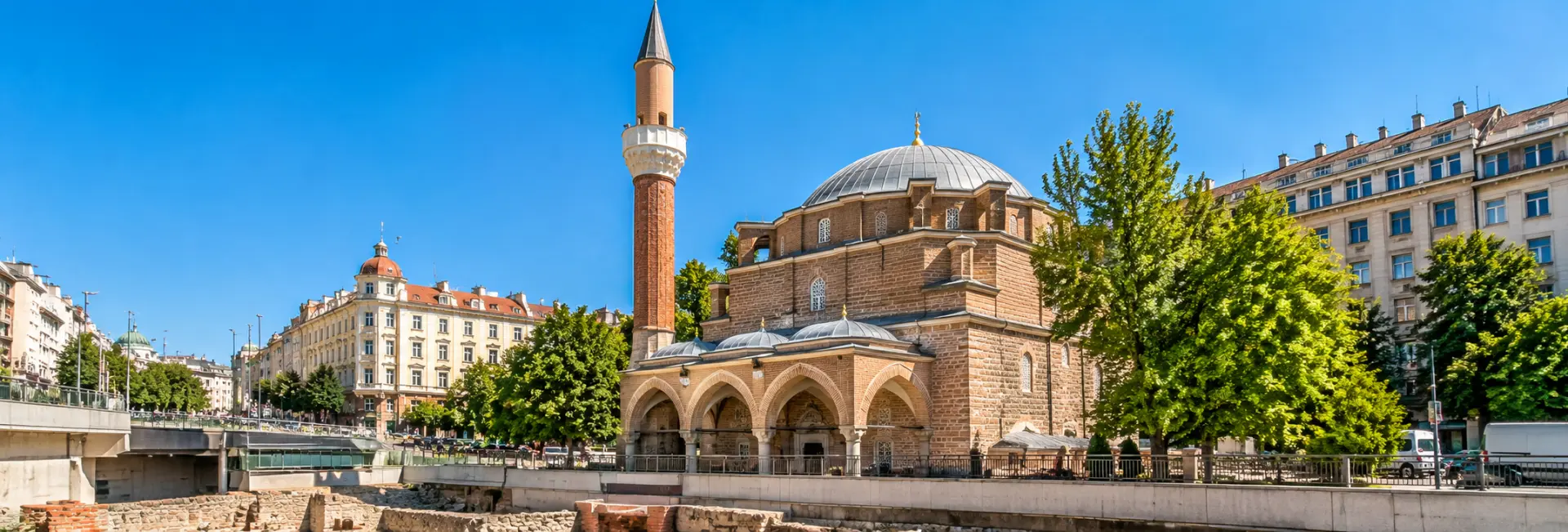
The mosque has a square prayer hall topped by one central dome, a form that is rare in Bulgaria and shows classic Ottoman planning. The walls combine carved stone and brick, and the prayer hall and its arches are described as stone throughout. The lead-covered dome has an interior diameter of about fifteen metres and dominates the building from the street.
The Minaret
A tall, slender minaret of red brick stands at the western corner of the building and works as a handy landmark for finding the mosque from nearby streets. The building does not sit parallel to the boulevard; its corner faces the road, which gives it an angled, characterful profile.
The Porch
In front of the main hall is a covered porch topped with three small domes. It is said to have been built in memory of the founder's wife and gives the entrance a gentle, welcoming scale before you reach the larger dome behind.
Interior
Inside, the prayer hall is light and open. Columns are described as carved from single pieces of stone, and the interior is decorated with colourful ceramic tiles. The effect is calm and balanced, with the central dome drawing the eye upward.
Cultural & Religious Significance
Banya Bashi is a living part of Sofia's religious life. Regular worship takes place here, and the busiest time is Friday, when around five hundred people attend the main congregational prayer. On major festivals the congregation can swell to nearly a thousand, and on Fridays the surrounding streets can feel particularly lively as worshippers arrive and, at times, spill beyond the building.
The mosque is also a symbol of coexistence. It stands close to Sofia's synagogue, an Orthodox church and a Catholic cathedral, so within a few minutes' walk you can pass the main places of worship of several faiths. This grouping is often called the Square of Tolerance and is frequently pointed out on city tours as a sign of the city's pluralist character.
For many visitors, the mosque offers a chance to understand a period of Bulgarian history that is easy to overlook in a city better known for its Roman ruins, Orthodox churches and socialist-era architecture. It is a reminder that Sofia has been shaped by many cultures over many centuries.
Notable Features
- The hot spring setting: the mosque was built over natural thermal springs, and in cold weather you can sometimes see steam rising from vents near its walls.
- The central dome: a large lead-covered dome about fifteen metres wide is the mosque's defining feature.
- The brick minaret: a tall minaret that rises above the surrounding buildings and is visible from many parts of the area.
- The three-domed porch: a small covered entrance that adds charm and a human scale to the facade.
- The tiled interior: coloured ceramic decoration and carved stone columns give the prayer hall its quiet beauty.
- The nearby drinking fountains: public fountains beside the mosque are a local favourite and are linked to the area's mineral springs.
Take a moment to walk around the outside of the building as well as looking at the front. From different corners you can compare the heavy stone and brick walls, the rounded dome and the thin line of the minaret, and see how the mosque sits among the taller buildings of the modern boulevard.
Visiting Etiquette & Tips
Before You Go In
Because this is an active mosque, access for visitors depends on the prayer schedule. Visitors are generally welcome outside the times of prayer, but the mosque is not run as a regular tourist attraction, so there are no fixed visiting hours for sightseeing. Prayer times change through the year with the position of the sun, so check the current times or look for notices at the entrance.
Etiquette
- Dress modestly: cover shoulders and knees, and bring a scarf if you wish to cover your head, as is customary for visitors to mosques.
- Remove your shoes: be ready to take off your shoes before entering the prayer hall, following the signs or the guidance of the staff.
- Keep quiet: speak softly and avoid disturbing anyone who is praying.
- Be careful with photography: take photographs of the building rather than of people at prayer, and ask permission before photographing anyone.
- Avoid prayer times and Friday midday: this is when the mosque is busiest and visitors may not be able to go in.
- Follow instructions: if staff or volunteers ask you to adjust your behaviour or leave a particular area, do so politely.
If the interior is closed to visitors when you arrive, you can still enjoy the exterior, the courtyard and the surrounding streets without going inside.
Best Time to Visit
The mosque can be seen at any time of year, but conditions differ with the seasons. Mild days in spring and early autumn are the most comfortable for walking around the area. In winter, cold air can make the steam from the nearby springs more visible, which adds atmosphere, although it also makes the pavements cooler and damper.
Time of Day
Mid-morning is a good time to go, after the early rush and before the midday prayers. Late afternoon can be pleasant for photographing the exterior in softer light. Fridays around midday are the busiest period, so choose another day if you want a quiet visit.
Nearby Attractions
The mosque sits in the middle of the old centre, so several major sights are only a short walk away.
- Central Mineral Baths: a large early twentieth-century building next to the mosque, built as Sofia's public mineral baths and now home to the Sofia History Museum.
- Central Market Hall: a historic covered market across the boulevard, good for local food and a taste of everyday city life.
- Sofia Synagogue: one of the largest synagogues in Europe, a short walk away and part of the same cluster of places of worship.
- St Nedelya Church: a well-known Orthodox church close to the mosque and the start of Vitosha Boulevard.
- Serdica Archaeological Complex: Roman streets, houses and an early Christian basilica around the Serdika metro station.
- Vitosha Boulevard: Sofia's main pedestrian street for shopping, cafes and strolling.
FAQs about visiting the Banya Bashi Mosque
What is the Banya Bashi Mosque? +
It is a sixteenth-century Ottoman mosque in the centre of Sofia and the only mosque in the city that is still in regular use for worship. It is known for its large dome, its brick minaret and its location above natural hot springs.
Why is it called Banya Bashi? +
The name is usually translated as many baths, reflecting its closeness to the hot mineral springs and the bath houses that grew up around them. Another reading of the name is head of the baths.
When was the Banya Bashi Mosque built? +
Most sources give 1566, based on the date above the entrance arch, though some guides state 1576. The design is traditionally linked to the Ottoman architect Mimar Sinan.
Can tourists go inside the mosque? +
Visitors are generally welcome outside the times of prayer, as long as they dress modestly and behave respectfully. Because it is a working mosque and not a formal attraction, access can change, so check on arrival.
Is there an entrance fee? +
There is typically no ticket system, as it is a place of worship rather than a museum, but check on site in case any donation box or notice applies.
What should I wear? +
Choose modest clothing that covers your shoulders and knees, and carry a scarf if you wish to cover your head. You will usually be asked to remove your shoes before entering the prayer hall.
When is the best time to visit? +
Mid-morning on a weekday is usually the quietest option. Avoid Friday around midday, when the main congregational prayer takes place and the area is at its busiest.
What can I see nearby? +
The Central Mineral Baths, the Central Market Hall, the Sofia Synagogue, St Nedelya Church and the Serdica Archaeological Complex are all within a short walk.
