
Table of Contents
Overview
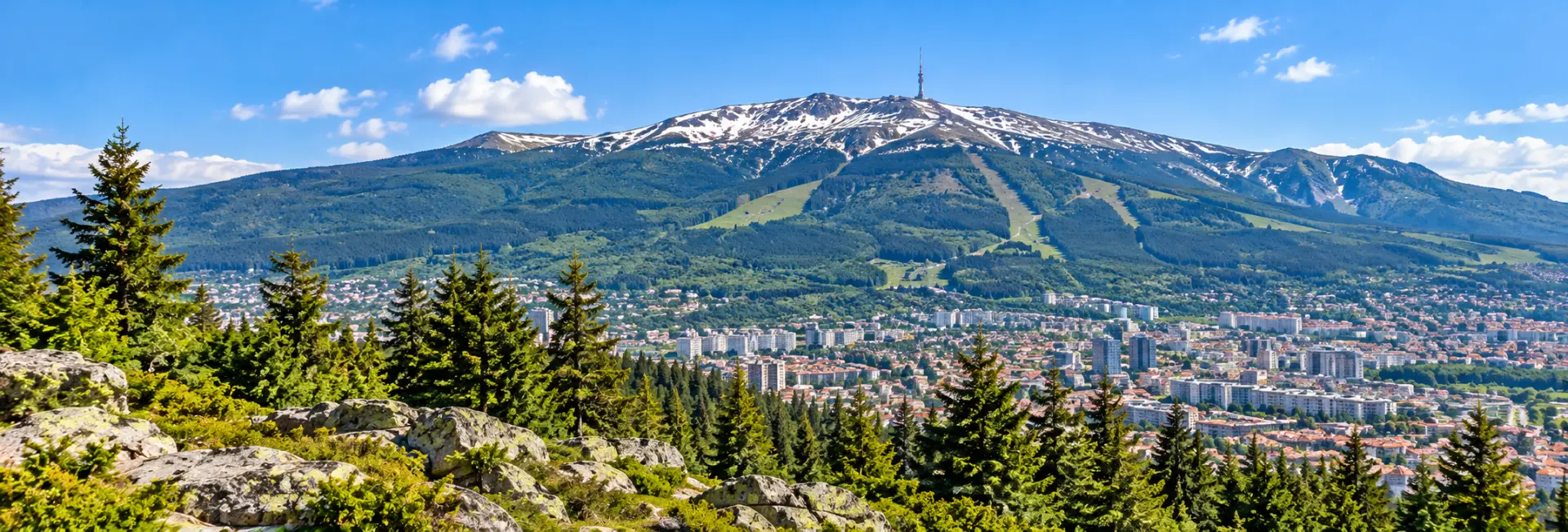
Vitosha is the mountain that Sofia lives beside. It rises directly south of the city as a broad, rounded dome, and on a clear day it fills the skyline from almost every district. Few European capitals have such a large stretch of genuine wilderness within reach of the centre, and locals treat it as a weekend garden, a training ground and a place to clear their heads.
The highest point, Cherni Vrah, reaches roughly 2,290 metres, while the city sits at about 550 metres. That difference of well over a kilometre gives the mountain a real alpine character, with open plateaus, grassy ridges, spruce forest, bogs and fields of giant boulders, all within a short ride of the streets below.
Most of the massif belongs to Vitosha Nature Park, which is widely described as the first protected park of its kind in the Balkans. Whether you want a gentle forest stroll, a summit hike, a day on skis or simply a view over Sofia, the mountain offers it without any need for a long journey.
Formation & Natural Features
A Mountain Shaped Like a Dome
Vitosha has the outline of an enormous dome, a form that geologists describe as laccolithic, meaning it grew from rock that pushed upward and lifted the layers above it. Its name is linked to the twin-ridge profile that stands out above the Sofia basin. Four main ridges spread out from the crown around Cherni Vrah, which gives the mountain a roughly star-shaped layout when seen on a map.
Stone Rivers
The most unusual feature is the stone river, a ribbon of huge boulders that seems to pour down the slope like frozen water. The best known example lies at Zlatnite Mostove, also called the Golden Bridges, above the Knyazhevo district. Walking beside it is a striking experience, and the sound of water running under the rocks adds to the effect.
Water, Caves and Springs
The Struma River begins on Vitosha, and many smaller streams run down the slopes toward Sofia. Boyana Waterfall is the highest on the mountain. Underground, the Duhlata cave system stretches for roughly 18 kilometres and is protected as a natural landmark. Mineral springs also surface around several villages at the foot of the mountain, including Knyazhevo.
Flora & Fauna
Plant Life
Forests cover more than half of the park, and colourful meadows and grassland make up about a quarter. Vitosha is small, yet it shelters close to half of Bulgaria's plant species, a result of its wide range of altitudes and climates. In late spring and early summer, meadows glow with yellow flowers, including the one locals call the Vitosha tulip and a yellow lily known as the elf tulip. Rare relics such as the yew tree also survive here.
Natural coniferous forest now remains mainly in the Bistrishko Branishte reserve and around the Golden Bridges, where tall spruce trees create deep shade. In autumn, hikers often find wild blueberries on the higher slopes.
Wildlife
The mountain is surprisingly rich in animal life for its size. More than 200 bird species have been recorded, along with some 500 kinds of butterfly and dozens of ant species. The park also supports 22 species of amphibians and reptiles.
Larger mammals are present too. Park staff estimate that a small number of brown bears roam the mountain, mostly in the quieter southern part that sees few visitors. Sightings are rare, and most hikers meet nothing more dramatic than birdsong and butterflies.
Protected Reserves
- Bistrishko Branishte, a reserve on the north-eastern slope with old spruce forest.
- Torfeno Branishte, a peat reserve of about 144 hectares that once supplied water to Sofia.
- Duhlata cave, recognised as a protected natural landmark.
History & Protected Status
The Birth of Mountain Tourism
For many years after Sofia became the capital, residents paid little attention to the mountain above them. That changed in 1895, when the writer Aleko Konstantinov persuaded a large group of enthusiasts to climb Cherni Vrah together. The outing is remembered as the start of organised tourism in Bulgaria, and his name is attached to the best-known hut and ski area on the slopes. A bust of him stands near the summit, and a mass climb is held each year in late August in his honour.
A Pioneering Park
In 1934, Vitosha was declared a national park at the initiative of nature-protection groups, making it the first of its kind in Bulgaria and the Balkans. At first it covered only the upper part of the mountain, but the boundaries were later widened to include nearly the whole massif. In 2000 it was re-categorised as a nature park, and today it covers roughly 270 square kilometres.
Why It Matters
Early park management included planting new forest on bare ground, building roads and marking tourist paths. Today forests again cover over half of the park, which is why the mountain looks so green.
Key Areas, Trails & Viewpoints
Aleko
Aleko, at about 1,810 metres, is the main gateway to the high mountain. A mountain hut built in the 1920s, a ski centre and several lifts are gathered here, and paths fan out toward Cherni Vrah, Zlatnite Mostove and the Bistrishko Branishte reserve. It is also a base for the mountain rescue service.
Cherni Vrah
The summit is a rounded, windswept crown with panoramic views across Sofia, the Balkan range and, on very clear days, the peaks of Rila in the distance. A weather station and a small tea house stand here, with food and drinks usually available at weekends and in high season. The route up from Aleko is not technically difficult, but it is long and exposed.
Zlatnite Mostove
This forested area on the northwest side of the mountain is built around the famous stone river. It is a popular, easy outing and a starting point for longer routes toward the Boyana Waterfall, Momina Skala hut and the summit. You can also walk up from the Boyana or Knyazhevo districts in around two hours.
Other Favourites
- The Herb Trail, which runs from the forest at Knyazhevo through Byalata Voda to Zlatnite Mostove, with wooden signposts carrying nature quotations.
- The path between Bistritsa and Zheleznitsa, lined with benches, stools and carved signs.
- Kopitoto, the ridge area known for its television tower and its view over the city.
Ways to Experience It
Hiking
Hiking is the classic way to enjoy Vitosha, with routes for every level. Families can choose short forest loops near Zlatnite Mostove, while stronger walkers can tackle the summit from Aleko, which takes a few hours each way depending on pace and route. Trails are marked with colour-coded signs, and maps are posted at major junctions.
Skiing and Winter Sport
The ski area around Aleko offers runs on the northern slopes and lighting for night skiing. The season usually runs from around January into spring, depending on snowfall. Ski touring and snowshoeing are also popular on the high plateau, though the weather can turn quickly.
Lifts and Views
A gondola from the Simeonovo district and chair lifts from Dragalevtsi can carry visitors up toward Aleko and beyond, which saves a long climb and gives views over Sofia on the way. Operating days and hours change with the season and with maintenance work, so check before planning your day around them.
Other Activities
- Mountain biking on forest roads and trails.
- Rock climbing and scrambling on the higher crags.
- Paragliding from suitable slopes in good weather.
- Caving for experienced groups with proper equipment.
Best Time to Visit
Spring
Spring brings melting snow, flowing streams and the first flowers on lower slopes. Higher paths may remain muddy or snow-covered into May, so choose forest routes early in the season.
Summer
Summer is the most reliable season for hiking the summit. Temperatures on the heights are noticeably cooler than in the city, which makes the mountain a favourite escape from the heat. Afternoon storms can appear suddenly, so set off early.
Autumn
Autumn is often the most beautiful time to visit. Forests turn gold and orange, crowds thin out and the air is crisp, and berries can be found on higher ground. Days are shorter, so plan your return before dusk.
Winter
Winter transforms the mountain into a snowy playground. Skiers and snowshoers head to the high plateau, while the lower forests are good for quiet snow walks. Conditions on the summit can be harsh, with strong wind and low visibility, so winter ascents need proper gear and experience.
Visitor Tips
Vitosha is easy to reach, which sometimes tempts visitors to underestimate it. Weather can deteriorate quickly at altitude, and the mountain rescue service is regularly called to help people who set out without suitable equipment. A little preparation makes the day safer and more enjoyable.
Getting There
- City buses connect the Vitosha metro area with Aleko, and other lines serve Zlatnite Mostove and the Boyana district. Routes and frequency vary by season and by weekday, so check current timetables.
- Taxis and ride services from central Sofia are quick and straightforward.
- If you drive, note that the parking area at Aleko often fills up on weekends.
What to Bring
- Sturdy walking shoes and layers, even in summer, since the summit is windy and cool.
- Water, snacks and a charged phone with an offline map.
- Sun protection in warm months and warm gloves and a hat outside them.
Rules and Respect
- Camping is not allowed inside the park.
- Entry to the Bistrishko Branishte reserve is allowed only along marked paths.
- Stay on trails, take rubbish home and avoid picking protected flowers.
Access to the park for hikers is generally free, but lift tickets and ski passes are charged separately, so confirm current prices before you go.
Nearby Attractions
Because Vitosha begins right at the edge of the city, it pairs naturally with several sights in the surrounding districts.
- Boyana Church, a UNESCO-listed medieval church with famous thirteenth century frescoes, sits at the foot of the mountain.
- The National Museum of History occupies the former Boyana Residence and is in the same district, so the two are easy to combine.
- Dragalevtsi Monastery, a small, quiet monastery near the lower station of the chair lift, makes a pleasant short stop.
- Knyazhevo, with its mineral springs and forest paths, is a handy starting point for the walk to Zlatnite Mostove.
- Central Sofia, including Alexander Nevsky Cathedral and the pedestrian streets of the old centre, is only a short ride away.
A popular combination is to visit Boyana Church in the morning, then follow the path past the waterfall toward the Golden Bridges for an afternoon in the forest.
FAQs about visiting Vitosha Mountain
How high is Vitosha, and what is its highest peak? +
The highest point is Cherni Vrah, at about 2,290 metres above sea level. It is one of several peaks above 2,000 metres on the massif.
Is it free to enter Vitosha Nature Park? +
Hiking and walking in the park are generally free. Lifts, ski passes and some services charge their own fees, so check current prices before you go.
How do I get to Vitosha from central Sofia? +
City buses, taxis and the metro-plus-bus combination all reach the mountain, usually in around 30 to 45 minutes. Aleko, Zlatnite Mostove and Boyana each have different connections, and timetables change with the season.
How long does it take to hike to Cherni Vrah? +
From Aleko, the walk to the summit usually takes a few hours each way, depending on your pace and route. Start early and allow time for rests and for the return.
Can I ski on Vitosha? +
Yes, the Aleko ski area has runs on the northern slopes and offers night skiing when conditions allow. The season generally runs from about January into spring, and lift operation can vary.
Are there bears or other dangerous animals? +
A small number of brown bears live on the mountain, mostly in the quiet southern area, but encounters are very rare. Keep to marked trails and avoid hiking alone at dusk.
Can I camp on Vitosha? +
No, camping is prohibited within the park. Mountain huts and hotels at Aleko and in nearby villages provide places to stay.
Is Vitosha suitable for families and beginners? +
Yes, if you choose the right route. Short forest paths near Zlatnite Mostove and the signposted trails near Knyazhevo are easy and scenic, while the summit is better saved for confident walkers.
