
Table of Contents
Overview
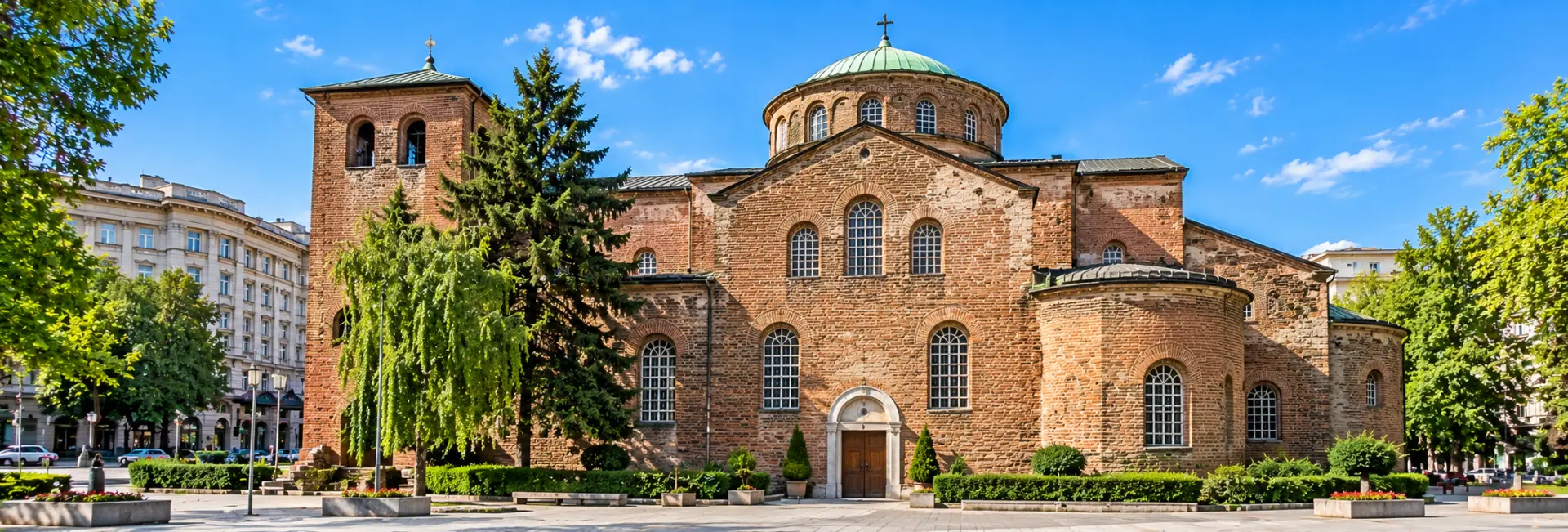
St. Sofia Church is one of the oldest and most meaningful buildings in Bulgaria's capital. Its plain red brick walls and simple, sturdy outline do not compete with the golden domes of its famous neighbour, Alexander Nevsky Cathedral, yet this church has a far deeper connection to the city. Sofia takes its name from it.
The present basilica dates back to the sixth century, and it stands on ground that has held places of worship for even longer. Beneath its floor lies an ancient burial ground from the Roman city of Serdica, now opened as an underground museum with tombs, mosaics and the remains of earlier churches.
A visit combines two experiences in one stop: a calm, atmospheric Orthodox church above ground and a journey back through many centuries below it. It is also an easy place to understand how Sofia grew from a Roman town into a modern capital.
History
A Sacred Site Since Roman Times
The church stands in the middle of what was once the eastern burial ground of Roman Serdica. From the fourth century onward, Christians built a succession of churches here, among the tombs of the early community. Several of these earlier buildings were destroyed during invasions by Goths, Huns and other groups, and each was replaced by a new one.
The Byzantine Basilica
The building seen today is believed to date from the reign of Emperor Justinian I in the sixth century. It was designed as a cross-shaped basilica with towers and a central cupola, a style that echoed the grand church of Hagia Sophia in Constantinople. The dedication to Holy Wisdom is the origin of its name.
Medieval Importance
During the Middle Ages, the church served as the seat of a metropolitan bishop, especially under the Second Bulgarian Empire. Its prestige grew so great that, in the fourteenth century, the city itself came to be known by the church's name.
Ottoman Mosque and Restoration
In the sixteenth century, the church was converted into a mosque. Minarets were added, and the earlier medieval frescoes were lost. The building was abandoned in the nineteenth century after earthquakes damaged one of the minarets. A major restoration took place between about 1926 and 1935, returning the building to its form as a Christian basilica.
Architecture & Design
A Cross Basilica in Brick
The church is a cross basilica, built mostly of brick, with a long nave and three altars. Its dimensions are about 47 metres in length and 20 metres in width, which makes it a substantial building without being overwhelming. The exterior is deliberately restrained. There are no gilded domes or lavish carvings, only arches, courses of brick and a solid, balanced shape.
Early Christian Character
The design belongs to the early Christian and Byzantine tradition, and it is regarded as one of the most valuable examples of that architecture in south-eastern Europe. Its simplicity helps you imagine how churches looked in the late Roman and Byzantine world, long before the elaborate styles of later centuries.
Layers Beneath and Around
The ground floor of the church rests on layers of older buildings. The restoration work, along with later archaeological excavation, revealed foundations of earlier churches and a dense cluster of tombs, which now form the basis of the underground museum.
Cultural & Religious Significance
The Church That Named a City
Few capitals are named after a church, and Sofia's story makes this site special. The name Sofia comes from the Greek word for wisdom, and the church dedicated to Holy Wisdom gave that name to the town. Before then, the settlement had been known as Serdica and later by other names, so the change marked a new chapter in the city's identity.
A Place of Memory
The grounds around the church hold several important memorials. Behind the building lies the grave of Ivan Vazov, the celebrated writer often called the patriarch of Bulgarian literature. His wish was to be buried where he could see Vitosha mountain, and his gravestone is a large boulder brought down from the Golden Bridges area of that very mountain. Beside the church burns the eternal flame of the Tomb of the Unknown Soldier, created in 1981 to honour the country's war dead.
Nearby Echoes of Freedom
The revolutionary Vasil Levski, a national hero, was executed by the Ottoman authorities not far from the church in 1873. This helps explain why the area around St. Sofia has long been a place where people gather to remember national history.
Inside the Church
A Calm, Simple Interior
Inside, the church feels peaceful rather than grand. The decoration is modest and suits the scale of the space, and the atmosphere is quiet, which makes it an appealing refuge from the busy streets outside.
Mosaics Underfoot
The floor is decorated with early Christian mosaics featuring floral and animal themes. These patterns echo the artistic taste of late antiquity and bring colour and detail to an otherwise plain interior.
Icons and Symbols
The icons include images of Saint George and Saint Vladimir, as well as the figure of Holy Wisdom shown in a distinctive way. Because Sophia means wisdom, the church uses an image of a youthful Christ seated on a rainbow, often called Christ Emmanuel, to represent that idea.
- Look down at the floor, where the early Christian mosaics are found.
- Notice the icons dedicated to Holy Wisdom, which carry the church's name in visual form.
- Find the three altars that give the interior its cross-shaped layout.
The Underground Necropolis Museum
A Museum Below the Floor
Under the church lies a museum that opened to the public in 2013 after careful excavation. Visitors descend through several levels, passing display panels that explain how the site changed from a Roman burial ground into a series of churches.
What You Can See
- About fifty tombs, some of which still show traces of painted decoration.
- Fragments of mosaic floors from earlier churches that once stood on the site.
- The remains of several earlier church buildings, showing how each new structure replaced the last.
- Burial structures that give a sense of how the people of Roman Serdica honoured their dead.
Practical Notes
The museum entrance is inside the church, and a separate small ticket is needed. Visitors often describe the necropolis as atmospheric rather than frightening, since the spaces are well lit and clearly explained. The underground section is not accessible to wheelchair users, although the church above has a ramp.
Best Time to Visit
Time of Day
Mornings and midweek visits tend to be the quietest, which is ideal if you want to stand alone in the nave or take your time in the necropolis. Late afternoon can be pleasant too, though opening hours are shorter in the cooler months, so do not leave it too late.
Season
Spring and early autumn are comfortable for combining the church with a stroll across the nearby square and gardens. Summer is warm, and the underground museum offers a cool break from the heat. In winter, the shorter days reduce your window for visiting, but crowds are thin and the area around the church is peaceful.
Religious Occasions
Because this is an active church, services take place on a regular schedule and on major feast days. Visiting during a service is a moving experience if you stay respectfully at the back, though sightseeing will be limited at those times.
Visitor Tips
The church is free to enter, while the underground museum charges a modest fee. Opening hours differ between the warmer and cooler months, and they can change on holidays, so check locally before you go.
Etiquette
- Dress modestly, with shoulders and knees covered.
- Keep your voice low and phones silent inside the church.
- Follow staff instructions about photography, especially in the museum and during services.
Practical Points
- Allow roughly 40 minutes to an hour and a half to see the church, the necropolis and the grounds.
- The museum is the highlight for many visitors, so do not skip it.
- The nearest metro stop is Sofia University, from which it is under ten minutes on foot.
Look Around the Grounds
Take a few minutes to walk behind the church to see Ivan Vazov's grave with its boulder from Vitosha, and to pause at the eternal flame beside the building. Both add context to the visit and take only a moment.
Nearby Attractions
The church sits in the heart of Sofia's main ceremonial square, so many top sights are only a short walk away.
- Alexander Nevsky Cathedral, with its gilded domes and crypt museum of icons, is right beside the church.
- The Tomb of the Unknown Soldier and its eternal flame stand directly next to St. Sofia.
- The National Assembly building and the Monument to the Tsar Liberator are a few minutes away along the boulevard.
- The Saint George Rotunda, the oldest preserved building in Sofia, lies about a kilometre to the west.
- Sofia University, with its classical front, is close to the metro stop used by most visitors.
- The open-air market near the cathedral square is a lively place to look for souvenirs and antiques.
A natural walking route links the church, the cathedral and the rotunda, passing from early Christian Sofia to the Roman remains in the city centre.
FAQs about visiting St. Sofia Church
Why is St. Sofia Church important? +
It is one of the oldest churches in Sofia and the building that gave the city its name. It also stands above an ancient Roman necropolis that is now an underground museum.
Is it free to enter? +
Entry to the church is free. The underground necropolis museum has a separate small admission fee.
How old is the church? +
The present basilica is generally dated to the sixth century, during the reign of Emperor Justinian I. Earlier churches stood on the same ground from the fourth century.
What can I see in the underground museum? +
You can see about fifty ancient tombs, fragments of mosaic floors, and the remains of earlier churches. Some tombs still show traces of painted decoration.
Is the underground museum accessible for wheelchair users? +
The church has a ramp, but the underground museum is not accessible for wheelchair users. It is worth checking with staff if you have mobility needs.
How long should I plan to spend there? +
Most visitors need around 40 minutes to an hour and a half to see the church, the museum and the grounds.
What else is there to see around the church? +
Ivan Vazov's grave and the Tomb of the Unknown Soldier are right beside it, and Alexander Nevsky Cathedral is only steps away.
Do I need to book tickets in advance? +
Individual visitors do not usually need to book in advance. Groups may need to arrange their visit, so check locally if you are travelling in a larger party.
