
Table of Contents
Overview
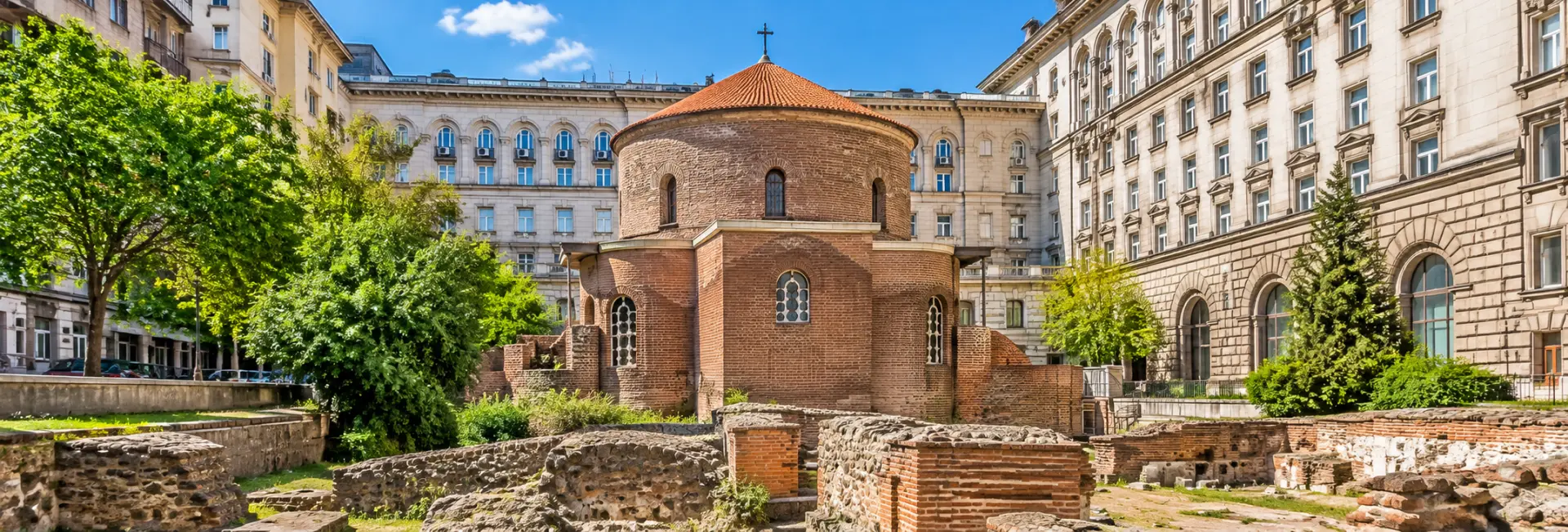
The Rotunda of Saint George is easy to miss, and that is part of its charm. Tucked into a courtyard between government buildings and a large hotel in the middle of Sofia, this small red-brick building is the oldest preserved structure in the city. It has stood here since the fourth century, long before Sofia took its name, back when the town was the Roman settlement of Serdica.
The rotunda has lived many lives. It has served as a Roman-era building, an early Christian church, a mosque under Ottoman rule, and a church again from the nineteenth century onward. Each chapter left something behind, and the layers of painting on its walls are among the finest records of that long story.
Today it is a working Orthodox church that also welcomes quiet visitors. Entry is free, the surroundings are filled with excavated Roman remains, and a short stop here gives a vivid sense of how deep the history beneath modern Sofia really goes.
History
Roman Serdica
The building dates to the early fourth century, a time when Serdica was an important Roman city. It is usually linked to the era of Emperor Constantine the Great, who spent time in the city, although some accounts attribute the start of construction to his predecessor Galerius, who issued an edict of religious toleration here in 311. What the structure was first used for is still debated. Some scholars see a bath or ceremonial hall, while others point to its position among public buildings as evidence of a religious role.
From Baptistery to Church
After Christianity was accepted in the empire, the rotunda is thought to have served as a baptistery, and baptisms continued here for centuries. It suffered damage in later turbulent periods and was rebuilt. Under Emperor Justinian in the sixth century, it was reshaped into a church. It was dedicated to Saint George, the martyr who was widely venerated across the Christian world.
The Ottoman Mosque
In the sixteenth century, during the reign of Sultan Selim I, the building was converted into a mosque known as the Gul Mosque. A minaret was added, and the Christian paintings inside were covered with Islamic decorative patterns. In the middle of the nineteenth century, it was abandoned as a mosque, and it soon returned to Christian use.
Rediscovery
In the twentieth century, restorers removed the later layers and uncovered the medieval paintings hidden beneath them, along with traces of even older decoration. This work transformed the rotunda from a quiet, overlooked chapel into one of the most important monuments in the city.
Architecture & Design
Form and Materials
The rotunda is a cylindrical, domed building set on a square base, with semicircular niches in its corners. It is built of red brick, a typical Roman material that also gives the structure its warm colour. The walls are exceptionally thick, which helped carry the weight of the dome and is a major reason the building has survived for so many centuries.
Scale
The interior is compact, with a diameter of roughly nine and a half metres and a height of around fourteen metres. It feels intimate rather than grand, and the dome seems to gather the space upward. The building sits a few metres below the level of today's streets, a reminder of how much the city has risen over the centuries as new layers of settlement piled up above the old ones.
A Setting Shaped by the Modern City
The courtyard around the rotunda was shaped in the twentieth century, when large government offices and a hotel were built nearby. The contrast between the ancient brick and the surrounding mid-century buildings is striking, and it makes the rotunda feel like a hidden pocket of the past.
The Frescoes
Five Layers of Painting
The interior preserves at least five partial layers of wall painting, each added as the building changed hands or purpose. Together, they trace a path from late antiquity to the later Middle Ages.
- The oldest layer shows floral motifs in a Roman-Byzantine style and dates to the fourth century.
- A second layer in a medieval Bulgarian style, with angels, belongs to the tenth century.
- A third layer from the eleventh and twelfth centuries includes a frieze of prophets and scenes such as the Ascension and the Assumption.
- A fourteenth century layer contains a donor portrait of a bishop, placed north of the entrance.
- The most recent layer is made of Islamic ornamental patterns from the Ottoman mosque period.
The Prophets in the Dome
The most famous painting crowns the dome, where twenty-two prophets, each more than two metres tall, look down on the room. Dating from the twelfth to the fourteenth centuries, they are admired for their grave expressions and for the confident, flowing lines of their robes. Standing beneath them and looking upward is the most memorable moment of a visit.
Why Layers Matter
Because the paintings were covered rather than destroyed, parts of every era survived. Patches where one layer has flaked away to reveal another let you see several centuries of history in a single glance.
The Serdica Ruins Around the Rotunda
The rotunda was never a lone monument. It was part of a larger complex of Roman buildings from the late third and early fourth centuries, and remains of that complex are still visible in the courtyard around it.
Behind the apse, archaeologists uncovered a section of Roman street with its drainage system, the foundations of a large basilica-like building, and smaller structures with underfloor heating channels. These excavations give a clear sense of the scale and sophistication of Roman Serdica.
It has even been suggested that some sessions of the Council of Serdica, held in 343, took place nearby, although this remains an assumption rather than a proven fact. The surrounding remains are outdoors, free to see and can be viewed at any hour, which makes them easy to combine with a visit to the rotunda itself.
Cultural & Religious Significance
For Sofia, the rotunda is a symbol of continuity. The city's name, its religious life and its architecture have all changed repeatedly over seventeen centuries, yet this small brick building has remained in place through every shift of power. Christians, Muslims and visitors of many backgrounds have all passed through its doors.
It belongs to the Bulgarian Orthodox Church and is used for regular services, so it is both a museum-like monument and a living place of prayer. The rotunda is dedicated to Saint George, one of the most widely honoured saints in the Orthodox tradition, and the name has carried through the changes of the centuries.
- It is regarded as the oldest preserved building in Sofia.
- It is a leading example of early Christian architecture in the Balkans.
- It is a rare place where Roman, Byzantine, medieval Bulgarian and Ottoman history can be read in a single room.
Ways to Experience It
A Short, Reflective Stop
The rotunda is small, so most visitors spend a modest amount of time inside, looking up at the dome and following the layers of paint along the walls. The experience is quiet and contemplative, and it works best when you slow down and let your eyes adjust to the dim light.
Add the Ruins
Walk around the exterior to see the Roman street and building foundations, which lie in the open courtyard. Reading the display boards, where available, helps you understand how the rotunda fitted into the wider ancient complex.
Join a Walking Tour
Many guided walks of central Sofia include the rotunda alongside nearby churches, the Serdica remains and the major landmarks. A guide can point out details in the frescoes that are easy to miss on your own, and can explain how the courtyard connects to the ancient streets beneath the city.
Attend a Service
If you are interested in the living tradition, regular services bring the space to life with candlelight and chanting. Visitors who attend should stand quietly at the back and follow the lead of the congregation.
Best Time to Visit
Time of Day
Morning and early afternoon are the most comfortable times for a quiet look inside, with daylight filtering into the courtyard and fewer groups passing through. The exterior ruins are accessible at any hour, and the courtyard can be atmospheric in the early evening when the brick glows in the low light.
Season
Spring and autumn are ideal, with mild weather for walking through central Sofia and exploring the outdoor remains. Summer can be warm, so a morning visit is more comfortable. In winter the courtyard is quiet, and a light dusting of snow gives the ruins a particularly atmospheric look.
Church Services
Because the rotunda is an active church, access for sightseeing may be limited during services. If you want to look closely at the frescoes, plan your visit outside service times, or arrive early and be prepared to wait if one is in progress.
Visitor Tips
The rotunda is free to visit and open to the public throughout the year, but its hours are shaped by the church and can change for religious holidays, so confirm details locally if you are planning a specific time slot.
Finding the Entrance
- The rotunda stands in the courtyard behind the Presidency building and beside the hotel complex on Knyaz Dondukov Boulevard.
- One way in is the passage between the Presidency and the neighbouring ministry building, which frames the rotunda at the far end.
- Another entrance leads in from Saborna Street.
Etiquette
- Dress modestly and keep your voice low.
- Switch off phones and avoid flash photography, which can harm old paintings.
- Do not walk through the church during services unless you are taking part.
Practical Notes
The courtyard is shared with government and hotel buildings, so follow any signs or staff instructions you meet on the way in. Allow a little extra time to find the entrance, since the rotunda is not visible from the main street.
Nearby Attractions
The rotunda sits in the very centre of Sofia, so it combines easily with other sights on foot.
- The Serdica archaeological complex and the Serdika metro station display more Roman streets and buildings just a few minutes away.
- Saint Nedelya Church, a landmark church on the main square, is close by.
- Saint Petka of the Saddlers, a small medieval church sunk below street level, is nearby on the same stretch of boulevard.
- Saint Sofia Church, the ancient basilica that gave the city its name, is a short walk away.
- Alexander Nevsky Cathedral, with its golden domes and crypt museum, is a pleasant walk from here.
- The National Archaeological Museum is housed in a former mosque and displays finds from across Bulgaria.
Together these stops form a compact route through Roman, medieval and modern Sofia.
FAQs about visiting the St George Rotunda
Why is the St George Rotunda important? +
It is the oldest preserved building in Sofia, dating to the fourth century, and it contains layers of frescoes from several different eras.
Is it free to visit? +
Yes, entry to the rotunda is free, and the surrounding archaeological remains can be viewed outdoors without a ticket.
Where exactly is it? +
It stands in a courtyard behind the Presidency and next to the hotel on Knyaz Dondukov Boulevard in central Sofia. You can reach it through the passage beside the Presidency or from Saborna Street.
Is it still an active church? +
Yes, it belongs to the Bulgarian Orthodox Church and holds regular services. Visitors should be respectful and expect limited access during worship.
What are the highlights inside? +
The main attractions are the twenty-two prophets painted in the dome and the visible layers of older frescoes on the walls. Look for the patches where different centuries of paint overlap.
Can I take photos? +
Photography rules can vary and may depend on church staff or services. Ask on arrival, avoid flash, and be discreet during prayers.
How long should I spend there? +
A short visit is enough for the interior, and you can add extra time to explore the Roman ruins in the courtyard.
What can I combine it with nearby? +
Good pairings include the Serdica archaeological complex, Saint Nedelya Church, Saint Sofia Church and Alexander Nevsky Cathedral, all within a short walk.
