
Table of Contents
Overview
Vitosha Boulevard, known to nearly everyone in Sofia as Vitoshka, is the capital's best-loved promenade and its most recognisable shopping street. It runs roughly 2.7 kilometres from St Nedelya Square in the north to the edge of South Park in the south, linking the historic core of the city with the wide open spaces around the National Palace of Culture.
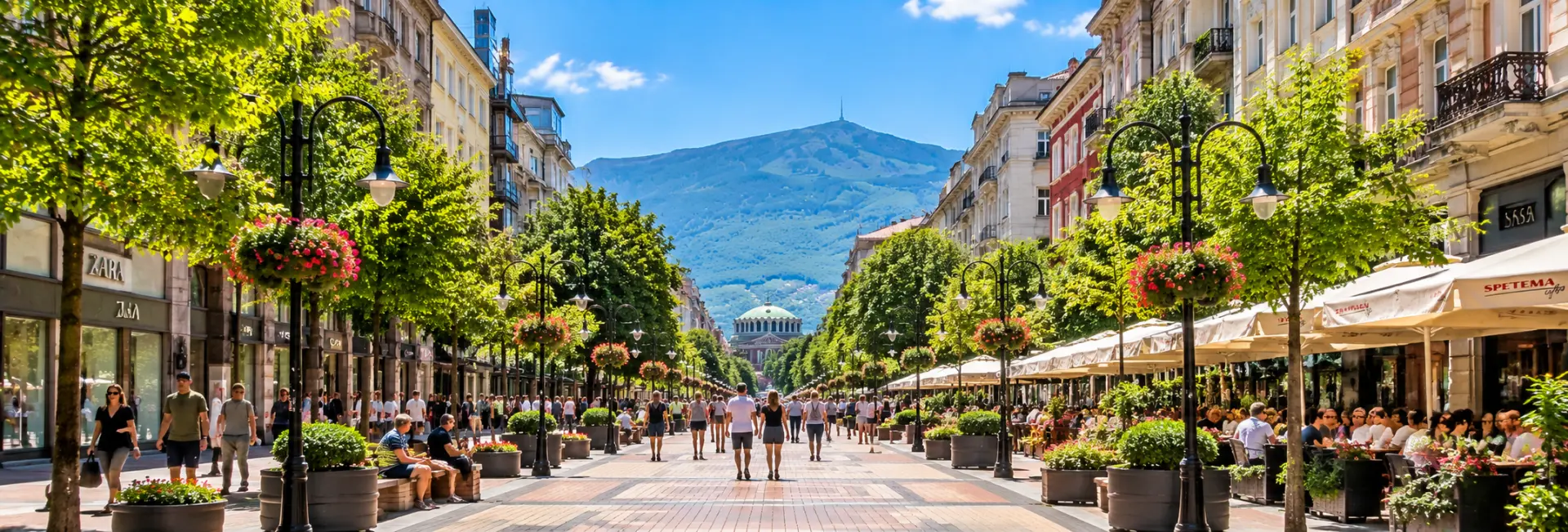
The boulevard is less a single sight than a living stage. Boutiques, cafe terraces, buskers and office workers on lunch breaks all share the same broad paving, while the outline of Vitosha Mountain fills the skyline at the southern end. Locals treat it as a meeting place, a shortcut and a place to be seen, and visitors tend to find themselves back on it more than once during a stay.
The central stretch between Alabin Street and Patriarch Evtimiy Boulevard is fully pedestrianised, which makes it the easiest part to enjoy on foot. The sections below cover its history, its buildings, the best ways to explore it and practical advice for planning a visit.
History
From Ottoman Lane to Named Street
Under Ottoman rule this was an unpaved track on the edge of a modest town, known by a name that already pointed toward Vitosha Mountain. After Bulgaria's liberation and Sofia's rise to national capital, the lane was formally named Vitoshka Street in 1883. It was first lined with low, one-storey houses, a far cry from the commercial avenue it would become.
The street has carried other names over the years, including General Gurko and Tsaritsa Yoanna during parts of the twentieth century, but the mountain-inspired name always returned in everyday speech.
The Interwar Transformation
The decisive change came between the world wars, when large public and commercial buildings began to replace the older houses. The Sofia Court House, built between 1929 and 1941 to a design by Pencho Koichev, anchors the northern end and is typical of the monumental style that reshaped the street. By this period Vitoshka had become the city's imposing trade street, and its character was set for decades.
Decline and Revival
For much of the twentieth century trams rattled along the boulevard, and a visit to the Central Department Store, known as TsUM, was an essential part of any shopping trip. When out-of-town shopping malls arrived, the street lost some of its pull, since parking in the centre was awkward and the pavements were tired.
New paving, planters and cafe terraces turned things around. As people returned in the evenings, shops followed, and the boulevard regained its place as the city's main social promenade.
The Modern Pedestrian Zone
In 2007 a renovation was announced that aimed to bring back the feel of 1930s Sofia, with period-style benches and street lamps, round Art Nouveau kiosks and more greenery. Reconstruction work began in March 2013, and a further renovation in summer 2015 completed the fully pedestrian section between Patriarch Evtimiy Boulevard and Alabin Street. The tram lines that once crossed this stretch were removed as part of the rebuild.
Architecture & Streetscape
Vitosha Boulevard is a street of layers rather than one unified style. Interwar public buildings with heavy stone facades stand beside older townhouses, mid-century blocks and modern retail fronts, so a single walk shows several chapters of Sofia's urban story. Ornate cornices and carved doorways reward anyone who looks above shop-window height.
The Yellow Brick Paving
Much of central Sofia is paved with yellow bricks, and the boulevard and the streets around it are part of that look. The warm colour has become a local symbol, and Sofia residents joke that being born on the yellow bricks simply means being born in the heart of the city. The bricks are hard-wearing but can turn slippery in rain and winter conditions, so good shoes matter.
Street Furniture and Greenery
The pedestrian zone is dotted with benches, planters, small fountains and kiosks that give the boulevard a leisurely, café-street feel. Because the road surface is shared by walkers and not cars, the whole width of the street becomes usable space for terraces, performers and seasonal decorations.
The Mountain Backdrop
Few European shopping streets have a mountain at the end of the view. On a clear day the slopes of Vitosha rise directly above the southern end of the boulevard, giving the street a natural focal point and a reason for the name that has endured since 1883.
Key Stretches of the Boulevard
The Northern End Near St Nedelya Square
The boulevard begins at the edge of St Nedelya Square, close to the Serdika metro stations. This is the oldest and most historic-feeling part, where the Court House with its pair of lion sculptures at the entrance stands near the start of the pedestrian zone. Many walking tours begin here, and the area is a natural starting point for exploring the old centre.
The Pedestrian Heart
The stretch between Alabin Street and Patriarch Evtimiy Boulevard is the busiest and most atmospheric section. Cafe terraces spill onto the paving, shop windows line both sides and street performers draw small crowds. The corner with Patriarch Evtimiy, nicknamed the Pharmacy after a long-standing shop there, is one of the city's best-known meeting points.
The Southern Section Toward NDK
South of the pedestrian zone the boulevard reopens to traffic and takes on a calmer, more residential feel. Higher-end fashion brands tend to cluster here and on nearby streets such as Saborna and Kaloyan. The section ends at the National Palace of Culture and the green spaces of South Park, which make a pleasant place to rest after a long walk.
Notable Landmarks
The boulevard itself is the main attraction, but several buildings and spots along it are worth a deliberate look:
- Sofia Court House (No. 2): a colonnaded interwar landmark completed in 1941, guarded by lion sculptures and often used as a meeting point for walking tours.
- TsUM, the Central Department Store: a historic retail address near the northern end, long tied to the shopping identity of the street.
- The Pharmacy corner: the junction with Patriarch Evtimiy Boulevard, a traditional place to say "meet you at the Pharmacy" when arranging to see friends.
- Peyo Yavorov's house: the home where the celebrated Bulgarian poet lived and died, a quiet reminder of the literary history behind the busy street.
- National Palace of Culture (NDK): the large congress and culture centre at the southern end, surrounded by a renovated plaza that locals love for walks and skateboarding.
- St Nedelya Church: the well-known church at the top of the boulevard, a short step from the start of the pedestrian zone.
Shopping, Cafes & Nightlife
Vitosha Boulevard has been Sofia's retail showcase for generations. Along the pedestrian stretch you will find international fashion chains, Bulgarian brands, bookshops, shoe stores and souvenir shops, while the pricier labels cluster along the non-pedestrian sections and the side streets. In a 2007 ranking by Cushman and Wakefield, the boulevard placed 22nd among the world's most expensive retail streets, a sign of how highly its prime addresses were valued.
Cafes and Restaurants
The street is as much about sitting as shopping. Terraces fill with people at almost every hour, and many restaurants here serve through the afternoon instead of closing between lunch and dinner, which suits travellers who do not follow local meal times. Expect everything from quick coffee stops and ice cream counters to full Bulgarian and international menus.
Evenings and Nightlife
After dark the boulevard becomes one of the focal points of the city's nightlife. Bars and lounges around the central stretch and in the lanes beside it stay lively into the night, and the lit-up street has a relaxed, festive mood on warm evenings and during the winter holiday season.
Ways to Experience It
The simplest way to enjoy Vitosha Boulevard is to walk it end to end, starting at the northern end and finishing at the National Palace of Culture and South Park. At an easy pace with a coffee stop, this takes between one and two hours, although it is easy to stretch into a half day.
- Join a walking tour: several free and paid city tours of Sofia begin at the Court House on the boulevard, which makes this a convenient first stop for learning the city's story.
- Go shopping: browse the main pedestrian stretch for everyday brands, then explore the side streets for smaller local shops.
- Linger on a terrace: people-watching from a cafe table is a favourite local pastime and the best way to feel the rhythm of the street.
- Photograph the mountain: the crossing near Patriarch Evtimiy Boulevard is a popular spot for pictures that include Vitosha rising above the street.
- Pair it with a larger walk: the boulevard links neatly with the historic core to the north and the parks and Palace of Culture to the south.
Best Time to Visit
Time of Day
Mornings are the quietest and offer the clearest mountain views, particularly on sunny days when the light catches the peaks. Late afternoon and early evening are the liveliest, with terraces full and the pavement crowded with strollers. If you prefer a calmer experience, visit on a weekday morning, and if you want the full social atmosphere, aim for a weekend evening.
Time of Year
Late spring and early autumn are especially pleasant, with mild weather for sitting outdoors and fewer extremes of heat or cold. Summer brings long evenings and busy terraces, while the winter holiday season adds decorative lighting that gives the boulevard a festive look. In cold or wet weather the yellow paving can be slippery, so allow extra time and wear shoes with good grip.
Visitor Tips
- Entry is free: it is an open public street, so there are no tickets and no fixed opening hours, although individual shops and restaurants keep their own schedules.
- Use the metro: Serdika serves the northern end and NDK serves the southern end, making it easy to walk the boulevard in one direction and ride back.
- Wear comfortable, grippy shoes: the yellow brick paving is attractive but can be slick when wet.
- Expect tourist-area pricing: terraces on the main pedestrian stretch can cost more than cafes on nearby side streets, so a short detour often saves money.
- Mind your belongings: like any busy shopping street, crowded moments call for ordinary city awareness with bags and phones.
- Plan for accessibility: the pedestrianised stretch is among the more wheelchair-friendly parts of central Sofia, although the older pavements can be uneven in places.
- Confirm details locally: shop hours, events and temporary works change from time to time, so check current information before you go.
Nearby Attractions
Vitosha Boulevard sits in the middle of Sofia's compact centre, so many of the city's highlights are a short walk away.
- St Nedelya Church and Square: at the northern end of the boulevard, a lively civic space with one of the city's best-known churches.
- Serdica archaeological remains: Roman-era ruins visible in and around the Serdika metro area, showing how deep Sofia's history goes.
- Alexander Nevsky Cathedral: Sofia's most famous landmark, reachable on foot in a pleasant stroll from the northern end.
- Pirotska Street: a long-established pedestrian street known for its market-style trade, a short walk from the top of the boulevard.
- South Park and the National Palace of Culture: green space and wide plazas at the southern end, ideal for relaxing after the walk.
FAQs about visiting Vitosha Boulevard
What is Vitosha Boulevard known for? +
Vitosha Boulevard, called Vitoshka by locals, is Sofia's main shopping and strolling street, famous for its cafes, boutiques, interwar architecture and the view of Vitosha Mountain at the southern end.
Is Vitosha Boulevard pedestrian-only? +
The central stretch between Alabin Street and Patriarch Evtimiy Boulevard is fully pedestrianised, while the northern and southern sections beyond it are open to some traffic.
How long is Vitosha Boulevard and how much time do I need? +
The boulevard is about 2.7 kilometres long, running from St Nedelya Square to South Park. A walk with a coffee break takes one to two hours, and shoppers or diners can easily spend half a day.
Is it free to visit Vitosha Boulevard? +
Yes, it is an open public street with no entrance fee, though anything you buy in the shops, cafes and restaurants is of course extra.
How do I get to Vitosha Boulevard? +
The easiest way is the Sofia Metro, getting off at Serdika for the northern end or NDK for the southern end. Many hotels in the centre are also within walking distance.
When is the best time to visit? +
Mornings are calmest and give the clearest mountain views, while late afternoons and evenings are the liveliest. Spring and early autumn have the most comfortable weather for outdoor seating.
Is Vitosha Boulevard suitable for families and wheelchair users? +
Yes, the pedestrian zone is traffic-free and generally easier to navigate than most of the centre, with wide paving and plenty of places to stop. Some older pavements can be uneven or slippery when wet, so take care.
What should I combine with a visit to the boulevard? +
St Nedelya Church, the Serdica ruins and Alexander Nevsky Cathedral are close to the northern end, while the National Palace of Culture and South Park lie at the southern end.
