Table of Contents
Overview
The Viktualienmarkt is Munich's everyday food market, a two-hectare square just a short walk from Marienplatz where locals have shopped for fresh produce, meat, fish, and flowers since the early nineteenth century. Unlike a weekly farmers' market that appears and disappears, it operates almost every day, with permanent stalls run by generations of the same families, some of which have held the same spot for decades.
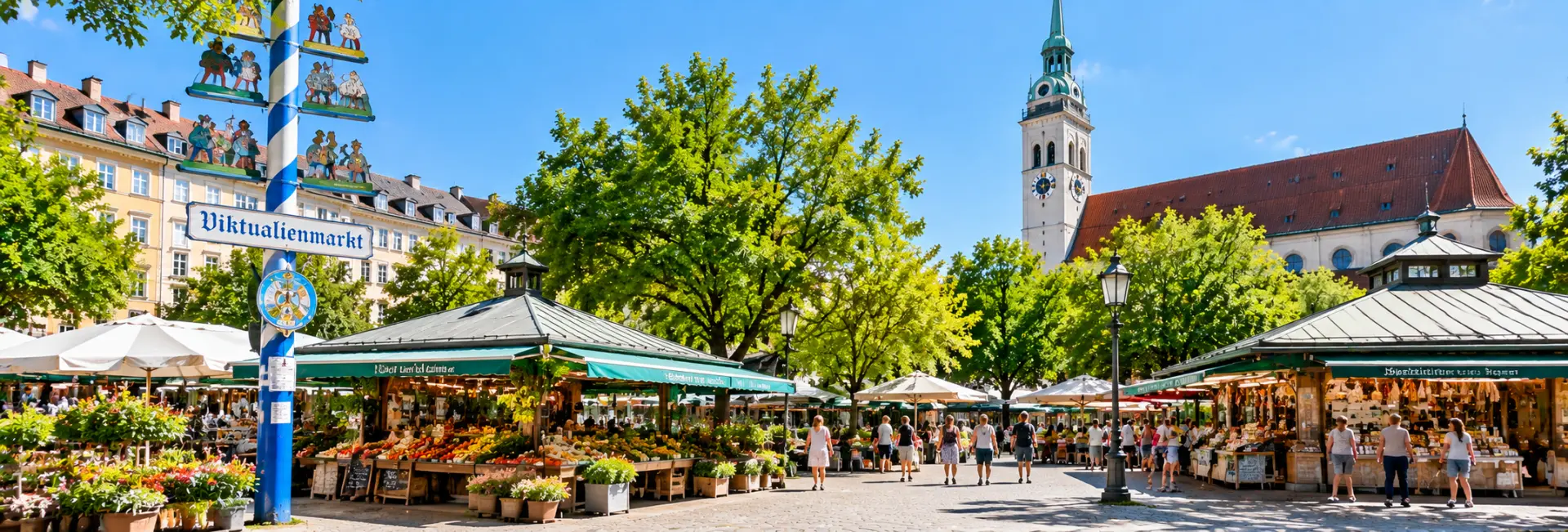
What draws visitors as much as residents is the atmosphere: a maypole painted in Bavarian blue and white rises above the stalls, a beer garden sits at the market's centre pouring beer from all six of Munich's major breweries, and small fountains dotted around the square commemorate local comedians and folk singers. It's a working market rather than a staged attraction, which is part of why it still feels genuinely Munich rather than built for tourists, even as it has become one of the city's most photographed spots.
History
From Marienplatz to a Market of Its Own
Munich's central food trade originally took place on what is now Marienplatz, then known as Schrannenplatz, where farmers and traders had long sold grain, produce, and other goods in the shadow of the city's town halls. But by the early 1800s the growing city had outgrown that space, and the daily crush of stalls and carts had become impractical for a square that was also meant to serve as Munich's civic centre. On 2 May 1807, King Maximilian I issued a decree moving the market a short distance southeast, to a site between the Heiliggeist-Kirche and Frauenstraße, where the buildings of a charitable hospice were demolished to make room. The new market was first called simply Marktplatz before the name Viktualienmarkt, from the Latin victus for food, took hold, reflecting a wider fashion at the time for giving everyday places Latinised names.
Steady Growth Through the Nineteenth Century
The market quickly needed more space. It was enlarged in the 1820s and continued growing through the rest of the century, with separate halls and pavilions added for fish, poultry and game, flowers, bakery goods, and eventually a tripe hall. In 1852 a large market hall called the Schrannenhalle was built at the market's southern edge for the grain trade; it later burned down in the early 1930s and stood unused for decades before being rebuilt and reopened in the mid-2000s. Permanent, fixed stalls only became the norm from 1870 onward; before that, vendors were assigned a new spot each day, since there were no refrigeration facilities and the market depended on daily deliveries. By 1890 the market had reached roughly the footprint it still occupies today.
Wartime Damage and Postwar Revival
The Viktualienmarkt was badly damaged during Allied bombing raids in the Second World War, and there was serious discussion afterward of clearing the site for multi-storey buildings instead of rebuilding it. Munich's city council chose to save the market instead, investing in its reconstruction, and residents added several new fountains honouring local folk performers as part of the postwar rebuilding. The market has stayed in continuous, daily use ever since.
The Market Today
Today's Viktualienmarkt covers around 22,000 square metres and is organised into seven informal sections, from the butchers' stalls clustered near the base of Petersbergl to the fish hall, flower stands, and produce vendors spread across the rest of the square. More than a hundred stalls operate here, selling everything from everyday fruit and vegetables to specialty items aimed squarely at food lovers: exotic fruit, game and poultry, artisanal cheese, fresh fish, and locally made honey, much of it sold from small family-run stands rather than chain operations.
At the centre of the market sits its beer garden, one of the most central in Munich, seating around 800 people under a stand of chestnut trees. Unlike most Munich beer gardens tied to a single brewery, this one rotates beer from all six of the city's major breweries, a deliberate arrangement meant to keep the market neutral ground rather than an advertisement for any one brand. The market has also had a modest facelift in recent years, with new planters, additional shade trees, and upgraded seating added to make the square more comfortable to linger in between errands.
Cultural Traditions & Landmarks
The Maypole
A roughly 35-metre maypole, or Maibaum, has stood at the centre of the market since 1962, donated by Munich's association of breweries after the city's then-mayor remarked that a "village of millions" like Munich ought to have one too, just like any Bavarian village, since a maypole traditionally stands beside the church in every settlement in the region. Painted in the state colours of blue and white, it's decorated with carved figure groups depicting local trades and traditions, including a horse-drawn beer wagon, dancing coopers performing the Schäfflertanz, market stallholders serving beer and goods, the flag of Munich, and the two patron saints of brewing at its top. The pole itself has been replaced several times over the decades as wood weathers, but the tradition of the brewers' donation has continued unbroken since the first one went up.
Fountains for Munich's Folk Characters
Scattered around the square are six small memorial fountains honouring Munich comedians and folk singers, including Karl Valentin and his stage partner Liesl Karlstadt, along with Weiß Ferdl, Ida Schumacher, Elise Aulinger, and Roider Jackl. Most date from the 1950s onward, part of the postwar effort to give the rebuilt market some local character, and market vendors still decorate the statues informally with flowers throughout the year.
The Dance of the Market Women
One of the market's best-known traditions is the Tanz der Marktweiber, or Dance of the Market Women, performed on Shrove Tuesday as the closing highlight of Munich's Fasching, or carnival, season. The custom traces back to the early twentieth century, when market women began dancing around their stalls in costume to shake off a reputation for being gruff, pouring free schnapps for customers as they went. What started as an unofficial, word-of-mouth tradition remained a local secret through the 1950s and 60s before growing in popularity over the following decades, and it was revived and formalised in 1987, when the performance moved from the cobblestones between stalls onto a proper stage beside the maypole. Today around a dozen stallholders, still working their regular stands the rest of the year, rehearse a choreographed routine with a dance instructor for months beforehand and sew or commission their own costumes, each reflecting the stall she runs.
Ways to Experience It
- Browse the stalls for Bavarian specialties like Weisswurst, Leberkäse, and local cheeses, or simply pick up fruit and vegetables like a local
- Have a drink at the central beer garden, sampling beer from a different Munich brewery depending on the rotation
- Look for the maypole's carved figures and the six memorial fountains scattered around the square
- Visit the Schrannenhalle at the market's southern edge, now home to an Italian food hall with cafés and restaurants
- Join a guided food tour, if available, for background on individual stallholders and Bavarian ingredients you might otherwise walk past
- Time a visit for the Fountain Festival on the first Friday in August, when the fountains are decorated and there's live music and dancing
- Catch the Tanz der Marktweiber on Shrove Tuesday if visiting during Munich's Fasching season
Best Time to Visit
Weekday mornings are the best time to see the Viktualienmarkt working as an actual market rather than a tourist stop, with stallholders setting up fresh produce and regulars doing their daily shopping before the midday crowds arrive. Saturday is the busiest and most festive day, since most stalls close earlier or entirely on Sundays and some also shut on Mondays.
The market runs year-round and is worth visiting in any season, though the central beer garden is naturally more appealing in the warmer months from spring through early autumn. Visiting during Fasching season in the weeks before Lent adds the chance to see the market's carnival traditions, including the Tanz der Marktweiber, on top of the everyday market experience.
Visitor Tips
- Entry to the square is free at all times; only individual purchases and any pre-booked guided tours cost money
- Most stalls open around 8 a.m. and close by 8 p.m. Monday to Saturday, with some closed on Mondays and almost none open on Sundays
- Bring cash, since many smaller stalls still don't accept card payments
- The market tends toward higher, specialty-food prices rather than budget grocery prices, so it suits browsing and tasting more than a full weekly shop
- Dogs must be kept on a leash, and bicycles and e-scooters generally may not be ridden through the market grounds
- Reach the market on foot from Marienplatz, a couple of minutes away and served by S-Bahn and U3/U6 U-Bahn lines
Nearby Attractions
- Marienplatz and Munich's town halls, just a short walk north
- The Heiliggeist-Kirche, the church that borders the market's northern edge
- St. Peter's Church, on the Petersbergl hill overlooking the market's butchers' section
- The Frauenkirche, Munich's cathedral with its distinctive twin towers, a few minutes further north
FAQs about visiting the Viktualienmarkt
What is the Viktualienmarkt known for? +
It's known as Munich's historic daily food market, famous for its more than a hundred stalls, its central beer garden serving all six Munich breweries, and its traditional maypole and memorial fountains.
Is the Viktualienmarkt free to visit? +
Yes, walking through the square costs nothing; you only pay for what you buy or eat, and for any guided tour you choose to book.
When is the Viktualienmarkt open? +
Most stalls operate Monday through Saturday, roughly from 8 a.m. to 8 p.m., with individual vendors setting their own hours and almost everything closed on Sundays.
How is the Viktualienmarkt different from a typical farmers' market? +
Rather than appearing on a single weekly market day, it operates with permanent, fixed stalls almost every day of the week, more like a dedicated food square than a rotating market.
Is the beer garden at Viktualienmarkt tied to one specific brewery? +
No, it's one of the few beer gardens in Munich that rotates between all six of the city's major breweries rather than serving a single house beer.
What is the Tanz der Marktweiber? +
It's the Dance of the Market Women, a Shrove Tuesday tradition in which market stallholders perform a rehearsed dance on a stage beside the maypole to mark the end of Munich's Fasching season.
Can I combine a visit to Viktualienmarkt with other Munich sights? +
Yes, its location just steps from Marienplatz makes it easy to pair with the town halls, the Frauenkirche, and St. Peter's Church on a single walk through the old town.