Table of Contents
Overview
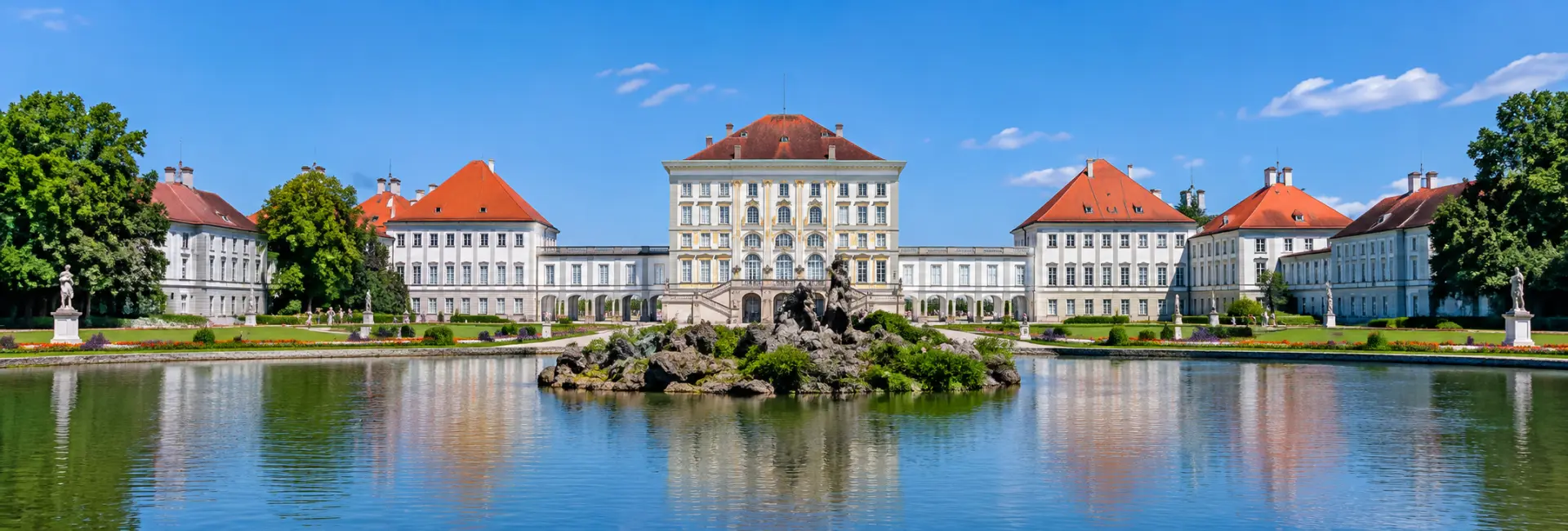
Nymphenburg Palace sits on the western edge of Munich, a sprawling white Baroque complex that once served as the summer home of Bavaria's ruling Wittelsbach family. Begun as a modest Italian-style villa in 1664, it grew over more than a century into one of the widest palace facades in Europe, flanked by galleries, a formal canal, and a park that stretches for nearly two hundred hectares.
What makes Nymphenburg worth the trip out from Munich's old town isn't just the scale of the building, but the sheer variety packed into its grounds: gilded state rooms, a museum of royal carriages, a working porcelain workshop, and four fantastical garden pavilions tucked among the trees. It rewards visitors who are happy to spend a half day wandering rather than ticking off a single monument.
History
Origins as a Birthday Gift
Nymphenburg's story begins in 1664, when Elector Ferdinand Maria of Bavaria commissioned the palace to mark the birth of his long-awaited son and heir, Max Emanuel. The Italian architect Agostino Barelli, who had also designed Munich's Theatine Church, was chosen to build a cubic, villa-like structure on land west of the city, then still open countryside. By the time the central pavilion was substantially complete in the 1670s, it already carried the airy, Italianate feel that gave the palace its early character.
Growth Under Max Emanuel
The palace only reached its familiar, sweeping form once Max Emanuel himself became elector. From 1701 he had court architect Enrico Zuccalli add pavilions to the north and south of Barelli's original building, linking them with long gallery wings. Work stalled for over a decade while Max Emanuel was forced abroad during the War of the Spanish Succession, but resumed after his return in 1715, when architect Joseph Effner reworked the central facade in the French Baroque style and added the enclosing pavilions that give the palace its present width.
The Age of the Kings
Later Wittelsbach rulers kept adding their own mark. Elector Max III Joseph founded the Nymphenburg Porcelain Manufactory on the grounds in 1747, and Elector Charles Theodor opened the park to the public in 1792, well before such gestures became common among Europe's ruling houses. Two of Charles Albert's children were born at the palace in the 1720s and 1730s, and Charles Albert himself lived there during his years as Holy Roman Emperor, dying at Nymphenburg in 1745. In the nineteenth century King Ludwig I filled a wing with portraits for his celebrated Gallery of Beauties, and in 1845 his great-grandson, the future King Ludwig II, was born inside the palace. King Max I Joseph also died at Nymphenburg, in 1825, underlining how central the palace remained to the dynasty even as Munich itself grew into a capital city around it.
Even after the Bavarian monarchy ended in 1918, part of Nymphenburg has remained linked to the Wittelsbach family, with a wing still used as a private residence by the family's head today, while the rest of the complex passed into the care of the Bavarian Administration of State-Owned Palaces, Gardens and Lakes, which now manages public access to the buildings and grounds.
Architecture & Notable Rooms
The Central Pavilion and the Steinerner Saal
The heart of the palace is the Steinerner Saal, or Stone Hall, a soaring room that rises through three storeys at the centre of the building. Its ceiling fresco, painted by Johann Baptist Zimmermann, shows the god Helios crossing the sky in his chariot, surrounded by a swirl of Rococo stucco. Concerts are still occasionally held in the hall today, a reminder that it was built for entertaining rather than quiet contemplation.
Royal Apartments and Galleries
On either side of the Stone Hall run suites of state rooms that trace changing tastes across two and a half centuries, from heavy Baroque ceilings to lighter Neoclassical furnishings. One room in the queen's apartments is where Ludwig II was born, and it still holds furniture from that period. Nearby, King Ludwig I's Gallery of Beauties gathers 36 portraits by court painter Joseph Stieler, each depicting a woman the king considered a great beauty of her day, including one of the dancer Lola Montez, whose relationship with Ludwig later became a political scandal that helped fuel the unrest of 1848.
The palace's north wing holds a different kind of gallery: a set of rooms hung with paintings of Bavarian castles and hunting lodges as they looked under Max Emanuel, giving a sense of just how many residences the electors maintained across the region. Architecturally, the building shows its long construction history plainly, with the central pavilion's Italianate proportions sitting alongside the more ornamented French Baroque wings that Joseph Effner added a half-century later.
- The Great Gallery of Beauties, an earlier and separate portrait cycle commissioned by Max Emanuel
- A lacquer cabinet lined with Chinese panel paintings, closed to visitors during restoration through autumn 2026
- The palace chapel of St. Mary Magdalene, reachable from the courtyard
Grounds & Gardens
From French Parterre to English Park
The park in front of the palace was originally laid out from 1701 as a strict, geometrical Baroque garden in the style of Versailles, complete with a long central canal. In the early nineteenth century, the landscape architect Friedrich Ludwig von Sckell reshaped most of it into a naturalistic English-style park of lakes and winding paths, while deliberately keeping the Great Parterre and central canal as a nod to the garden's Baroque origins. The result is nearly two hundred hectares combining both styles, making it one of the largest palace parks in Europe.
Four Pavilions Hidden in the Park
Scattered symmetrically along the park's main axis are four small pavilions, each built for a different form of court escape. The Amalienburg, a Rococo hunting lodge finished in 1739, holds a dazzling silver-and-mirror Hall of Mirrors and is generally considered the finest of the four. The Badenburg once housed one of the first heated indoor pools in Europe, tiled in blue and white. The octagonal Pagodenburg was decorated to resemble a Chinese tea house, while the Magdalenenklause was deliberately built to look like a crumbling hermit's ruin, offering the electors a place for quiet retreat from court life.
Cultural Significance & Royal Legacy
Nymphenburg is inseparable from the House of Wittelsbach, which ruled Bavaria for centuries and used the palace as its favoured warm-weather residence. Its scale, with a facade wider than that of Versailles, was a deliberate statement of Bavarian prestige within the Holy Roman Empire, built to be seen and admired by visiting courts as much as to be lived in.
The palace's cultural reach extends beyond its walls: the Nymphenburg Porcelain Manufactory, founded on the grounds in 1747, still produces hand-painted porcelain today, working with contemporary designers alongside its historic patterns, and pieces from the workshop can be seen in the Museum of Nymphenburg Porcelain inside the Marstallmuseum building. The palace park is also credited as one of the influences behind Munich's reputation as one of Europe's greener major cities, since Elector Charles Theodor's decision to open it to the public in 1792 set a precedent later followed elsewhere in the city.
For Bavarians, the palace also carries a personal kind of significance tied to Ludwig II, later famous as the builder of Neuschwanstein Castle. His birth at Nymphenburg in 1845 is still marked locally, and the room associated with the event remains one of the most visited parts of the state apartments.
Ways to Experience It
- Tour the state rooms of the main palace, including the Steinerner Saal and the Gallery of Beauties
- Visit the Marstallmuseum in the former court stables, home to ornate royal carriages and sleighs, including one built for Ludwig II's wedding
- Walk or cycle through the park to see the four pavilions, open only from April to mid-October
- Take a gondola ride along the central canal in summer, weather permitting
- Stop by the Botanical Garden bordering the park, or the Museum Mensch und Natur (Museum of Man and Nature) nearby
- Pick up an audio guide, available in several languages, for a self-paced tour of the palace interior
Best Time to Visit
Spring through early autumn is the most rewarding time to visit, when the park's flower beds are in bloom, the fountains run in the Great Parterre, and all four park pavilions are open. Weekday mornings tend to be quieter than weekend afternoons, when the park draws large numbers of local visitors as well as tourists.
Visiting in winter still has its appeal: the palace's state rooms stay open year-round on a shorter daily schedule, crowds thin out considerably, and the bare trees make the symmetry of the garden's layout easier to appreciate. The park pavilions, however, close for the winter months, so a winter visit will miss the Amalienburg and its neighbours.
Visitor Tips
- Buy a combination ticket if you want to see the palace, the park pavilions, and the Marstallmuseum together, since single tickets only cover one section
- Check the current opening hours before visiting, since the palace switches to a shorter winter schedule in mid-October
- Wear comfortable shoes; the park is large, and reaching all four pavilions on foot takes a couple of hours
- Entry to the park itself is free, so it's possible to enjoy the gardens without buying a ticket to any building
- Children under 18 are admitted free to the paid sections of the palace and museums
- Reach the palace by tram from central Munich rather than driving, since parking near the entrance is limited
Nearby Attractions
- The Hirschgarten, a large beer garden and deer park a short walk from the palace, good for a break after touring the grounds
- The Munich Botanical Garden, directly bordering Nymphenburg's park
- Blutenburg Castle, a smaller moated hunting lodge a few kilometres further west
- Munich's old town and the Residenz palace, the Wittelsbachs' main city residence, a tram ride away
FAQs about visiting Nymphenburg Palace
What is Nymphenburg Palace known for? +
It's known as the Bavarian royal family's Baroque summer residence, prized for its wide symmetrical facade, its Rococo state rooms like the Steinerner Saal, and the four fantasy garden pavilions scattered through its park.
How much time should I plan for a visit? +
Budget at least half a day if you want to see the palace interior and walk through the park to the pavilions; a rushed visit to just the main building can be done in under two hours.
Is Nymphenburg Palace free to visit? +
The park and gardens are free to enter, but tickets are required for the palace interior, the park pavilions, and the Marstallmuseum.
How do I get to Nymphenburg Palace from central Munich? +
Tram line 17 runs directly to the Schloss Nymphenburg stop from the city centre, making it the easiest option; buses also serve the area, and there is limited paid parking on-site.
Are the park pavilions open all year? +
No, the four park pavilions (Amalienburg, Badenburg, Pagodenburg, and Magdalenenklause) are only open from April to mid-October and are closed through the winter months.
Is Nymphenburg Palace suitable for children? +
Yes, children under 18 get free admission, and the park's lakes, canals, and open lawns give kids room to run around between the more formal indoor sections.
Can I combine a Nymphenburg visit with other Munich sights in one day? +
It's possible but tight, since Nymphenburg sits west of the city centre; many visitors treat it as a half-day trip on its own, pairing it with a stop at the nearby Hirschgarten or Botanical Garden rather than the old town.