Table of Contents
Overview
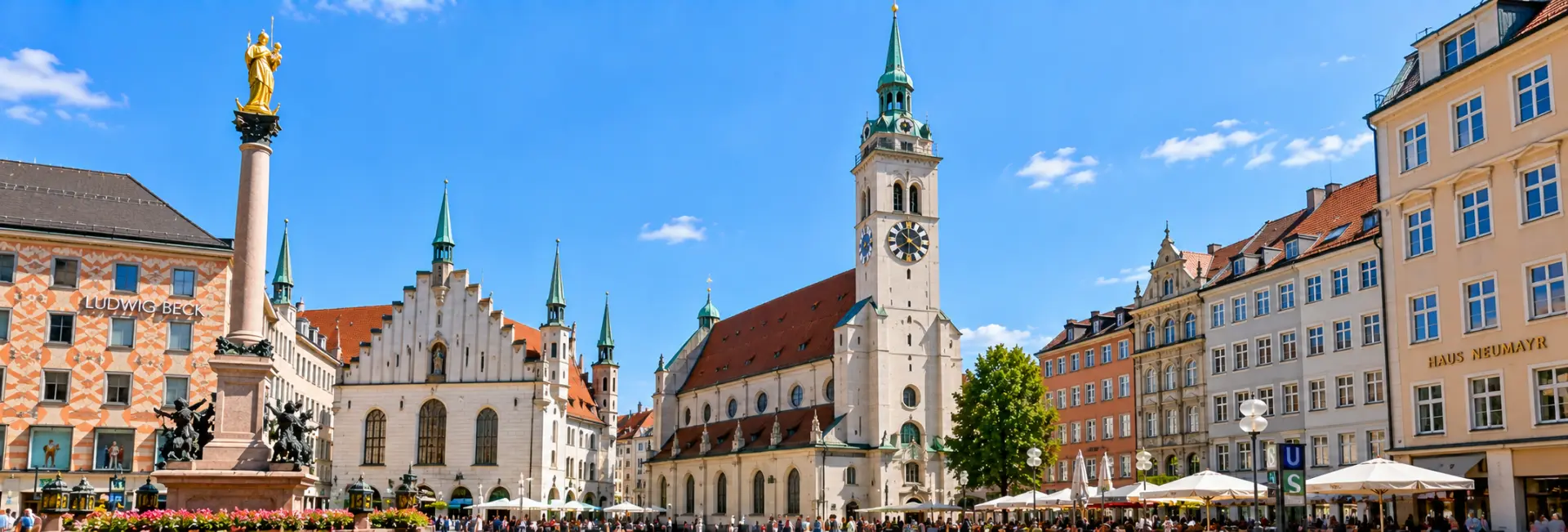
Standing on the highest point of Munich's old town, a spot known since the Middle Ages as Petersbergl, St. Peter's Church is the city's oldest parish church and one of its most recognizable landmarks. Locals know it simply as Alter Peter, or Old Peter, a nickname that has stuck for generations and now refers as much to its tower as to the church itself.
Just steps from Marienplatz, the church combines a long, layered history with one of the best panoramic viewpoints in the city center. Visitors come both for its Baroque interior, filled with art accumulated over centuries, and for the climb up its tower, which rewards the effort with sweeping views over Munich's rooftops and, on clear days, toward the Alps.
History
Origins and Early Rebuilding
Tradition holds that a small community of Benedictine monks settled on this hilltop before Munich itself existed as a city, and the settlement's name, derived from the German word for monks, eventually gave Munich (Munchen) its name. A church dedicated to Saint Peter had already been established here by the twelfth century, making it the oldest parish church in the city once Munich was formally founded in 1158.
The early church did not survive intact for long. A major fire in the fourteenth century destroyed much of the building, and reconstruction over the following decades gave the church many of its Gothic features. Centuries later, in the seventeenth and eighteenth centuries, the interior was reworked again with Baroque and Rococo decoration, layering new artistic styles onto the older Gothic structure.
Destruction and Postwar Rebuilding
Like much of central Munich, St. Peter's suffered severe damage during Allied bombing raids in the Second World War, with its roof and tower badly affected. Rebuilding took place gradually over the following decades, following the church's historic form as closely as possible, and the full restoration was not considered complete until the year 2000, even though the church had reopened for worship long before that milestone.
Architecture & Design
St. Peter's tower, rebuilt in its current form in the early seventeenth century, is instantly recognizable for its distinctive lantern-shaped dome and, unusually, eight separate clock faces rather than the more common four, one for each side of the octagonal upper section. Rising roughly 90 metres above the street, it remains one of the defining silhouettes of Munich's skyline alongside the domes of the nearby Frauenkirche.
Inside, the church reflects centuries of layered renovation rather than a single architectural style. Gothic arches and vaulting from the medieval rebuilding sit beneath ceiling frescoes and gilded ornamentation added during later Baroque and Rococo campaigns, giving the interior a richer, more decorative character than the church's plain exterior might suggest. The current facade, added later still, was designed in the eighteenth century, layering yet another era onto the building's long architectural history.
Inside the Church: Art and Relics
The church's Baroque high altar, completed in the eighteenth century, is one of its best-known artistic features, crowned by a gilded statue of Saint Peter dating back to the late fifteenth century. According to tradition, the tiara placed on the statue's head is removed after the death of a pope and only restored once a new pope has been elected, a small but symbolic ritual tied directly to the wider Catholic Church.
A more unusual sight awaits at one of the side altars, where the jewel-covered skeletal remains of Saint Munditia, an early Christian martyr, have been displayed since the relics were brought from Rome in the seventeenth century. The elaborately decorated shrine is among the more striking examples of the Baroque tradition of venerating relics found throughout Bavarian churches.
Climbing the Tower: Alter Peter
The main reason many visitors climb Alter Peter is the view from its observation platform, reached after a steep ascent of roughly 300 narrow steps with no elevator option. The effort is rewarded with a close-up look over the rooftops of Munich's old town, taking in Marienplatz, the New Town Hall, and the twin towers of the Frauenkirche just beyond.
- On especially clear days, the view extends south toward the Alps, marked by colored rings on the lower platform that indicate current visibility conditions
- Inside the tower hang several bells, including one of the oldest documented in Munich, historically used to mark executions carried out on Marienplatz
- The tower's clock faces are also considered among the earliest recorded public clocks in the city
Because the stairs are steep and narrow, the climb is not well suited to visitors with mobility issues, and access is generally closed during poor weather or at certain times of year.
Visiting Etiquette & Tips
As an active parish church, St. Peter's asks visitors to remain quiet and respectful inside, particularly during Mass and other services, when sightseeing access to the main nave is typically paused.
- Entry to the church itself is free, though the tower climb usually requires a small admission fee
- Wear comfortable, sturdy shoes for the tower climb, since the stairs are steep, narrow, and can be slippery
- Dress modestly, as is customary when visiting an active church
- Photography is generally allowed inside the church, but flash and tripods may be restricted during services
- Check current opening hours before visiting, since tower access can vary by season and sometimes closes in poor weather
Best Time to Visit
Because the tower climb depends entirely on clear conditions for its best views, it is worth checking the weather and aiming for a clear morning or late afternoon when visibility toward the Alps is more likely. Weekday visits generally mean shorter waits on the narrow staircase compared to weekends, when both the church and the surrounding Marienplatz area are at their busiest.
The church itself can be visited comfortably at almost any time of year, though visitors hoping to also enjoy the nearby Viktualienmarkt or a walk around the Old Town might find spring and early autumn a pleasant balance between good weather and manageable crowds.
Nearby Attractions
St. Peter's sits at the very center of Munich's Old Town, making it easy to combine with several other major sights in a short walk.
- Marienplatz and the New Town Hall, directly next to the church and visible from its tower
- The Frauenkirche, Munich's twin-domed cathedral, a short walk away and clearly visible from the tower platform
- The Viktualienmarkt food market, just behind the church, popular for a snack or lunch
- The Munich Residenz and the historic Hofbrauhaus beer hall, both within easy walking distance
FAQs about visiting St. Peter's Church
What is St. Peter's Church known as locally? +
Locals call it Alter Peter, or Old Peter, a nickname that refers to both the church and its distinctive tower.
Is St. Peter's Church free to visit? +
Yes, entry to the church itself is free, though climbing the tower usually requires a small admission fee.
How many steps are there to the top of the tower? +
The climb involves roughly 300 steep, narrow steps with no elevator, so comfortable shoes are recommended.
What can you see from the top? +
On a clear day, the observation platform offers views over Marienplatz, the Frauenkirche, and Munich's old town rooftops, extending as far as the Alps.
What is the jeweled skeleton inside the church? +
It is the relic of Saint Munditia, an early Christian martyr whose remains, brought from Rome in the seventeenth century, are displayed in a jewel-covered shrine at a side altar.
Is St. Peter's Church the oldest church in Munich? +
Yes, it is generally considered Munich's oldest parish church, with roots going back to before the city was formally founded in 1158.
Can I visit during a church service? +
Sightseeing access to the main nave is typically paused during Mass and other services, so it's best to check the schedule if you want to look around freely.
How close is St. Peter's to Marienplatz? +
It sits directly beside Marienplatz, making it one of the easiest landmarks to combine with a visit to Munich's central square.