Table of Contents
Overview
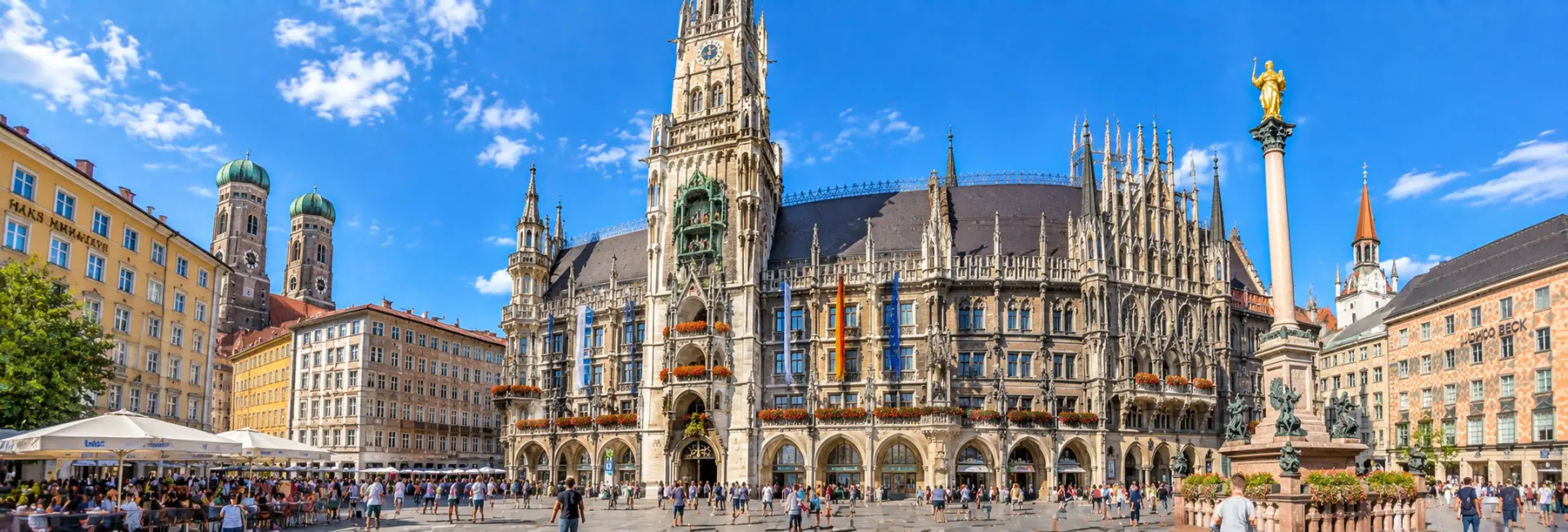
Marienplatz has been Munich's central square since 1158, and it remains the symbolic heart of the city today, ringed by the neo-Gothic New Town Hall, the older Gothic-revival Old Town Hall, and a scattering of fountains and monuments that trace the square's long civic history. Framed by pedestrianized shopping streets and just steps from the Frauenkirche and the Viktualienmarkt food market, Marienplatz functions as Munich's default meeting point and the natural starting point for exploring the surrounding Altstadt. Its best-known feature, the Rathaus-Glockenspiel carillon in the New Town Hall's tower, draws crowds several times a day, but the square is worth lingering in beyond the show, as a place where medieval market history, 19th-century civic architecture, and everyday Munich life all overlap in one open space.
History
A Medieval Market Square
The square has served as Munich's main marketplace since 1158, originally known simply as Markt, and later as Schrannenplatz once it specialized in grain trading; markets and public tournaments were held here throughout the Middle Ages. The grain market moved to a dedicated hall elsewhere in the city in 1853, and the square took its current name the following year, after the Marian column already standing at its center.
The Mariensäule and the Thirty Years' War
That column, the Mariensäule, was erected in 1638 on the orders of Elector Maximilian I to mark the end of Swedish occupation during the Thirty Years' War and to give thanks for the city's deliverance, and it eventually gave the square its present name.
A Turbulent Twentieth Century
In November 1923, Adolf Hitler's failed Beer Hall Putsch ended a few streets from the square, and in the years that followed the Nazi Party staged annual marches that passed directly through it; a nearby side alley, Viscardigasse, became known informally as an escape route for residents avoiding a compulsory salute at a memorial plaque close by. Both the Old and New Town Halls suffered heavy damage in Allied bombing raids during the Second World War, but each was subsequently restored, and the square resumed its role as the everyday center of city life.
The New Town Hall & Glockenspiel
The New Town Hall, or Neues Rathaus, occupies the entire north side of Marienplatz and was built between 1867 and 1908 to a Gothic Revival design by the architect Georg von Hauberrisser, replacing older buildings on the site. Its nearly 100-metre-long façade, richly decorated with statues, gargoyles, and turrets, still serves as the seat of Munich's mayor and city council, and an elevator inside carries visitors up the 85-metre tower to an observation deck looking out over the Altstadt toward the Alps.
Set into that tower, the Rathaus-Glockenspiel carillon reenacts two scenes from the 16th century: a knights' jousting tournament held for the 1568 wedding of Duke Wilhelm V, and the Schäfflertanz, a coopers' dance said to have been performed to lift the city's spirits during a 16th-century outbreak of plague. Its 43 bells and 32 life-size figures perform daily at 11am and noon, with an additional afternoon show in the warmer months and a quieter nighttime performance in the evening.
The Old Town Hall
On the square's east side stands the Altes Rathaus, a Gothic council hall first built in the 14th century and substantially reworked in the 15th century by the architect Jörg von Halsbach, whose work also shaped Munich's Frauenkirche. Its great hall once hosted the city council and civic ceremonies, and its slender tower has served over the centuries as both a lookout point and, briefly, a jail.
Severely damaged by Allied bombing in the Second World War, the Old Town Hall was rebuilt after 1945 in a close reconstruction of its historic appearance, and today it houses a small toy museum in its tower alongside municipal offices.
Mariensäule & Fischbrunnen
At the center of the square stands the Mariensäule, a column topped by a gilded statue of the Virgin Mary, erected in 1638 as an act of thanksgiving after the end of Swedish occupation during the Thirty Years' War. Four bronze putti at its base, added later, battle personifications of war, plague, hunger, and heresy, and the monument was rededicated as a general war memorial in the 20th century.
Nearby, the Fischbrunnen, or Fish Fountain, recalls the centuries when live fish were sold at the square's market; a long-standing local tradition holds that dunking a wallet in its waters on Ash Wednesday brings good fortune for the coming year, and the fountain remains a popular meeting spot and photo stop.
Ways to Experience It
- Watch the Rathaus-Glockenspiel perform from the square below at 11am, noon, or during the added afternoon and evening shows
- Ride the elevator up the New Town Hall's tower for a panoramic view over Munich's Altstadt and, on clear days, the Alps
- Climb or take the elevator up St. Peter's Church tower, just south of the square, for a view that includes Marienplatz itself
- Browse the surrounding pedestrian shopping streets, Kaufingerstraße and Neuhauser Straße, which run directly off the square
- Visit during the Christkindlmarkt, one of Munich's oldest and largest Christmas markets, held on the square each winter
Best Time to Visit
Marienplatz is busiest around the Glockenspiel's midday performances, when crowds gather beneath the New Town Hall tower, so arriving for the quieter 9pm evening show, or simply visiting outside performance times, makes for a calmer experience of the square itself. Early mornings before the shops and market stalls open are the best time to see the buildings without crowds, while evenings bring a livelier atmosphere as restaurants and bars around the square fill up.
The square takes on a different character during the winter Christmas market season, when it becomes considerably more crowded but also more atmospheric, lit with market stalls and a large Christmas tree.
Visitor Tips
- Check the Glockenspiel schedule in advance, since show times and the additional afternoon performance vary by season
- Book tower tickets for the New Town Hall or St. Peter's Church ahead of time in peak season to avoid long waits
- Use the Marienplatz U-Bahn and S-Bahn station directly beneath the square as a central starting point for reaching other parts of Munich
- Keep valuables close, as the square's crowds and street performers can attract pickpockets during busy periods
- Combine a visit with the nearby Viktualienmarkt food market for lunch after seeing the main sights
Nearby Attractions
Marienplatz sits at the center of Munich's Altstadt, within walking distance of several of the city's best-known landmarks.
- Frauenkirche, Munich's twin-towered cathedral, a short walk northwest
- Viktualienmarkt, the city's historic food market, just south of the square
- St. Peter's Church, Munich's oldest parish church, directly south
- Odeonsplatz and the Residenz palace, a short walk north
FAQs about visiting Marienplatz
What is Marienplatz known for? +
It's Munich's central square, home to the New Town Hall's Rathaus-Glockenspiel carillon, the Gothic Old Town Hall, and the Mariensäule column, and it's been the city's main marketplace since 1158.
When does the Glockenspiel perform? +
It plays daily at 11am and noon, with an additional afternoon show from March through October and a quieter evening performance at 9pm.
Is Marienplatz free to visit? +
Yes, the square itself is always open and free to walk through; admission fees only apply to specific attractions nearby, such as the town hall tower or church viewing platforms.
How do I get to Marienplatz? +
The easiest way is by U-Bahn or S-Bahn to Marienplatz station, which sits directly beneath the square and connects to most other parts of Munich.
Is it worth going up the New Town Hall tower? +
Yes, the 85-metre tower has an elevator to an observation deck with panoramic views over Munich's old town and, on clear days, the Alps.
What's the best time to visit to avoid crowds? +
Early mornings before the midday Glockenspiel shows, or the quieter 9pm evening performance, offer a calmer experience than the busy 11am and noon crowds.
Is Marienplatz different during the Christmas season? +
Yes, it hosts the Christkindlmarkt, one of Munich's oldest and largest Christmas markets, which fills the square with stalls and a large Christmas tree but also draws much bigger crowds.
What else is within walking distance of Marienplatz? +
The Frauenkirche, Viktualienmarkt food market, St. Peter's Church, and Odeonsplatz are all within a few minutes on foot.