Table of Contents
Overview
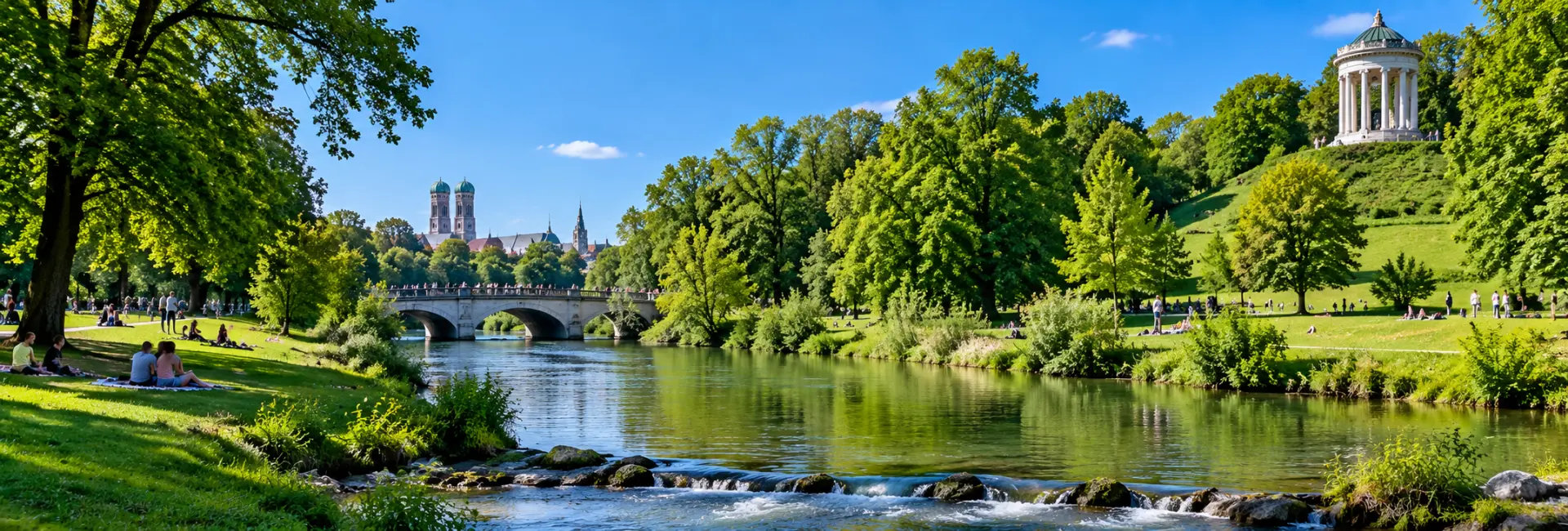
The Englischer Garten, or English Garden, is a 375-hectare public park that runs from the edge of Munich's old town all the way to the city's northeastern outskirts. Laid out in the late eighteenth century, it's one of the largest urban parks anywhere in the world, noticeably bigger than New York's Central Park, and it manages to feel less like a manicured city garden than a slice of countryside that happens to sit inside a major European capital.
Munich residents treat it as an everyday extension of their city rather than a sightseeing checkbox: joggers and cyclists cut through it on their commutes, families picnic on its meadows, and crowds gather along a small river near the southern entrance to watch surfers ride a standing wave. For visitors, it offers a rare mix of genuine green space and offbeat landmarks, from a Chinese-style pagoda to a Greek temple on a hill.
History & Creation
A Garden for Soldiers
The park's origins are more practical than romantic. In 1789, Elector Charles Theodore commissioned the American-born scientist and statesman Sir Benjamin Thompson, later known as Count Rumford, to lay out a "military garden" on the edge of Munich. The idea was to give soldiers land to farm and to demonstrate modern agricultural techniques, while also providing them somewhere to relax outside the barracks.
From Military Plot to Public Park
The military garden quickly grew into something bigger. Later in 1789, Charles Theodore ordered the area to the east turned into a park open to everyone, an unusually democratic move for a European ruler at the time and one of the first such public parks on the continent. It opened fully in 1792 under the name Theodor's Park, though the public soon started calling it the English Garden instead, after the informal, naturalistic style of landscaping it followed rather than the rigid geometry of a French Baroque garden.
Sckell's Landscape Vision
Two men did the most to shape what visitors see today. Reinhard von Werneck oversaw the park in its early years, but it was the landscape architect Friedrich Ludwig von Sckell, who had trained on English-style gardens abroad, who gave the park its rolling meadows, winding paths, and carefully framed views. Sckell's approach avoided straight lines almost entirely, instead grouping trees and opening meadows to create the impression of natural countryside rather than a designed garden, a style that has defined the park ever since.
Sckell went on to apply the same principles elsewhere in Bavaria, including at the palace park of Nymphenburg, but the English Garden is generally considered his signature achievement and one of the earliest large-scale examples of the naturalistic landscape style on the European continent. The park continued to grow through the nineteenth century as the city expanded around it, eventually reaching its current length of roughly five and a half kilometres, stretching from the inner city out to the meadows along the Isar in Munich's north.
Key Landmarks & Areas
Chinesischer Turm
The park's best-known structure is the Chinesischer Turm, a 25-metre wooden pagoda modelled loosely on the Great Pagoda at Kew Gardens in London. Designed by Johann Baptist Lechner and built between 1789 and 1790, it burned down during a bombing raid in 1944 and was faithfully rebuilt in 1952. Visitors can't climb the tower itself, since access is reserved for the brass band that plays from its lower gallery on weekend afternoons, but the beer garden surrounding it, one of Munich's oldest and largest, draws big crowds on warm days, along with a restored antique children's carousel nearby.
Monopteros and the Lake
A short walk south, the Monopteros is a small Greek-style rotunda built in 1838 on top of an artificial hill. It has no real function beyond providing a viewpoint, but the panorama over the park's treetops toward Munich's skyline makes the short climb worthwhile, and the surrounding grass slopes are a favourite spot for sitting out an afternoon. Nearby, the Kleinhesseloher See is a small lake dotted with three little islands, popular for rowing boats and the Seehaus beer garden in summer, and, when it freezes, ice skating in winter.
The Eisbach and Its Wave
At the park's southern edge, near the Haus der Kunst museum, a fast-flowing branch of the Isar called the Eisbach produces a standing wave that has drawn river surfers since the early 1970s. For decades the sport was technically illegal, with surfers occasionally chased off by police, until the city legalised it in 2010. The wave has had a turbulent recent history: a fatal accident in April 2025 led to a temporary ban, and a routine autumn riverbed clearing later that year caused the wave to disappear entirely. It re-formed naturally over the following months and was reopened for surfing by the city in May 2026 under a revised set of safety rules, including a required quick-release leash and restricted night-time hours, though conditions can change again, so it's worth checking current status before expecting to see surfers there.
Japanese Teahouse and Beyond
Further into the park, past the lake, a Japanese Teahouse built for the 1972 Munich Olympics sits beside a quiet pond, hosting traditional tea ceremonies on a limited schedule. The park's northern stretches, including the Hirschau and Aumeister areas, are far less visited than the sections near the Chinesischer Turm and Eisbach, and reward anyone willing to walk further out with quieter woodland paths and the countryside feel Sckell originally intended.
Flora, Fauna & Waterways
Three streams cross the park roughly in parallel: the Schwabinger Bach and the Eisbach enter from the south, merge briefly, then split apart again, while the Oberstjägermeisterbach branches off the Eisbach further north. These waterways, along with the Kleinhesseloher See, give the park a surprising amount of running and still water for a site in the middle of a large city.
Wildlife is more abundant than the urban setting might suggest. Around fifty to sixty species of birds breed within the park, and visitors regularly spot squirrels, hedgehogs, wild rabbits, hares, and foxes, with occasional sightings of roe deer and even beavers along the streams. A small flock of sheep grazes some of the meadows as a low-impact way of managing the grassland, a practice used at several historic parks in the region, and a dedicated trail highlights the park's wild bee population. In recent years the Bavarian Administration of State-Owned Palaces, Gardens and Lakes has also begun converting sections of mown lawn into wildflower meadows to support local insect life, part of a broader effort to restore the kind of species-rich grassland the park had before intensive mowing became common in the mid-twentieth century.
Ways to Experience It
- Walk or cycle the length of the park, from the city-centre entrances near the Hofgarten to the wilder Isar meadows in the north
- Watch the surfers riding the Eisbach standing wave near the southern entrance, conditions permitting
- Climb to the Monopteros for a view over the park and the Munich skyline
- Spend an afternoon at the beer garden beneath the Chinesischer Turm, or at the quieter Seehaus by the lake
- Rent a rowing boat on the Kleinhesseloher See, or skate on it if it freezes over in winter
- Visit the Japanese Teahouse, built for the 1972 Munich Olympics, for an occasional traditional tea ceremony
Best Time to Visit
Late spring through early autumn is when the park is at its busiest and most colourful, with meadows in bloom, beer gardens in full swing, and the Eisbach wave, when open, drawing spectators throughout the day. Weekday visits tend to be noticeably quieter than weekends, when much of Munich seems to head for the park at once.
The park stays open and worth visiting through the colder months too. Crowds thin out considerably, the Kleinhesseloher See occasionally freezes over for skating, and the bare trees make some of the park's sightlines, like the view from the Monopteros, easier to appreciate. Outdoor beer gardens scale back their hours in winter, so check ahead if that's part of the plan.
Visitor Tips
- Entry to the park is free and it's open year-round, with no set opening or closing times
- Wear comfortable shoes or bring a bike; the park stretches over five kilometres from end to end
- Some meadows, including the Schönfeldwiese and Schwabinger Bucht, are designated areas where nude sunbathing is common and legally tolerated, so be aware of this if walking through with children
- Clean up after dogs and keep them under control in shared meadow areas, as is required throughout the park
- If you plan to watch or attempt surfing at the Eisbach, check the current rules and status first, since access has changed multiple times in recent years
- The closest U-Bahn stations are Giselastraße, Münchner Freiheit, and Universität, all within easy walking distance of the park's southern half
Nearby Attractions
- The Haus der Kunst, a modern and contemporary art museum right at the park's southern entrance
- The Bavarian State Museum of Ethnology and the museum quarter around Königsplatz, a short trip west
- The Schwabing district, known for its cafés and student-town atmosphere, bordering the park's western edge
- The Hofgarten and Residenz palace, a short walk south toward Munich's old town
FAQs about visiting the English Garden
What is the English Garden known for? +
It's known for being one of the world's largest urban parks, home to the Eisbach surf wave, the Chinesischer Turm beer garden, and long stretches of meadow and woodland within easy reach of central Munich.
Is the English Garden free to visit? +
Yes, entry is completely free and the park is open around the clock, though individual attractions like boat rentals or the Japanese Teahouse's tea ceremonies have their own costs and schedules.
Can you still surf the Eisbach wave? +
Surfing was reopened in May 2026 after a period of closure following a fatal accident and a temporary disappearance of the wave, but conditions and rules have shifted several times in recent years, so it's worth checking current status before visiting specifically to watch or surf.
How long does it take to walk through the English Garden? +
Walking the full five-and-a-half-kilometre length takes a couple of hours at a relaxed pace; most visitors instead explore one section, such as the area around the Chinesischer Turm and Monopteros, in an hour or two.
Is the English Garden suitable for families? +
Yes, with open meadows, a children's carousel near the Chinesischer Turm, and boating on the Kleinhesseloher See, though families should be aware that some meadows are designated nudist areas.
How do I get to the English Garden from central Munich? +
The U3 and U6 U-Bahn lines stop at Giselastraße, Münchner Freiheit, and Universität, all a short walk from the park's busier southern half, and it's also within easy walking distance of the old town.
What's the best time of year to visit? +
Late spring to early autumn offers the fullest experience, with blooming meadows and open beer gardens, but the park is worth visiting in winter too for quieter paths and occasional ice skating on the lake.