Table of Contents
Overview
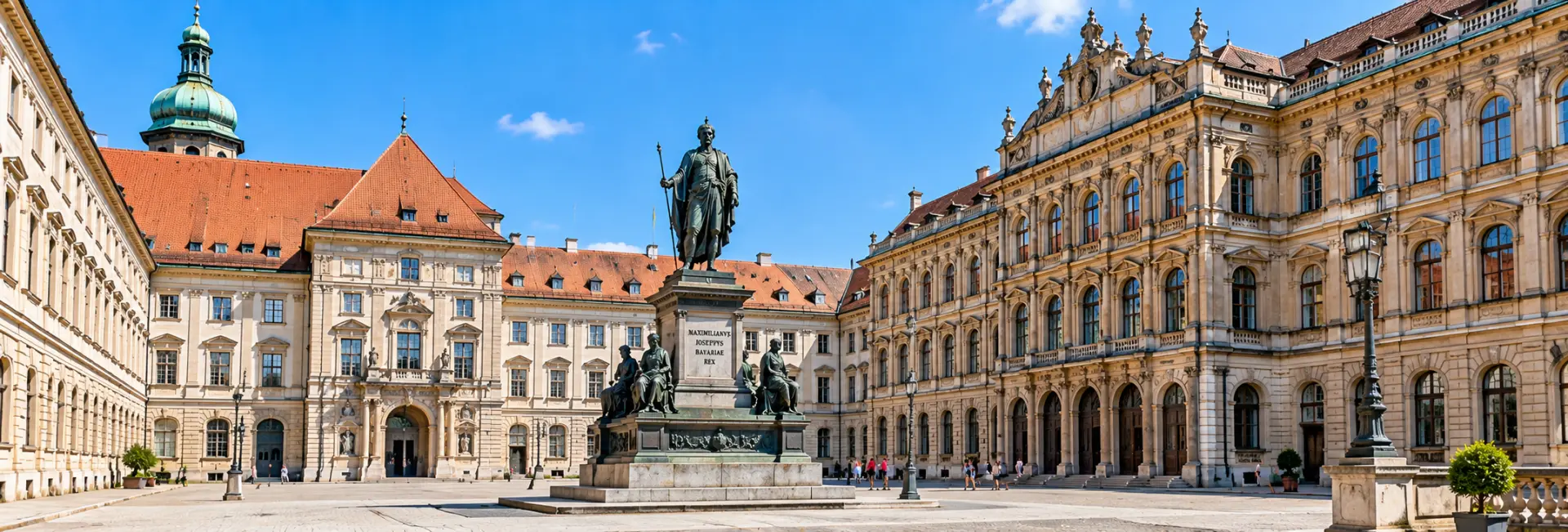
The Munich Residenz sits right in the heart of the old town, a sprawling palace complex that grew, wing by wing, into the largest city palace in Germany. For over four hundred years it was the political and residential centre of the Wittelsbach dynasty, the family that ruled Bavaria from the Middle Ages until 1918, and today it stands as one of Europe's richest surviving examples of how a single royal house's changing tastes, from Renaissance to Rococo to Neoclassical, can pile up inside one building.
What makes a visit worthwhile isn't a single showpiece room but the sheer accumulation: ten courtyards, well over a hundred rooms open to the public, a treasury of royal jewellery spanning a thousand years, and a jewel-box Rococo theatre tucked inside one wing. Much of what visitors see is careful postwar reconstruction, since the palace was heavily damaged in the Second World War, but that history is part of what makes the place interesting rather than something to look past.
History
From Fortress to Court
The Residenz began modestly in 1385 as a moated stronghold called the Neuveste, built on the northeastern edge of Munich's city walls after the town's residents rebelled against Duke Stephen III. The location was chosen partly for defence, close enough to the city to govern it but positioned to allow the ruling family to slip away without passing through the town's own streets if trouble broke out.
Renaissance Expansion
The Residenz only became the Wittelsbachs' primary seat in 1508, and it grew substantially under Duke Wilhelm IV and then Duke Albert V later in the sixteenth century. Albert V's passion for antiquities led to the construction of the Antiquarium between 1568 and 1571, built specifically to house his collection of classical sculpture, a project that set the tone for the palace's later reputation as a showcase of Wittelsbach taste and wealth rather than just a residence. Successive dukes and electors kept adding new wings and courtyards over the following centuries, so that by the eighteenth century the complex already covered ten separate courtyards, each reflecting the fashions of whichever ruler had commissioned it.
Baroque, Rococo, and Neoclassical Growth
Later rulers kept adding to the complex in whatever style was fashionable at the time. Elector Karl Albrecht commissioned the gilded Ancestors' Gallery in the 1720s, and Elector Maximilian III Joseph had the architect François de Cuvilliés build a private court theatre in the 1750s, which opened in 1753 with a performance of Ferrandini's opera Catone in Utica. The Residenz took on much of its present outward appearance under King Ludwig I in the early nineteenth century, when architect Leo von Klenze added the Königsbau facing Max-Joseph-Platz, modelled on Florentine Renaissance palaces such as the Palazzo Pitti, along with the Festsaalbau and the Byzantine-style Court Church of All Saints, completed by 1842.
Destruction and Postwar Reconstruction
The Residenz suffered severe damage during Allied bombing raids in the Second World War; by some accounts, only about fifty square metres of the original roof survived intact. Fortunately, many of the palace's most valuable furnishings, including the entire carved and gilded interior of the Cuvilliés Theatre, had been dismantled and stored elsewhere for safekeeping before the bombing. Reconstruction began almost immediately after the war, and the museum reopened to the public in stages starting in 1958, a process of careful restoration that has continued in various forms ever since.
Architecture & Notable Rooms
The Antiquarium
The single most celebrated room in the Residenz is the Antiquarium, a long barrel-vaulted hall covered in sixteenth and seventeenth-century frescoes and lined with classical busts and statues. Widely considered the largest and finest Renaissance interior north of the Alps, it was originally built to display Duke Albert V's antiquities collection and later doubled as a banqueting hall for state occasions.
Courtyards and Grand Rooms
Visitors typically begin at the Grottenhof, a small courtyard built around a shell-encrusted grotto and the Perseus Fountain, before moving through sequences of state rooms that shift noticeably in style from one wing to the next. The Ancestors' Gallery presents a long run of gilt-framed portraits of Wittelsbach rulers, while Maximilian I's Reiche Kapelle, or Rich Chapel, packs an extraordinary amount of marble, gilding, and ivory carving into a surprisingly small private prayer room.
- The Kurfürstenzimmer, or Electors' Rooms, hung with Italian portraits and a corridor of romantic Italian landscape paintings by Carl Rottmann
- The neo-Byzantine Allerheiligen-Hofkirche, reduced to bare brick walls by wartime bombing and reopened as a concert venue in 2003
- The Königsbau apartments of King Ludwig I, built in the 1830s in a self-consciously Florentine Renaissance style
The Treasury and Cuvilliés Theatre
The Schatzkammer
The Residenz's Treasury, or Schatzkammer, holds one of the most important collections of secular treasure in Europe, with pieces spanning roughly a thousand years. Alongside crowns, jewelled swords, and elaborate goldsmith's work made for the Bavarian court, the collection includes religious reliquaries, Chinese porcelain, and objects carved from ivory and rock crystal, reflecting centuries of the Wittelsbachs' collecting habits rather than a single era's taste. Many of the oldest pieces predate the Wittelsbachs' own rule in Bavaria, having entered the collection through marriage alliances, inheritance, or outright acquisition over the centuries, which gives the Schatzkammer a broader European character than the rest of the palace.
The Cuvilliés Theatre
Tucked into the Festsaalbau wing is the Cuvilliés Theatre, an intimate red-and-gold Rococo court theatre designed by François de Cuvilliés and completed in 1755. Because its carved and gilded boxes had been removed and stored elsewhere during the war, the theatre survived the destruction of its original building and was reassembled in its current location within the Residenz during postwar reconstruction, reopening in 1958. It remains a working venue today, hosting concerts and smaller opera productions in surroundings built for exactly that purpose over two and a half centuries ago, and it is considered one of the finest surviving Rococo theatres anywhere.
Cultural Significance & Royal Legacy
For more than four centuries, the Residenz functioned as the seat of government for Bavaria as much as a home, which is why its architecture reads less like a single unified design and more like a physical record of shifting political fortunes and personal tastes across generations of Wittelsbach rule. Napoleon reportedly stayed here during his campaigns in the region, and a young Mozart is known to have performed at the Bavarian court within the palace.
Not every Wittelsbach ruler felt at home here. King Ludwig II, later famous for building Neuschwanstein and other fantasy castles in the Bavarian countryside, reportedly disliked the Residenz and the formal duties tied to it, preferring the private, opera-inspired worlds he built for himself elsewhere. That contrast, between the Residenz as a working seat of state power and the more personal palaces built by later kings, is part of what makes the building's history feel layered rather than purely decorative.
Ways to Experience It
- Tour the Residenzmuseum's state rooms, including the Antiquarium, the Ancestors' Gallery, and the Reiche Kapelle
- Visit the Schatzkammer separately or as part of a combination ticket to see the Wittelsbach crown jewels and treasury objects
- See the Cuvilliés Theatre, either on a standalone ticket or by attending one of the concerts still staged there
- Pick up the free audio guide, available in multiple languages, to follow the museum's short or long route through the complex
- Walk through the adjoining Hofgarten, a formal court garden centred on a domed Diana Temple, free to enter
- Catch a concert at the Allerheiligen-Hofkirche or the Herkulessaal, both still used as performance venues today
Best Time to Visit
The Residenz is indoors and open year-round, which makes it a reliable option regardless of season, but early on a weekday morning is the best time to beat the tour groups that build up by midday, particularly in the busy summer months. Because the museum can take a couple of hours or more to see properly, arriving well before closing time matters more here than at outdoor attractions.
Visiting between October and March, when the palace switches to shorter winter hours, generally means noticeably smaller crowds than the peak April-to-October season, though some rooms occasionally close for rotating renovation work regardless of when you visit.
Visitor Tips
- Buy a combination ticket if you plan to see the Residenzmuseum, Schatzkammer, and Cuvilliés Theatre together, since each has a separate standalone ticket otherwise
- Check opening hours before visiting, since they shift between an April-to-mid-October schedule and a shorter mid-October-to-March schedule
- Note that the Residenzmuseum and Schatzkammer involve a considerable number of stairs and are not step-free, while the Cuvilliés Theatre is accessible
- Children under 18 are admitted free to all three museums
- Set aside at least two hours, and closer to half a day if you want to see the treasury and theatre as well as the main museum
- Reach the Residenz on foot from Marienplatz or Odeonsplatz, both served by U-Bahn and S-Bahn lines a short walk away
Nearby Attractions
- The Hofgarten, the Residenz's own formal garden, leading toward the English Garden further north
- Marienplatz and Munich's old town, a short walk south with the city's town halls and Frauenkirche
- The National Theatre on Max-Joseph-Platz, home of the Bavarian State Opera, directly facing the Residenz
- The Odeonsplatz and Feldherrnhalle, a few minutes' walk to the north
FAQs about visiting the Munich Residenz
What is the Munich Residenz known for? +
It's known as Germany's largest city palace and the former seat of the Wittelsbach dynasty, prized for the Renaissance Antiquarium, its royal treasury, and the Rococo Cuvilliés Theatre.
How much time should I plan for a visit? +
Budget at least two hours for the main Residenzmuseum alone, and closer to half a day if you also want to see the Treasury and Cuvilliés Theatre in the same visit.
Is the Munich Residenz the same as the Residenzmuseum? +
The Residenz is the whole palace complex; the Residenzmuseum refers specifically to the section of around 130 rooms open as a museum, while the Treasury and Cuvilliés Theatre are ticketed separately within the same complex.
Was the Residenz destroyed in World War II? +
Yes, large parts of the palace were severely damaged in Allied bombing raids, and much of what visitors see today is the result of careful postwar reconstruction that began soon after the war ended.
Is the Munich Residenz suitable for visitors with mobility issues? +
Not fully; the Residenzmuseum and Treasury involve a significant number of stairs and are not step-free, though the Cuvilliés Theatre is accessible and tactile tours are available on request.
How do I get to the Munich Residenz? +
It sits right in the old town, an easy walk from the Marienplatz or Odeonsplatz U-Bahn and S-Bahn stations, with the main entrance facing Max-Joseph-Platz.
Can you combine a Residenz visit with other Munich sights in one day? +
Yes, its central location makes it easy to pair with Marienplatz, the Hofgarten, and the start of the English Garden, all within a short walk of the palace.