Table of Contents
Overview
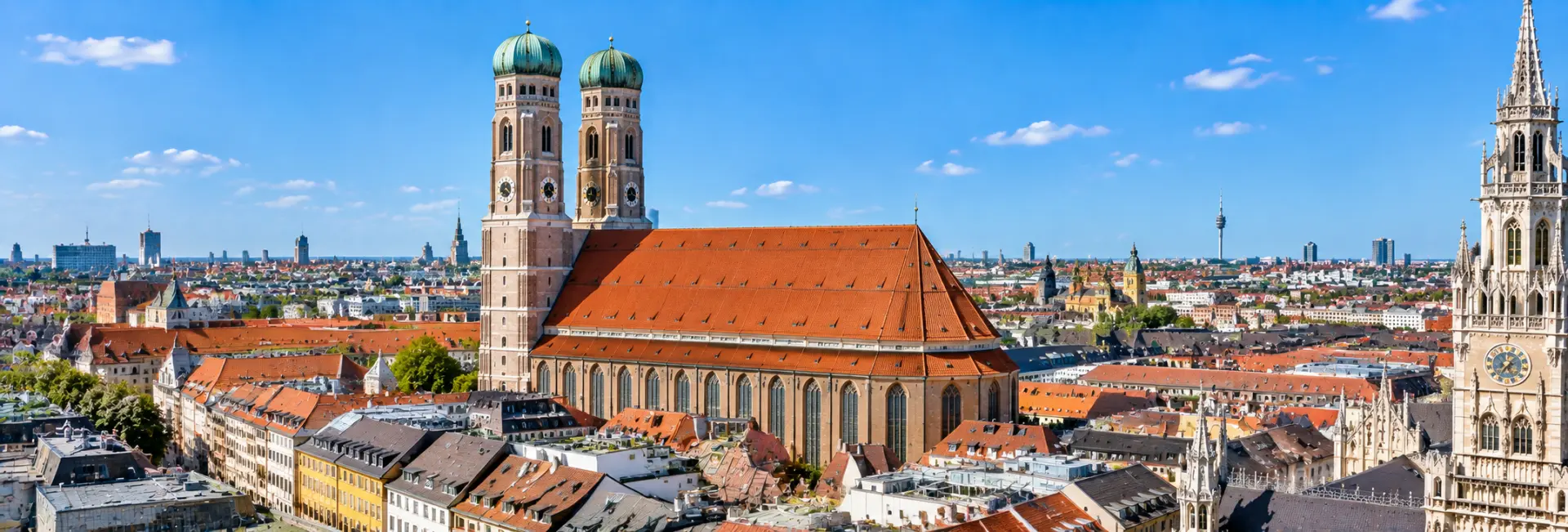
Rising above the rooftops of Munich's Old Town, the Frauenkirche (Cathedral of Our Dear Lady) is the city's most recognizable landmark and the seat of the Archbishop of Munich and Freising. Its two brick towers, capped with distinctive green onion domes, have watched over the Bavarian capital for more than five centuries and appear on postcards, skyline photos, and municipal branding across the region.
Despite its imposing exterior, the cathedral's origin story is a practical one: it was built quickly and cheaply from local brick rather than imported stone, yet it grew into one of the largest Gothic hall churches in southern Germany. Visitors come for the architecture, the medieval legends tied to its entrance hall, and the panoramic views available from its south tower, making it one of the first stops for anyone exploring central Munich on foot.
History
Origins and Construction
Construction of the Frauenkirche began in 1468 under Duke Sigismund of Bavaria, who commissioned local architect Jorg von Halsbach to design a church large enough to serve the growing city's congregation. Because the region around Munich had no accessible stone quarries, the builders turned to brick, a material that was cheaper and faster to work with but still allowed for an imposing structure. Remarkably, the main body of the church, including its two towers, was substantially complete within twenty years, by 1488, and the building was formally consecrated in 1494.
For decades afterward, the towers stood without their now-famous roofs. During a regional conflict known as the War of the Succession of Landshut, the open tops of the towers were even used as platforms for cannons defending the city. It was not until 1525 that the distinctive helmet-shaped domes were finally added, modeled on a structure in Jerusalem that European builders at the time mistakenly believed to be the ancient Temple of Solomon.
War Damage and Postwar Rebuilding
The cathedral suffered extensive damage during Allied air raids on Munich in the Second World War, with much of its roof, vaulting, and interior decoration destroyed or badly damaged. Reconstruction took place mainly between 1948 and 1955, and because resources were limited in postwar Germany, the rebuilt interior was given a plainer, more restrained appearance than the original. In the decades since, further restoration campaigns have gradually reintroduced some of the ornamentation that was lost, though the interior today still reflects much of that simpler postwar character alongside its medieval structure.
Architecture & Design
A Brick Gothic Hall Church
The Frauenkirche is built in the hall-church style typical of late Gothic architecture in southern Germany, with a nave and two side aisles rising to nearly the same height rather than one dominant central nave. Tall, slender columns divide the interior into these three parallel spaces, and because they are positioned to block direct sightlines from the entrance, first-time visitors are often surprised by how much of the church only becomes visible once they walk further inside. The building measures roughly 109 metres in length and about 40 metres in width, with an interior capacity large enough to seat several thousand worshippers at once.
The Onion Domes
The cathedral's most famous architectural feature is its pair of green copper domes, which sit atop towers of slightly different heights, roughly 98.5 metres for the north tower and just under that for the south. Their bulbous, helmet-like shape was unusual for German church architecture of the period and has since become closely associated with Bavarian ecclesiastical design more broadly. A 2004 city referendum formalized what had long been an informal rule in central Munich: no new building may rise higher than the Frauenkirche's towers, which is one reason the domes remain visible from almost anywhere in the historic city center.
The Twin Towers and the Devil's Footprint
Stasi and Blasi
Munich locals have long given the two towers their own nicknames, calling the south tower "Stasi" and the north tower "Blasi." Though they look almost identical from a distance, careful measurement shows the two towers differ in height by a matter of centimetres, a small asymmetry that architectural historians attribute to practical adjustments made during construction rather than any deliberate design choice.
The Legend of the Devil's Footprint
Just inside the main entrance, visitors can still find a dark, foot-shaped mark set into the stone floor, known locally as the Teufelstritt, or Devil's Footprint. According to legend, the devil offered to fund the church's construction on the condition that it contain no visible windows, and the master builder cleverly positioned the interior columns so that, from the exact spot where the mark now appears, the windows are indeed hidden from view. When the devil returned to inspect the completed church and saw no windows from that vantage point, he is said to have stamped his foot in fury, leaving the mark behind before storming out.
Cultural & Religious Significance
As the seat of the Archbishop of Munich and Freising, the Frauenkirche remains an active place of worship rather than a purely historical monument, hosting regular Mass, feast-day services, and diocesan ceremonies throughout the year. Its scale and prominence have made it the natural venue for major religious and civic occasions in Munich for over five centuries.
The cathedral is also a resting place tied to Bavarian history. Near the entrance stands the black marble and bronze cenotaph honoring Emperor Louis IV of Bavaria, a memorial rather than an actual tomb, alongside burial sites of other members of the Wittelsbach dynasty and past clergy. Bronze plaques elsewhere in the church commemorate Pope Benedict XVI, who served as Archbishop of Munich and Freising before his election, and his predecessor Pope John Paul II, underscoring the cathedral's continuing connection to the wider Catholic Church.
Ways to Experience It
Most visitors begin by simply walking through the nave and side aisles to take in the scale of the interior and the postwar restoration work, an experience that costs nothing and requires no advance planning. From there, the main additional activity is climbing the south tower for a view over Munich's rooftops.
- Enter the tower via the south chapel, close to the main portal, where the climb begins
- Ascend around 86 to 89 steps of a spiral staircase to an intermediate platform
- Take a small lift, which holds only a handful of people at a time, up to the observation level
- On clear days, the platform offers views that extend beyond the city to the Alps on the horizon
Because the tower has limited capacity and set opening hours, tickets are sold for specific time slots and are best booked online in advance, particularly during the busy summer months. The tower is sometimes closed entirely for maintenance, so it is worth checking current availability before building a visit around it.
Best Time to Visit
The Frauenkirche can be visited year-round, but the experience changes noticeably with the seasons. Spring and early autumn tend to bring milder weather and thinner crowds than peak summer, making them comfortable times to combine a visit to the cathedral with walking around the surrounding Old Town.
For the tower climb specifically, clear days offer by far the best rewards, since the view toward the Alps depends entirely on visibility. Arriving earlier in the day, shortly after opening, generally means shorter waits for the lift and softer light for photography, while late afternoon can bring warmer tones to the domes and surrounding rooftops. Visiting around major religious holidays such as Christmas or Easter adds a different atmosphere, with special services, though regular sightseeing access may be more limited during those times.
Visitor Tips
A little planning helps visitors get the most out of the Frauenkirche without running into avoidable frustrations.
- Entry to the main church is free, but a ticket is required for the south tower ascent
- Dress modestly and keep voices low, since the building remains an active place of worship
- Photography is generally permitted inside, but flash and tripods may be restricted during services
- Check the tower's opening hours in advance, as these can change around public holidays and maintenance periods
- The lift to the tower platform is small, so allow extra time if visiting with a larger group
- The nearest public transport hub is Marienplatz station, within easy walking distance of the cathedral
Nearby Attractions
The Frauenkirche sits at the heart of Munich's Old Town, within easy walking distance of several of the city's best-known sights.
- Marienplatz, home to the New Town Hall and its animated Glockenspiel, just a short walk away
- Viktualienmarkt, a long-running open-air food market popular for a quick bite between sightseeing stops
- The Munich Residenz, the former royal palace of the Wittelsbach family, with its museum and treasury
- St. Peter's Church (Peterskirche), whose tower offers another popular viewpoint over the city center
FAQs about visiting the Frauenkirche
What is the Frauenkirche? +
The Frauenkirche, or Cathedral of Our Dear Lady, is Munich's main cathedral and best-known landmark, recognizable by its two brick towers topped with green onion domes.
Is it free to enter the Frauenkirche? +
Yes, entry to the main church is free. A paid ticket is only required if you want to climb the south tower for the rooftop view.
How much time should I set aside for a visit? +
Walking through the interior on its own takes about 20 to 30 minutes, while adding the south tower climb, including waiting for the lift, typically brings a visit closer to an hour.
Can you go up the towers? +
Only the south tower is open to visitors. Access starts from the south chapel near the main portal, involves a spiral staircase followed by a small lift, and ends at an observation platform with city and Alpine views on clear days.
What is the Devil's Footprint? +
It is a dark, foot-shaped mark in the stone floor near the entrance, tied to a local legend in which the devil supposedly stamped his foot in anger after being tricked by the church's builder over a bet about windows.
What's the best time of day or year to visit? +
Spring and early autumn generally offer milder weather and smaller crowds, and visiting the tower on a clear day greatly improves the views toward the Alps; arriving soon after opening also tends to mean shorter waits for the lift.
How do I get to the Frauenkirche? +
The cathedral is in the pedestrian heart of Munich's Old Town, a short walk from Marienplatz station, which is served by multiple U-Bahn and S-Bahn lines as well as several bus routes.
What else is nearby that I can combine with a visit? +
Marienplatz, the Viktualienmarkt food market, the Munich Residenz, and St. Peter's Church are all within easy walking distance, making the Frauenkirche easy to fold into a longer walk around the Old Town.