Table of Contents
Overview
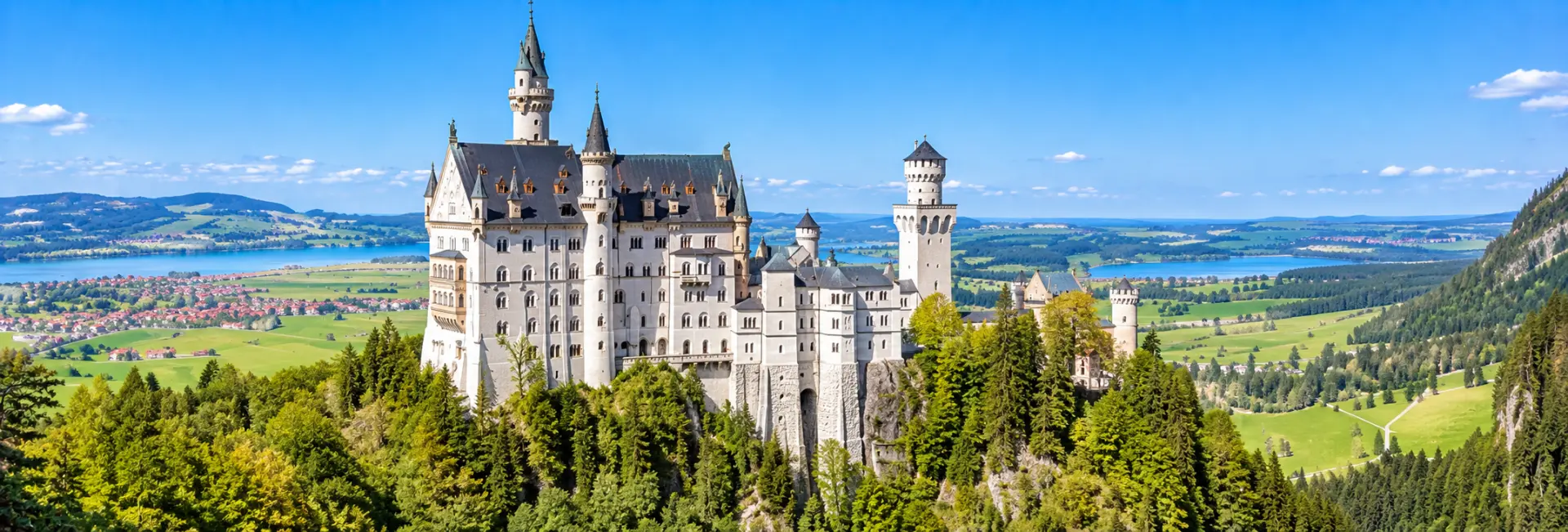
Perched on a rocky outcrop above the village of Hohenschwangau in the Bavarian Alps, Neuschwanstein Castle is a 19th-century fairy-tale palace built for King Ludwig II of Bavaria as a private retreat rather than a seat of government. Construction began in 1869 and was still incomplete when Ludwig died in 1886, yet the castle was opened to the public within weeks of his death and has since become one of the most visited and most photographed buildings in Germany. Its turreted silhouette, set against forested hills and distant peaks, later inspired Walt Disney's Sleeping Beauty Castle, cementing Neuschwanstein's status as the visual template many people picture when they imagine a fairy-tale castle. Though only a fraction of its planned rooms were ever finished, the completed interiors offer an unusually direct look into the private world and artistic obsessions of one of Europe's most eccentric monarchs.
History
A Childhood Passion for the Middle Ages
Ludwig II, born in 1845, grew up nearby at Hohenschwangau Castle, which his father had rebuilt in a romanticized Gothic style, and developed an early fascination with medieval legend that would shape the rest of his life. After becoming king in 1864 and then watching Bavaria lose its independence to Prussia two years later, Ludwig increasingly withdrew from politics and turned his attention to building projects that let him recreate an idealized medieval past.
Building an Idealized Castle
Construction of Neuschwanstein began in 1869, based on designs credited to the theatrical set designer Christian Jank and refined by the architects Eduard Riedel, Georg von Dollmann, and Julius Hofmann. Ludwig funded the project almost entirely from his personal fortune and heavy borrowing rather than state funds, and he took a close personal interest in its design, drawing on both medieval architecture and the operas of Richard Wagner for inspiration.
An Unfinished Legacy
By 1886, Ludwig had been declared mentally unfit to rule and was removed from power; he died in disputed circumstances only days later, and construction on the unfinished castle stopped almost immediately. Fewer than twenty of the more than two hundred rooms originally planned were ever completed, but the Bavarian government opened the finished portions to paying visitors within weeks of Ludwig's death in order to help recoup its costs.
Architecture & Design
Neuschwanstein blends Romanesque, Gothic, and Byzantine elements in a style typical of 19th-century historicism, which sought to recreate and idealize earlier architectural periods rather than strictly reproduce them. Its exterior, with turrets, a keep-like tower, and pale limestone-clad walls set against the Alpine backdrop, was directly inspired by the recently restored Wartburg Castle in Thuringia, a building Ludwig admired for its medieval associations. Painted frescoes on the exterior walls, including a scene of Saint George slaying a dragon, extend the castle's storytelling to its façade, blurring the line between architecture and stage design that Ludwig also explored in his other building projects.
Despite its deliberately old-fashioned appearance, the castle was built using the most advanced construction technology available at the time, including a steel framework behind its stone facing, and its completed rooms were fitted with running hot and cold water, an early electric bell and telephone system, and forced-air central heating, making it considerably more technologically advanced than its medieval-looking exterior would suggest.
Interior Highlights: The Throne Room & Singers' Hall
The Throne Room, spanning two storeys and modeled loosely on Byzantine churches such as the Hagia Sophia, is one of the castle's most elaborate spaces, with a mosaic floor, gilded columns, and a large chandelier - though the throne itself was never installed, since Ludwig died before the room's dais was completed. The Singers' Hall, occupying the entire top floor of the main building, was inspired by the festival hall at Wartburg Castle and decorated with murals illustrating the medieval Parzival legend that also inspired several of Wagner's operas; despite Ludwig's evident care in designing it, the hall was never used for a performance during his lifetime.
- Ludwig's private bedroom, richly carved in neo-Gothic style with symbols drawn from Wagnerian opera
- A grotto-like artificial cave built into the castle to evoke scenes from Wagner's Tannhäuser
- The castle kitchen, fitted with running water and an automatic spit roaster despite the building's medieval appearance
Grounds & Views
Immediately behind the castle, the Marienbrücke, or Mary's Bridge, spans the deep Pöllat gorge and offers one of the most photographed views of Neuschwanstein's façade, though it is regularly closed during icy winter conditions. The surrounding hillsides and the nearby Alpsee lake, visible from the castle's balconies, form part of the same royal landscape that Ludwig and his father shaped around Hohenschwangau and Neuschwanstein.
Within the castle itself, an open balcony at the rear of the finished apartments gives visitors sweeping views back across the valley to Hohenschwangau Castle, Ludwig's childhood home, and the Alpine foothills beyond.
Recognition & Status
In 2025, Neuschwanstein was inscribed on the UNESCO World Heritage List together with three other palace projects built for Ludwig II - Linderhof Palace, Herrenchiemsee, and the King's House on Schachen - recognized collectively as an outstanding expression of 19th-century architectural idealism. The castle had long been informally regarded as one of the most iconic buildings in Germany, and it draws well over a million visitors most years, making it one of the country's most visited historic sites.
Ways to Experience It
- Join the guided interior tour, the only way to see the completed Throne Room, Singers' Hall, and royal apartments, since the castle cannot be visited without a guide
- Walk or take the shuttle bus up to the Marienbrücke bridge for the classic postcard view of the castle's façade
- Hike the Pöllat gorge trail when open, for a different vantage point on the castle from below
- Combine a visit with nearby Hohenschwangau Castle, Ludwig's childhood home, to see both royal residences in a single day
- Take the horse-drawn carriage or shuttle bus between the village of Hohenschwangau and the castle entrance, since no cars are allowed up the hill
Best Time to Visit
Neuschwanstein draws large numbers of visitors year-round, and tickets for the timed guided tour can sell out well in advance during the summer high season, so booking online ahead of a visit is strongly recommended. Early morning tour slots tend to be less crowded on the approach paths and at the Marienbrücke viewpoint, while the surrounding trails and the bridge itself are at their busiest in the middle of the day.
Winter visits offer a quieter, snow-covered version of the castle, though the Marienbrücke and some hiking trails are frequently closed for safety during icy conditions, which can limit access to the best-known photo viewpoint.
Visitor Tips
- Book tickets online in advance, since walk-up availability is limited and lines at the ticket center in Hohenschwangau can be long in peak season
- Arrive with time to spare before your assigned tour slot, since latecomers may not be admitted and tickets are non-transferable
- Remember that photography and filming are not permitted inside the castle's finished rooms
- Wear sturdy shoes, since reaching the castle involves a steep uphill walk, horse-carriage ride, or shuttle bus from the parking areas below
- Check the status of the Marienbrücke bridge and Pöllat gorge trail in advance during winter, as both are frequently closed in icy conditions
Nearby Attractions
Neuschwanstein sits within a small cluster of royal and scenic sights around Hohenschwangau, most reachable on foot or by a short local bus ride.
- Hohenschwangau Castle, Ludwig II's childhood home, just below Neuschwanstein on a neighboring hill
- The Alpsee, a lake at the foot of both castles popular for short walks
- Marienbrücke and the Pöllat gorge, immediately behind Neuschwanstein
- The town of Füssen, about 4 kilometres away, at the southern end of Germany's Romantic Road
FAQs about visiting Neuschwanstein Castle
What is Neuschwanstein Castle? +
It's a 19th-century fairy-tale palace built in the Bavarian Alps for King Ludwig II of Bavaria as a private retreat, left unfinished at his death in 1886 and opened to the public soon afterward.
Why is the castle unfinished? +
Ludwig was declared mentally unfit and removed from power in 1886, and he died only days later; construction stopped almost immediately, leaving fewer than twenty of the more than two hundred planned rooms completed.
Can I take photos inside the castle? +
No, photography and filming are not permitted inside the finished rooms, though photos of the exterior, courtyards, and surrounding views are unrestricted.
Is Neuschwanstein close to Munich? +
It's roughly two hours by car or train from Munich, near the town of Füssen in the Bavarian Alps, making it a popular but fairly long day trip rather than a stop within the city itself.
Did Neuschwanstein really inspire Disney's castles? +
Yes, its turreted silhouette is widely credited as an inspiration for Walt Disney's Sleeping Beauty Castle, which helped cement Neuschwanstein's image as the archetypal fairy-tale castle.
How long does a visit take? +
The guided interior tour itself runs about half an hour through the completed rooms, but most visitors spend two to three hours in total once travel up the hill, the Marienbrücke viewpoint, and queuing are factored in.
Is Neuschwanstein a UNESCO World Heritage Site? +
Yes, it was inscribed in 2025 alongside three other palaces built for King Ludwig II, recognized together as an outstanding example of 19th-century architectural idealism.
What's the best viewpoint for photos of the castle? +
The Marienbrücke bridge behind the castle offers the classic postcard view of its façade, though it's frequently closed in icy winter conditions.