Table of Contents
Overview
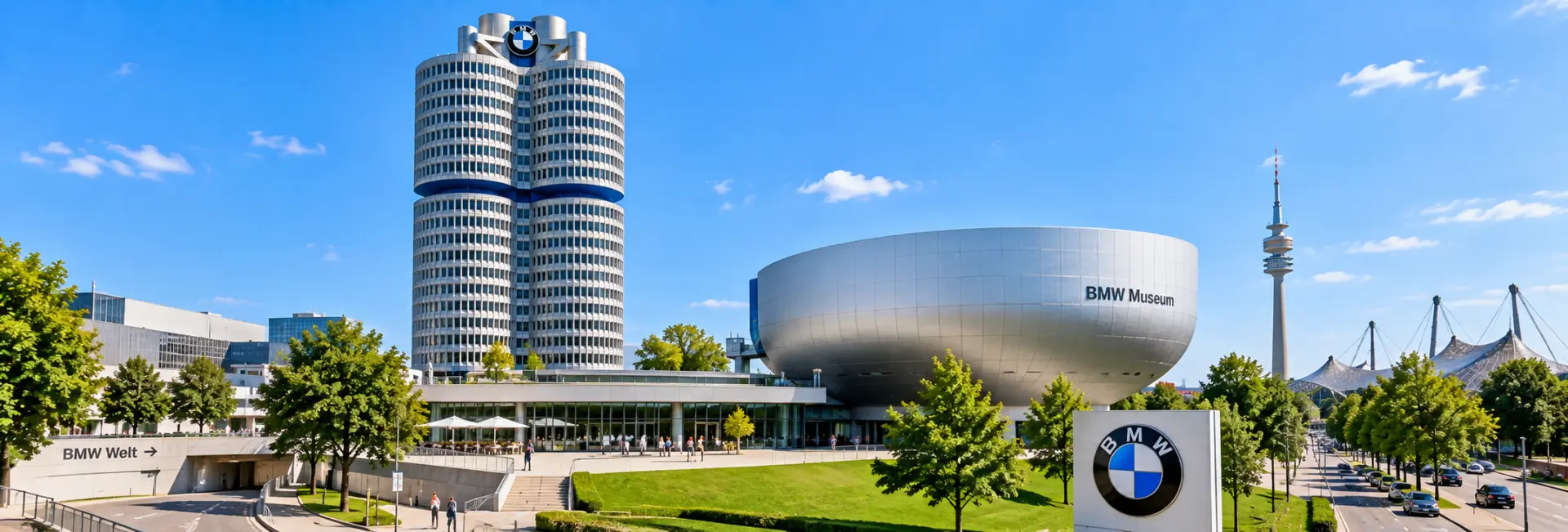
Facing the futuristic BMW Welt showroom near Munich's Olympiapark, the BMW Museum traces more than a century of the Bavarian carmaker's history in one of the city's most recognizable pieces of modern architecture. The building's silver, bowl-shaped centerpiece has become a local landmark in its own right, nicknamed the "soup bowl" by generations of Munich residents long before most visitors ever step inside.
Behind its unusual shape sits a largely chronological journey through BMW's story, from its early days building aircraft engines through decades of motorcycles, sports cars, and record-breaking racing machines. Car enthusiasts and casual visitors alike can walk from century-old engineering to concept vehicles built only a few years ago, all within a single, purpose-designed exhibition space that sits directly beside the company's own headquarters and production plant.
History
From Aircraft Engines to a Company Museum
BMW's own history begins in 1916, when the company started out producing aircraft engines, well before it built its first motorcycle in 1923 or its first car in 1928. For decades afterward, the company kept a small, informal collection of significant vehicles and engines, and in 1966 it opened a modest factory museum at its Munich plant to display some of these historic pieces to visitors for the first time.
Building the Museum Bowl
As visitor numbers grew, BMW's leadership decided a purpose-built museum was needed, and the company held a design competition that Viennese architect Karl Schwanzer, who had also designed BMW's nearby headquarters tower, went on to win. His striking circular building, informally nicknamed the "Bowl," opened to the public on 18 May 1973, shortly after Munich hosted the Summer Olympics nearby. Between 2004 and 2008, the museum closed for a major renovation and expansion tied to the construction of the neighboring BMW Welt building, before reopening to the public on 21 June 2008 with several times its original exhibition space.
Architecture: The Museum Bowl
The museum's original building, now generally referred to as the Bowl, is an almost perfectly circular structure with a compact base only around 20 metres across that widens dramatically toward a flat roof roughly twice that width. Architect Karl Schwanzer designed the interior as a continuous upward spiral, so visitors climb gradually through the building's levels rather than moving between separate floors, an arrangement meant to echo the experience of a road winding through a landscape.
The 2004-2008 renovation extended this idea into an adjoining low-rise structure, adding a series of connected exhibition spaces that BMW describes internally as streets, squares, bridges, and houses, arranged like a small built-up district. Today the original Bowl is used mainly for temporary exhibitions, while the surrounding extension houses the museum's main permanent collection.
Collections & Exhibits
Spread across seven theme-based exhibition areas, the BMW Museum uses roughly 125 original vehicles, engines, and design objects to walk visitors through more than a hundred years of company history. The presentation generally follows a chronological arc, moving from the earliest aircraft engines through the rise of BMW motorcycles and the postwar recovery of the car business, and on to contemporary and concept vehicles, with each themed area given room to explore a distinct chapter of that story in depth.
- Early aircraft engines from BMW's founding decades
- Motorcycles spanning nearly the full history of the brand
- Postwar and modern production cars tracing design and engineering changes over time
- Motorsport vehicles connected to BMW's racing history
- Concept cars and technology studies from recent decades
A rotating temporary exhibition inside the original Bowl building complements the permanent collection, typically focusing on a specific model, era, or theme within BMW's history.
Must-See Highlights
A handful of vehicles tend to draw the most attention from visitors moving through the museum's chronological displays.
- An early 1928 Dixi, based on a licensed foreign design and among the first cars to carry the BMW name
- The BMW 328, a prewar sports car remembered for its outright win at the 1940 Mille Miglia road race
- A 1970s BMW 3.0 CSL race car, nicknamed the "Batmobile" for its dramatic aerodynamic add-ons
- Motorcycles that trace BMW's long history in two-wheeled engineering, from early models to more recent machines
- Art cars created by contemporary artists, part of a long-running BMW program pairing racing cars with well-known names in the art world
Because the collection spans everything from delicate prewar engineering to modern concept vehicles, visitors with very different interests, whether in design, motorsport, or engineering history, tend to find something that stands out to them personally.
Ways to Experience It
The museum's spiral layout is designed to be walked as a single, mostly linear route, making it straightforward to explore independently at your own pace using the exhibition's information panels.
- Guided tours are available in German and English for visitors who want more detailed background on specific vehicles and eras
- A museum app offers additional multimedia content that can be used alongside a self-guided visit
- The BMW Junior Museum programme offers activities aimed at younger visitors and school groups
- Combined tickets and guided factory tours let visitors extend their trip to include the neighboring BMW Welt and the BMW Group's Munich production plant
Because the museum sits directly across from BMW Welt, many visitors treat the two as a single outing, moving between the historical collection and the more experience-driven, contemporary exhibits next door.
Best Time to Visit
The BMW Museum is closed on Mondays, so it is worth checking the weekly schedule before planning a visit around a specific day. On the days it is open, arriving close to opening time or visiting on a weekday generally means smaller crowds and easier access to popular exhibits and guided tours.
Because the museum, BMW Welt, and the factory tours are all clustered together near the Olympiapark, visitors often plan a half-day or full-day trip to the area, and weekday mornings tend to work well for combining several of these in a single visit without long waits.
Visitor Tips
A little preparation helps visitors make the most of a trip to the BMW Museum.
- Book tickets online in advance, particularly for guided tours or combined visits with the BMW plant
- The museum and the wider BMW Welt complex are fully wheelchair accessible
- Allow at least two hours to see the permanent collection at a comfortable pace
- Check current opening hours before visiting, since the museum is closed on Mondays and on several public holidays
- The nearest public transport connections are the Olympiazentrum U-Bahn station and several nearby bus and tram stops
- On-site parking is available for visitors arriving by car
Nearby Attractions
The BMW Museum sits within a compact cluster of sights near Munich's Olympiapark, making it easy to combine with other stops in the same afternoon.
- BMW Welt, the brand's showroom and delivery center, directly across the street
- The BMW Group's Munich production plant, which offers its own guided tours
- Olympiapark, with its stadium, tower, and lake, a short walk away
- The BMW Tower, the company's distinctive four-cylinder-shaped headquarters building next door
FAQs about visiting the BMW Museum
What is the BMW Museum? +
It is BMW's corporate history museum in Munich, using around 125 original vehicles and engines to trace more than a century of the company's engineering and design history.
How much time should I plan for a visit? +
Most visitors need at least two hours to see the permanent collection at a comfortable pace, more if combining the visit with BMW Welt or a plant tour.
Is the BMW Museum the same as BMW Welt? +
No, they are separate but neighboring buildings. The Museum focuses on BMW's history through original vehicles, while BMW Welt is a showroom and delivery center for current models.
What are the must-see exhibits? +
Popular highlights include the early 1928 Dixi, the Mille Miglia-winning BMW 328, the 1970s "Batmobile" 3.0 CSL race car, and BMW's art cars created with contemporary artists.
Is the museum open every day? +
No, the BMW Museum is closed on Mondays and on several public holidays, so it is worth checking current opening hours before planning a visit.
Can I combine a museum visit with a factory tour? +
Yes, guided tours of the neighboring BMW Group production plant can be booked alongside a museum visit for a more complete look at the company.
Is the museum accessible for visitors with mobility needs? +
Yes, the BMW Museum and the wider BMW Welt complex are fully wheelchair accessible.
How do I get to the BMW Museum? +
The museum is a short walk from the Olympiazentrum U-Bahn station, with several bus and tram stops also nearby, and on-site parking is available for visitors arriving by car.