Table of Contents
Overview
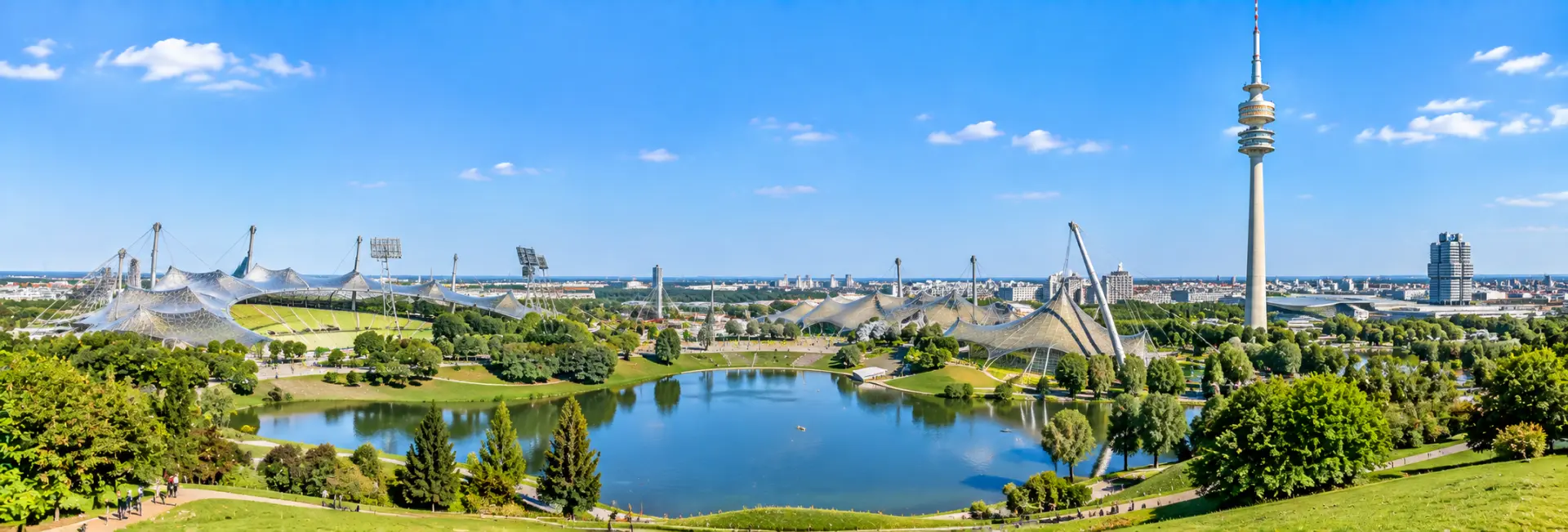
North of Munich's city center, on a stretch of land once used as a military drill ground and later as an airfield, spreads Olympiapark, the sprawling green complex built for the 1972 Summer Olympics. More than half a century later, it remains one of the city's most visited destinations, blending sports venues, a lake, an artificial hill, and one of the most celebrated pieces of postwar German architecture into a single, walkable park.
What draws most visitors today is not nostalgia for a single Olympic Games but the park's continued life as a venue: concerts under the stadium's famous tent roof, swimming and ice skating, boat rides on the lake, and sweeping views from the Olympic Tower all keep Olympiapark busy throughout the year, alongside quieter corners simply made for a walk or a picnic.
History
From Airfield to Olympic Site
The site now occupied by Olympiapark, known as Oberwiesenfeld, has a layered history that predates the Olympics by decades. It served as a military drill ground before Munich's first airport opened there, and it was even the landing site for one of the earliest Zeppelin flights in 1909. After the Second World War, rubble cleared from the heavily bombed city was piled onto the flat terrain, gradually forming what would later become the artificial hill known as the Olympiaberg.
Designing the 1972 Olympics
After Munich won the right to host the 1972 Summer Olympics in 1966, a team of young architects led by Gunter Behnisch won the design competition for the new Olympic site. To realize their vision of a light, transparent tent roof over the main venues, Behnisch's team brought in architect Frei Otto and structural engineer Jorg Schlaich, while landscape architect Gunther Grzimek shaped the surrounding parkland and graphic designer Otl Aicher created its now-famous visual identity. Construction began in 1968, and the finished park was deliberately designed as an open, welcoming contrast to the monumental stadiums of the 1936 Berlin Olympics.
The Munich Massacre
The 1972 Games were marked by tragedy when, on 5 September, members of the Palestinian group Black September took eleven Israeli athletes and coaches hostage in the nearby Olympic Village; all the hostages, along with a German police officer, were killed before the crisis ended. The park today includes two memorials to the victims, an earlier sculpture from 1995 and a dedicated documentation site that opened in 2017, both offering visitors a place for quiet reflection alongside the park's more celebratory attractions.
Key Areas & Landmarks
Olympiapark is generally understood to cover several connected zones, each with its own character and attractions, spread across roughly 85 hectares of parkland.
- The Olympic Stadium, once home to FC Bayern Munich and now used for concerts and events, still seats tens of thousands beneath its tent roof
- The Olympiahalle, an indoor arena for concerts and sporting events, and the neighboring Olympia-Schwimmhalle swimming hall
- The Olympiaturm, a 291-metre tower with an observation deck, a revolving restaurant, and a small rock and roll museum
- The Olympiasee, an artificial lake used for boating and popular for walks along its banks
- The Olympiaberg, a hill built from wartime rubble that has become one of the city's best free viewpoints
- The former Olympic Village, now largely residential, just north of the main sports facilities
Architecture & Design
Olympiapark's defining architectural feature is its sweeping tent roof, a cable-net structure engineered by Frei Otto that stretches over the stadium, the Olympiahalle, and the swimming hall in a series of translucent, acrylic-paneled canopies. Suspended from tall steel masts and anchored by long cables, the roof was one of the most ambitious lightweight structures built anywhere in the world at the time, and it remains a touchstone in the history of tensile architecture.
The choice of such an airy, transparent design was deliberate: after the heavy, monumental stadiums built for the 1936 Berlin Olympics under the Nazi regime, Munich's organizers wanted architecture that expressed openness and democracy instead. That philosophy extended to the surrounding landscape design, which favored rolling green hills and an informal lake over rigid, symmetrical layouts, and to Otl Aicher's simplified pictograms, which were widely adopted afterward as a model for clear visual signage at other major events.
Ways to Experience It
Beyond simply walking through the park, Olympiapark offers a wide range of structured activities for visitors who want to get more hands-on with the site.
- Ride the elevator up the Olympic Tower for panoramic views over the park and the city, weather permitting
- Take a guided climb across the stadium's tent roof, or a zipline descent down to the field below, for a closer look at the structure
- Rent a pedal boat on the Olympiasee, or simply walk or jog the paths that circle it
- Visit the SEA LIFE aquarium, go ice skating or swimming, or take in a match or concert at one of the indoor arenas
- Follow the Munich Walk of Stars, or catch an open-air concert or festival such as Tollwood or Superbloom, depending on the season
Many of these activities, particularly the tower and the roof climb, are seasonal or require advance booking, so it is worth checking current availability and opening status before planning a visit around a specific one.
Best Time to Visit
Olympiapark rewards a visit in almost any season, though the outdoor parts of the experience, walking the lake paths, climbing the Olympiaberg, or catching an open-air concert, are naturally best enjoyed from late spring through early autumn. Summer also brings the park's busiest festival season, with major events drawing large crowds on weekends.
For quieter visits, weekday mornings tend to be calmest, especially outside of the summer festival months. Clear days are particularly worth prioritizing for a trip up the Olympic Tower, since the payoff, views stretching toward the Alps, depends heavily on visibility, and the tower's schedule and access can change during periods of maintenance or renovation.
Visitor Tips
A few practical points make it easier to enjoy a visit to Olympiapark.
- Entry to the park itself is free, though individual attractions such as the tower, aquarium, or roof climb charge separate admission
- Check the current status of the Olympic Tower before visiting, since it has periodically closed for maintenance and renovation work
- Wear comfortable shoes, since the park is large and many of its best views involve some walking or a climb up the Olympiaberg
- Book popular activities like the roof climb or zipline in advance, particularly during summer weekends
- The nearest U-Bahn station is Olympiazentrum, served by lines U3 and U8, with several bus and tram connections also nearby
- Check the events calendar before visiting if you would rather avoid, or specifically attend, a large concert or festival
Nearby Attractions
Olympiapark sits within a compact cluster of Munich attractions, several of them within walking distance.
- The BMW Museum and BMW Welt, telling the history of the Bavarian carmaker just across the road
- The BMW Group's Munich production plant, which offers guided factory tours
- The Pinakothek museums and the Museum Brandhorst, part of Munich's wider art district a short ride away
- Munich's Old Town and Marienplatz, reachable directly by U-Bahn for those combining a park visit with central sightseeing
FAQs about visiting Olympiapark
What is Olympiapark? +
It is the park built for the 1972 Summer Olympics in Munich, now a public green space with sports venues, a lake, a hill, and the Olympic Tower.
Is entry to Olympiapark free? +
Yes, walking through the park itself is free, though individual attractions such as the Olympic Tower, the SEA LIFE aquarium, and the roof climb charge separate admission.
Can you still go up the Olympic Tower? +
Usually yes, though the tower has periodically closed for maintenance and renovation, so it is worth checking its current status before planning a visit around it.
What happened at the 1972 Olympics here? +
Alongside the sporting events, the Games were marked by the Munich massacre, in which Israeli athletes and coaches were taken hostage and killed; the park includes memorials to the victims.
How much time should I plan for a visit? +
A couple of hours covers a walk around the lake and hill, while a full day allows time for the tower, an activity like the roof climb, and a nearby museum such as the BMW Museum.
What's the best viewpoint in the park? +
The Olympiaberg hill offers a free panoramic view over the park and city, while the Olympic Tower's observation deck provides a higher, more distant view on clear days.
Is Olympiapark good for families? +
Yes, attractions such as the SEA LIFE aquarium, the lake, ice skating, and open green spaces for picnics make it a popular destination for families.
How do I get to Olympiapark? +
The nearest U-Bahn station is Olympiazentrum on lines U3 and U8, with several bus and tram routes also stopping nearby.