

Table of Contents
- About Frankfurt
- Climate in Frankfurt
- Getting to Frankfurt
- Transportation in Frankfurt
- Top Attractions in Frankfurt
- Neighborhoods to Explore
- Food in Frankfurt
- Accommodation in Frankfurt
- Day Trips from Frankfurt
- Safety Tips in Frankfurt
- Budget & Costs in Frankfurt
- Local Customs & Etiquette
- Suggested Itineraries
About Frankfurt
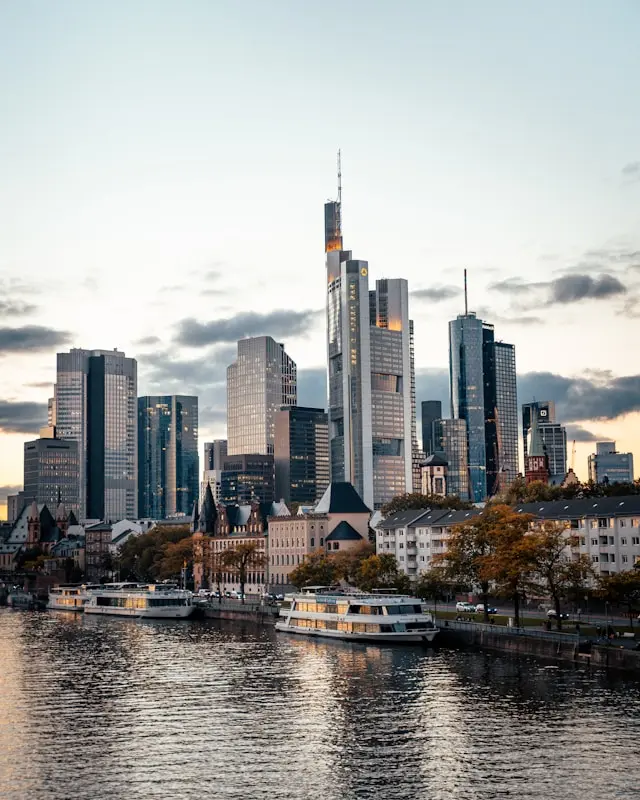
Frankfurt often gets treated as a layover city rather than a destination, mostly thanks to its enormous airport and role as Germany's financial capital. That reputation undersells it. The skyline of glass towers, unusual for a German city and often nicknamed Mainhattan after the River Main that runs through it, sits just a short walk from a carefully reconstructed old town and some genuinely excellent museums.
The city was heavily damaged during the Second World War, and much of what looks historic in the Altstadt, or old town, is in fact a modern reconstruction completed in recent decades, rebuilt to resemble the medieval quarter that stood there before. This blend of old and new, high finance and half timbered houses, gives Frankfurt a different character than either Germany's more classically preserved towns or its purely modern cities.
Frankfurt is compact enough to explore largely on foot or by a short tram ride, with most major sights sitting within a few kilometers of each other along or near the river.
Climate in Frankfurt
Frankfurt has a temperate continental climate, with warmer summers and colder winters than the maritime cities of northwestern Europe, though still without extremes in either direction.
- Spring, from March to May, is mild and increasingly pleasant as the season progresses, with temperatures generally between 8 and 18 degrees Celsius, or 46 to 64 degrees Fahrenheit.
- Summer, from June to August, is warm and can turn genuinely hot for stretches, with temperatures typically between 20 and 28 degrees Celsius, or 68 to 82 degrees Fahrenheit, and occasional spikes higher during heatwaves.
- Autumn, from September to November, cools steadily, with comfortable early autumn days giving way to greyer, wetter conditions by November.
- Winter, from December to February, is cold, with temperatures generally between minus 1 and 5 degrees Celsius, or 30 to 41 degrees Fahrenheit, and occasional snow, particularly in January and February.
Late spring through early summer, along with September, tend to offer the most comfortable weather for exploring the city on foot, while Frankfurt's Christmas market season in late November and December draws visitors despite the cold.
Getting to Frankfurt
Frankfurt Airport is one of the busiest in Europe and a major long haul hub, located about 12 kilometers southwest of the city center. Regional and long distance trains run directly from the airport's own train station to Frankfurt Hauptbahnhof, the main station, in around 12 minutes, making it one of the more convenient major airports to reach the city center from.
Frankfurt is also one of the most centrally connected cities in Germany's rail network. High speed ICE trains link it to Cologne in about an hour, Munich in around three hours, and Berlin in roughly four hours, while international connections reach Paris, Amsterdam, and Zurich directly.
Frankfurt Hauptbahnhof sits close to the city center, with the Altstadt and central business district both reachable on foot or by a short tram ride.
Entry requirements depend on nationality and are subject to change, so it is worth confirming current visa and Schengen area rules directly with an official German or EU government source shortly before traveling.

Transportation in Frankfurt
Frankfurt's public transport network, run by the RMV, combines U-Bahn light rail lines, S-Bahn regional trains, trams, and buses into a single integrated system that covers the city and surrounding region well. Trains generally run from around 4:30 a.m. until just after midnight, with night bus and tram services filling in some gaps on weekends.
Tickets cover all forms of transport within a given fare zone, and a day pass is often the most practical option if you plan on making several trips, since single tickets add up quickly.
The city center is compact enough that walking is often the most practical way to move between the Altstadt, the Museumsufer along the river, and the central business district, all of which sit within a reasonable walking distance of each other.
Trams cover routes the U-Bahn does not reach as directly and are a pleasant, scenic way to see more of the city above ground.
Taxis and ride hailing apps are both readily available, and Frankfurt's compact size means fares between central points tend to be reasonable compared to larger German cities like Berlin or Munich.
Top Attractions in Frankfurt
Frankfurt's sights mix reconstructed medieval charm with striking modern architecture, and most sit close enough together to combine easily in a single day.
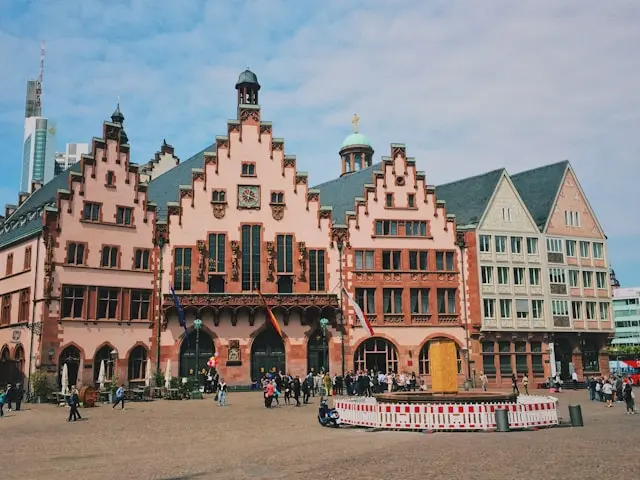
- Romerberg, the reconstructed medieval square at the heart of the Altstadt, is anchored by the distinctive stepped gable facades of the Romer, Frankfurt's historic city hall, and is one of the most photographed spots in the city.
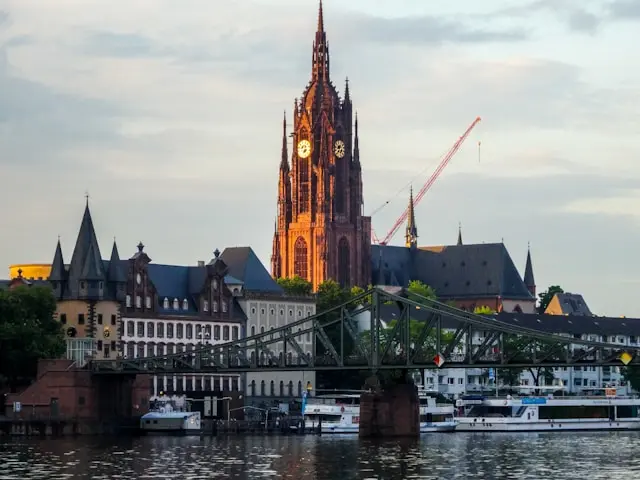
- The Frankfurt Cathedral, or Dom, a red sandstone Gothic church, offers a climbable tower with sweeping views over the Altstadt and the modern skyline beyond it.
- The Museumsufer, a stretch of riverside along the Main lined with over a dozen museums, includes the Stadel Museum for classical and modern art and the Museum Angewandte Kunst for applied arts, making it easy to combine museum visits with a riverside walk.
- The Main Tower, one of the few skyscrapers in the city open to the public, offers an observation deck with views over both the historic center and the surrounding financial district skyline.
- Goethe House, the birthplace and childhood home of the writer Johann Wolfgang von Goethe, offers a detailed look at 18th century domestic life alongside the writer's own history.
- The Palmengarten, one of Germany's largest botanical gardens, offers a quiet, green counterpoint to the density of the city center.
Because so many sights sit within walking distance of the river, a single well planned day can cover the Altstadt, the Dom, and a couple of Museumsufer museums without needing much transport at all.
Neighborhoods to Explore
Beyond the reconstructed Altstadt and the skyscrapers of the financial district, Frankfurt's surrounding neighborhoods each have a distinct feel worth exploring.
- Sachsenhausen, on the south bank of the Main, is known for its traditional apple wine taverns, called Apfelweinkneipen, and offers a more local, low key contrast to the business focused north bank.
- Bornheim, northeast of the center, has a village-like feel with a lively weekly market and a strong concentration of casual bars and restaurants popular with a younger crowd.
- Nordend, just north of the center, is a leafy, residential area with a mix of well preserved late 19th century buildings and a good concentration of independent cafes.
- Bockenheim, home to parts of Goethe University, has a studenty, relaxed atmosphere with affordable dining options and a genuinely local feel.
- The Westend, close to the financial district, mixes grand historic villas with proximity to the Palmengarten, offering a quieter, greener alternative to the busier center.
An evening in Sachsenhausen trying apple wine, or an afternoon wandering Bornheim's market, tends to give a much clearer sense of everyday Frankfurt life than time spent only around the skyscrapers and the Altstadt.

Food in Frankfurt
Frankfurt has its own distinct culinary identity within Germany, built around a handful of regional specialties that are worth prioritizing over generic German food elsewhere in the city.
- Apfelwein, a tart, fermented apple wine unique to the Frankfurt region, is the local drink of choice and is traditionally served in a distinctive ribbed glass called a Gerippte, best tried at a traditional tavern in Sachsenhausen.
- Grune Sosse, a green sauce made from a mix of fresh herbs and typically served with boiled eggs and potatoes, is one of Frankfurt's most iconic dishes and has its own dedicated festival each year.
- Frankfurter sausages, the origin of the word frankfurter, are traditionally made from pork and are worth trying from a proper butcher or traditional restaurant rather than a generic hot dog stand.
- Handkase mit Musik, a tangy, marinated cheese served with onions, bread, and butter, is a distinctly Frankfurt bar snack that pairs naturally with a glass of apple wine.
- The city's Christmas markets, particularly the one at Romerberg, are worth visiting in season for mulled wine and traditional baked goods, even outside a dedicated food itinerary.
Trying a few of these regional specialties at a traditional Apfelweinkneipen in Sachsenhausen tends to give a much more authentic sense of Frankfurt's food culture than dining exclusively near the tourist heavy Romerberg square.
Accommodation in Frankfurt
Where to stay in Frankfurt depends partly on the purpose of your trip, since the city serves both business travelers and tourists in noticeably different ways.
- The city center, around the Altstadt and Hauptwache, puts you within walking distance of the Romerberg, the Dom, and the Museumsufer, with a good mix of hotel options at various price points.
- The financial district, or Bankenviertel, is convenient for business travelers and offers modern high rise hotels, though it can feel quiet and corporate outside working hours.
- Sachsenhausen offers a more local, atmospheric base close to the Museumsufer and the apple wine taverns, with generally better value than the city center.
- Westend provides a quieter, greener option close to the Palmengarten, appealing if you want a residential feel without being far from the center.
- Areas near the Hauptbahnhof offer convenience for arrivals and departures and tend to be more budget friendly, though the immediate station area is less polished than other parts of the city.
Frankfurt's role as a major trade fair city means hotel prices can spike significantly during large conventions and events, so checking the trade fair calendar before booking can help avoid unexpectedly high rates.
Day Trips from Frankfurt
Frankfurt's central location in Germany, along with its strong rail connections, makes several worthwhile destinations accessible as day trips.
- Heidelberg, about an hour away by train, is known for its picturesque old town and hilltop castle ruins, and remains one of the most popular day trips from Frankfurt.
- The Rhine Valley, particularly the stretch between Rudesheim and Koblenz, offers dramatic river scenery, hilltop castles, and vineyard covered slopes, and is often explored by a combination of train and river cruise.
- Mainz, just 40 minutes away by train, has a well preserved old town and is home to the Gutenberg Museum, dedicated to the inventor of the printing press.
- Rothenburg ob der Tauber, around two and a half hours by train, is one of Germany's best preserved medieval walled towns and, while a longer trip, is popular enough to be done as a full day if time allows.
- Wiesbaden, about 40 minutes away, offers an elegant spa town atmosphere with grand 19th century architecture, a notable contrast to Frankfurt's mix of medieval and ultra modern.
Most of these destinations are straightforward to reach independently by regional or high speed train, and Frankfurt's central position in Germany's rail network makes even the further options manageable within a single day.
Safety Tips in Frankfurt
Frankfurt is generally a safe city for travelers, and violent crime against tourists is uncommon. The more realistic concerns are petty theft around the main train station and in crowded areas during major trade fairs or events.
A few practical habits help reduce risk.
- Keep bags secured and stay alert around the Hauptbahnhof, particularly in the evening, since this area sees a higher concentration of petty crime than most other parts of the city.
- Be cautious in the area immediately around the station at night, known locally as the Bahnhofsviertel, which has a mix of legitimate nightlife and some rougher edges depending on the specific street and time of night.
- Use licensed taxis or well known ride hailing apps rather than unmarked cars offering rides.
- Keep valuables out of sight on trams and trains, particularly during busy commuting hours or large public events.
- Stay aware of your surroundings during Frankfurt's major trade fairs, when the city sees a significant spike in visitor numbers and, correspondingly, in pickpocketing incidents.
If something is stolen, German police stations can issue an official report, which is generally required for any travel insurance claim.

Budget & Costs in Frankfurt
Frankfurt is moderately priced compared to other major European financial capitals, though costs can spike significantly around major trade fairs and conventions, which are frequent given the city's role as a global business hub.
- Budget travelers can manage well by staying slightly outside the center, eating at bakeries and traditional taverns rather than upscale restaurants, and relying on day passes for public transport.
- Mid-range travelers have a wide range of comfortable hotel options, along with a good mix of casual dining and museum visits along the Museumsufer.
- Higher end travelers will find plenty of ways to spend more, particularly in the financial district's upscale hotels and restaurants catering to business travelers.
A few habits help stretch a budget regardless of spending level, including checking the city's trade fair calendar before booking accommodation, since hotel prices can double or more during major events, taking advantage of the Museumsufer's combined ticket options if visiting several museums, and eating at traditional Apfelweinkneipen in Sachsenhausen, which tend to offer better value than restaurants closer to the tourist heavy Romerberg.
Local Customs & Etiquette
German etiquette in Frankfurt tends to be straightforward and punctuality focused, and a few local norms are worth knowing before you go.
- Punctuality is taken seriously, whether for a train, a restaurant reservation, or a business meeting, and arriving late without notice is generally viewed as a lack of respect for the other person's time.
- Jaywalking, even on an empty street, is frowned upon, and locals generally wait for pedestrian signals even when no traffic is visibly coming.
- Formal address, using Herr or Frau along with a surname, remains common in business and initial social interactions, with a shift to first names typically coming only after some familiarity is established.
- Ordering apple wine diluted with sparkling water, known as a Sauergespritzter, is a completely normal way to drink it and not seen as watering down the experience.
- Tipping is customary but modest, generally rounding up or adding around 5 to 10 percent, and is usually communicated verbally to the server rather than left on the table.
Beyond these specifics, a direct, efficient approach to interactions tends to fit comfortably with the local culture, particularly given Frankfurt's business oriented character.
Suggested Itineraries
One Day in Frankfurt
Start at Romerberg and the Altstadt in the morning, climb the Dom tower for a view over the city, then walk along the Museumsufer, choosing one or two museums depending on interest. Cross into Sachsenhausen in the evening for apple wine and Grune Sosse at a traditional tavern.
Three Days in Frankfurt
- Day one covers Romerberg, the Dom, and the Museumsufer, followed by an evening in Sachsenhausen.
- Day two covers the Main Tower for city views, the Palmengarten, and the Westend, with Goethe House added if time allows.
- Day three covers a day trip to Heidelberg or a Rhine Valley excursion, both easily reachable within a single day by train.
One Week in Frankfurt
The extra days allow for additional day trips such as Mainz, Wiesbaden, or Rothenburg ob der Tauber, along with time to explore local neighborhoods like Bornheim and Nordend, and enough flexibility to slow down with an afternoon spent simply working through the Museumsufer's remaining museums at a relaxed pace.

FAQs about Frankfurt
Is Frankfurt worth visiting beyond the airport? +
Yes. While often treated as a layover city, Frankfurt has a genuinely interesting mix of reconstructed medieval old town, strong museums along the Museumsufer, and a distinct local food and drink culture centered on apple wine.
How many days do you need in Frankfurt? +
Two to three days covers the main sights comfortably, while a week allows time for day trips like Heidelberg or the Rhine Valley alongside a slower exploration of local neighborhoods.
Is Frankfurt safe for solo travelers? +
Generally yes. The main concerns are petty theft around the main train station and its immediate surroundings, and normal city awareness covers most situations.
What is the best time of year to visit? +
Late spring through early summer and September tend to offer the most comfortable weather, while late November and December draw visitors for the Christmas markets despite the cold.
Does Frankfurt get more expensive during certain times? +
Yes. As a major trade fair city, hotel prices can spike significantly during large conventions, so checking the fair calendar before booking accommodation is worthwhile.
Is public transport easy to use for visitors? +
Yes. The integrated U-Bahn, S-Bahn, tram, and bus network is efficient and well signposted, and the compact city center also makes much of it walkable without relying on transport at all.