Table of Contents
Overview
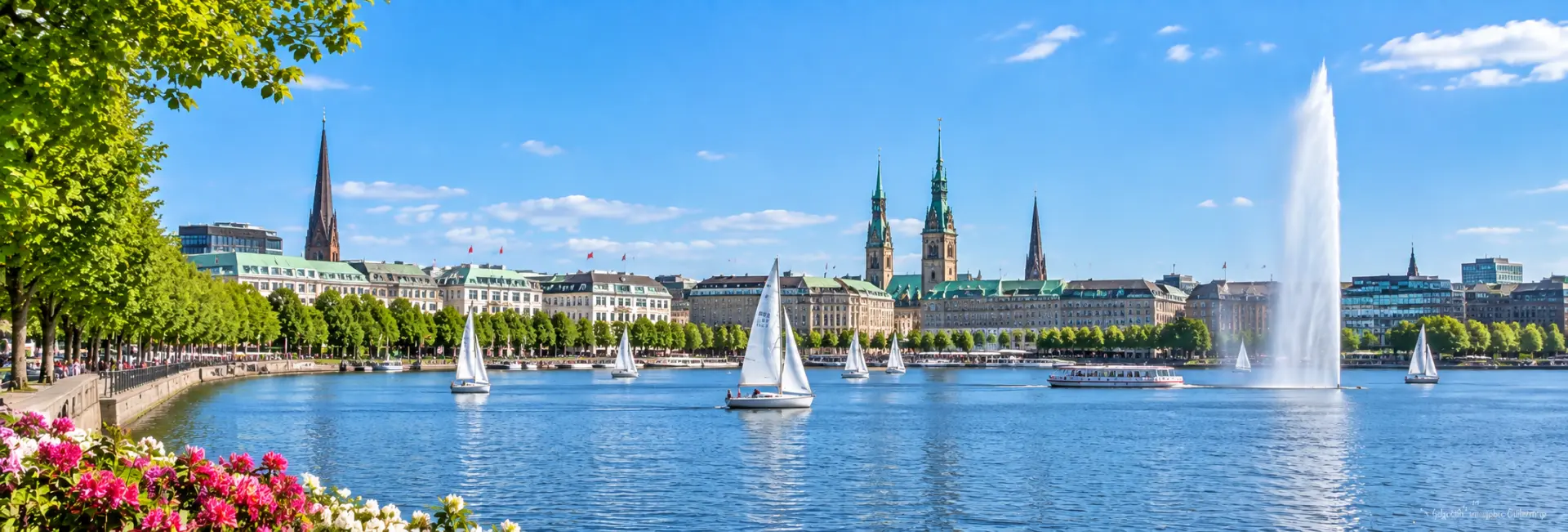
The Alster Lakes sit right at the heart of Hamburg, giving Germany's second-largest city a stretch of open water where most metropolises would have only more streets and buildings. The two connected basins, the small Binnenalster and the much larger Außenalster, were formed by damming the Alster River centuries ago and have since become the defining image of the city, appearing on postcards, in films and in the daily routines of hundreds of thousands of residents.
What makes the lakes so distinctive is how thoroughly they are woven into everyday city life rather than roped off as a single tourist site. Bankers step out of glass office towers onto the same waterfront promenade used by joggers, sailors rig their boats a few minutes' walk from department stores, and grand nineteenth-century villas line shores that are also home to public parks anyone can wander into for free. Visitors get panoramic views, historic streetscapes and a genuine slice of local life all within the same short walk.
History
From River to Reservoir
The Alster began as a modest river flowing toward the Elbe, but its course through the heart of Hamburg was permanently altered in the thirteenth century when the settlement's rulers dammed it to power watermills. The first dam, built around 1190, was followed by a second in 1235 under Count Adolf IV of Schauenburg and Holstein, a project that raised the water level enough to flood the surrounding lowland and effectively create a lake where a river had been. That structure, known as the Reesendamm, later gave its name and its route to what is now the Jungfernstieg promenade.
Inner and Outer, Divided by the City Walls
As Hamburg grew, its fortifications split the flooded area into two distinct bodies of water. The smaller portion, enclosed within the city walls, became the Binnenalster, or "Inner Alster," while the larger expanse beyond the ramparts became the Außenalster, the "Outer Alster." When the walls were dismantled in the early nineteenth century and replaced with landscaped grounds, the physical barrier between city and countryside disappeared, but the two lakes kept their separate names and character, still divided today by the Lombardsbrücke and Kennedybrücke bridges.
Twentieth-Century Disruption and Renewal
During the Second World War, the Binnenalster was disguised under a temporary wooden covering designed to make it harder for Allied bombers flying at night to use the reflective water as a navigational landmark for the surrounding inner city. A decoy bridge was even built on the Außenalster to complete the deception. The lakes survived the war and, through public projects such as the 1953 International Horticulture Show, saw many of their formerly private western shores opened up as public parkland, a shift that shaped the open, walkable character visitors experience today.
The Two Lakes: Binnenalster & Außenalster
Although often spoken of as a single attraction, the Alster Lakes are technically two separate basins joined by a narrow channel beneath the Lombardsbrücke and Kennedybrücke bridges. The Binnenalster is compact, covering roughly 20 hectares, and is framed almost entirely by dense city development: the Rathaus, the Jungfernstieg shopping promenade and grand hotels all face directly onto its water. At its centre stands the Alster Fountain, a jet of water that has become one of Hamburg's most photographed landmarks since it was installed in the late 1980s.
Beyond the bridges, the Außenalster opens into a far larger lake of around 164 hectares, ringed not by dense commercial streets but by parkland, tree-lined paths and some of the city's most desirable residential districts. Its shoreline stretches for roughly 7.6 kilometres, drawing joggers, cyclists and walkers who circle the entire lake as a matter of daily routine. Several smaller canals, including the Osterbekkanal and the Goldbekkanal, feed into the Außenalster, giving rowers and sailors quieter side channels to explore away from the open water.
- Binnenalster: roughly 20 hectares, average depth around 2 metres, bordered by the city centre
- Außenalster: roughly 164 hectares, average depth around 2.5 metres, bordered by parks and villa districts
- Connected beneath the Lombardsbrücke and Kennedybrücke bridges
- Fed by the Alster River along with the Osterbek and Wandse tributaries
Parks, Promenades & Architecture
The shores of the Alster Lakes read like an open-air catalogue of Hamburg's architectural history. Along the Binnenalster, the Jungfernstieg promenade is lined with grand nineteenth-century commercial buildings from Hamburg's Gründerzeit boom years, including the Alsterhaus department store, while the elegant Alsterarkaden arcade offers a sheltered, colonnaded walkway along the adjoining Kleine Alster canal, with views toward the Rathaus and its clock tower.
Around the larger Außenalster, the mood shifts from commercial bustle to leafy residential grandeur. Neighbourhoods such as Rotherbaum, Harvestehude, Winterhude and Uhlenhorst grew up along its banks from the late eighteenth century onward, and their waterfront streets are still lined with ornate villas, consulates and hotels that once housed the city's merchant elite. Much of the western shoreline was opened to the public during the 1953 International Horticulture Show, and today green spaces such as the Alsterpark give everyone, not just the residents of the surrounding mansions, direct access to the water's edge.
The Alster Swans
Few details capture Hamburg's affection for its lakes quite like the Alster swans, a flock of white mute swans that has been protected in the city since at least the seventeenth century, when an ordinance first made it illegal to harm or kill them. Hamburg has kept swans on its waterways since as far back as the eleventh century, and the tradition carries genuine civic weight: at a time when swan-keeping was normally reserved for royalty, maintaining a flock signalled that the Hanseatic city considered itself the equal of any court in Europe.
The birds are cared for by an official "Schwanenvater," or swan father, a post that has existed within Hamburg's administration since the 1670s and is often passed down within the same family. Each November, the swans are gathered from the open water by hand and ferried to sheltered winter quarters at the Eppendorfer Mühlenteich, where they stay through the coldest months. Their return each spring, traditionally on the first day of the season, is treated as an unofficial sign that winter in Hamburg is finally over.
Ways to Experience It
On the Water
Boat trips are the classic way to see the lakes from a different angle, with operators such as ATG Alster-Touristik running scheduled cruises from the pier at Jungfernstieg. Options range from a straightforward round trip across the Binnenalster and Außenalster to quieter canal cruises along the narrower Alster arms, evening cruises timed for sunset, and hop-on-hop-off day tickets that let visitors combine a cruise with stops for walking or dining along the shore. Sailing and rowing are equally popular, and small boat and pedal boat rentals are available for anyone who wants to get out onto the water independently.
On Foot or by Bike
The path circling the Außenalster is one of the most heavily used recreational routes in Hamburg, popular with runners, walkers and cyclists at almost any hour. Because the loop is largely flat and well maintained, it suits a leisurely stroll just as well as serious training, and benches and cafés along the way make it easy to break the walk into shorter stretches.
- Alster round trip and canal cruises with ATG Alster-Touristik, departing from Jungfernstieg
- Full loop walk or run around the Außenalster, roughly 7.6 kilometres
- Sailing, rowing and stand-up paddleboarding, with rental options at several jetties
- Ice skating on the Außenalster during the rare winters it freezes solid enough (Alstereisvergnügen)
Best Time to Visit
Late spring through early autumn is the most rewarding stretch for visiting, when the swans are back on the water, sailing boats fill the Außenalster, and the lakeside parks and cafés are at their liveliest. Early morning is especially pleasant for a walk or run, before the paths fill up and while the light on the water is at its softest.
Winter has its own appeal for those visiting outside the busiest months, with quieter promenades and the atmospheric annual Christmas market held around the Binnenalster and Jungfernstieg. On the rare occasions when the Außenalster freezes over completely, the city opens the ice for public skating during the Alstereisvergnügen, an unpredictable but memorable event that only happens when a cold snap is severe enough.
Visitor Tips
- The area around the lakes is free to visit at any time; only boat cruises, rentals and guided tours carry a charge
- Jungfernstieg station (U1, U2, S1, S3) sits right at the Binnenalster and is the easiest starting point for a first visit
- Wear comfortable shoes if planning to walk any real distance, since the full Außenalster loop takes most visitors two to three hours
- Check current departure times for boat cruises in advance, as schedules shrink outside the main March–October season
- The lakeside paths can get crowded with cyclists during commuting hours, so pedestrians should keep to the designated walking side where paths are marked
- Dress for wind: the open expanse of the Außenalster is notably breezier than the surrounding streets
Nearby Attractions
The lakes sit within easy walking distance of several of Hamburg's other major sights, making it simple to combine a lakeside visit with a broader day of sightseeing. The Hamburg Rathaus, the city's ornate town hall, is just a few minutes from the Binnenalster, while the shopping streets around Jungfernstieg and the Neuer Wall lead directly into the historic core of the city centre.
Further afield, the Speicherstadt warehouse district and HafenCity waterfront quarter lie a short walk or metro ride to the south, offering a contrasting view of Hamburg's maritime and modern architecture. To the north and west, the villa-lined streets of Rotherbaum and Harvestehude provide a quieter extension to a walk around the Außenalster, while St. Michaelis Church, one of the city's landmark towers, offers panoramic views back over the lakes from its observation deck.
FAQs about visiting the Alster Lakes
What are the Alster Lakes? +
They're two connected artificial lakes in the centre of Hamburg, the smaller Binnenalster and the much larger Außenalster, both formed by damming the Alster River centuries ago and now surrounded by parks, promenades and historic architecture.
Is it free to visit the Alster Lakes? +
Yes, walking the shoreline, using the parks and watching the swans cost nothing; only optional extras like boat cruises, sailing rentals and guided tours are paid.
How long does it take to walk around the Außenalster? +
The full loop is about 7.6 kilometres and typically takes two to three hours on foot at a relaxed pace, or considerably less by bike.
What's the best way to get to the Alster Lakes? +
Jungfernstieg station, served by the U1, U2, S1 and S3 lines, sits directly on the Binnenalster and is the most convenient starting point for most visitors.
Can you take a boat trip on the Alster? +
Yes, operators such as ATG Alster-Touristik run round trips, canal cruises and evening cruises departing from the pier at Jungfernstieg, generally running most frequently between March and October.
When can you see the Alster swans? +
The swans are on the water from around March through November; each autumn they're gathered up and moved to sheltered winter quarters, returning each spring as an informal sign that winter is over.
Does the Alster ever freeze over for ice skating? +
Only during unusually cold winters does the Außenalster freeze thick enough for the city to open it for public skating during the Alstereisvergnügen, so it's a rare, weather-dependent event rather than an annual one.
What's nearby the Alster Lakes worth combining with a visit? +
The Hamburg Rathaus, the Jungfernstieg shopping streets, the Speicherstadt warehouse district and St. Michaelis Church are all within easy reach for a fuller day of sightseeing.
Is the area around the lakes good for families or less mobile visitors? +
The paved, largely flat paths around both lakes are stroller- and wheelchair-friendly, and shorter sections can easily be chosen instead of the full loop for anyone who doesn't want to cover the whole distance.