Table of Contents
Overview
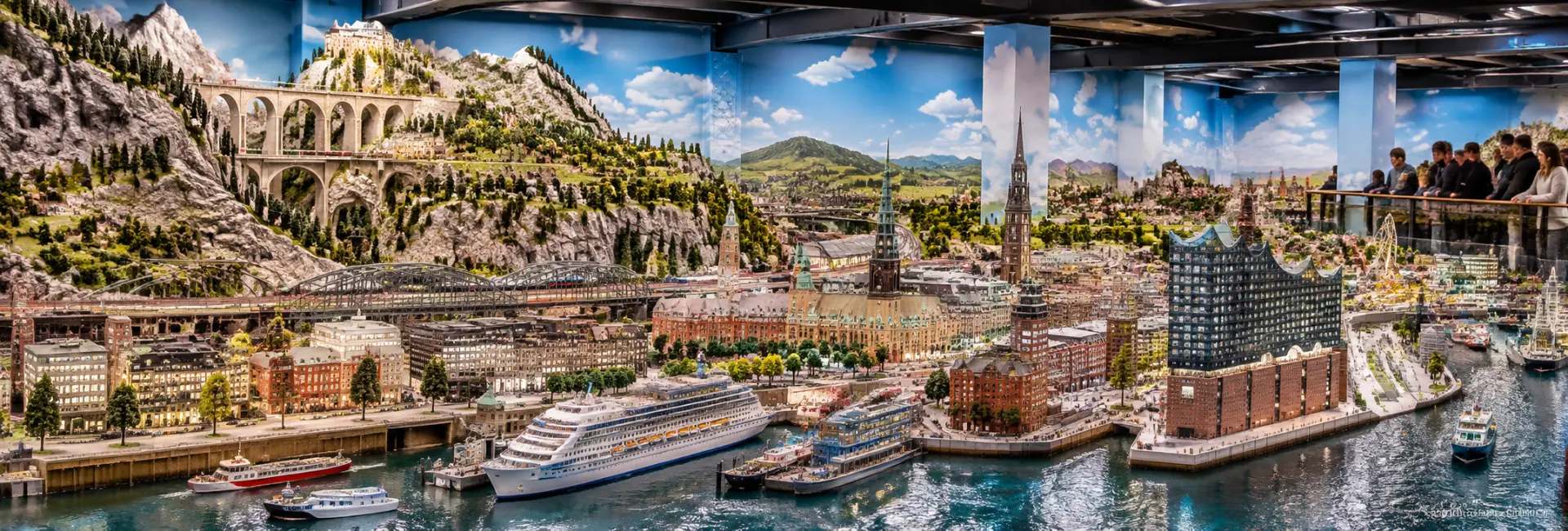
Miniatur Wunderland occupies two converted warehouse buildings in Hamburg's Speicherstadt, and it holds the Guinness World Record for the largest model railway system on the planet. What began as one brother's half-serious idea has grown into a sprawling, hand-built miniature world where trains rattle past mountain villages, planes taxi down a working runway, and an entire day-night cycle rolls through Scandinavia, Italy, and the American Southwest every fifteen minutes.
The exhibition is less a train set than a living diorama of the world. Model builders have spent hundreds of thousands of hours filling every corner with small jokes, tiny dramas, and moving parts, so that a single visit rewards both a quick walk-through and an afternoon spent crouched at eye level looking for hidden details.
What makes the layout unusual is its refusal to sit still. New sections have been added roughly every few years since the exhibition opened, and older ones are periodically reworked, so a visitor who last came a decade ago will still find plenty they haven't seen. That constant construction, carried out in full view of the public, has become almost as much a part of the appeal as the finished scenes themselves.
History
An Idea Born on a Trip to Zurich
The idea for Miniatur Wunderland traces back to the summer of 2000, when Frederik Braun wandered into a model railway shop in Zurich while on a trip and found himself pulled back into a childhood fascination with miniature trains. He pitched his twin brother, Gerrit, on building the largest model railway in the world. Gerrit was skeptical at first, but he came around, and together with their business partner Stephan Hertz they left the nightlife business they had been running in Hamburg to pursue the idea full time.
From Empty Warehouse to World Record
Construction began in a disused Speicherstadt warehouse in December 2000, and the doors opened to the public just eight months later, on 16 August 2001, with three sections: Central Germany, the fictional town of Knuffingen, and Austria. The pace of that first build set the tone for everything that followed: ambitious plans turned into working models on a tight timeline, built in full view of visitors rather than behind closed doors.
Two Decades of Continuous Expansion
The exhibition has never really stopped growing. Hamburg's own cityscape followed in 2002, America in 2003, Scandinavia in 2005, and Switzerland in 2007. The technically ambitious Knuffingen Airport took nearly six years to build before opening in 2011, and Italy, Venice, Rio de Janeiro, Monaco, and Provence have all joined the layout in the years since. Further sections, including a planned depiction of Great Britain, are already on the drawing board for construction later this decade.
The team behind the exhibition has grown just as steadily as the layout itself, from three founders working out of a bare warehouse to a workshop staffed by hundreds of model builders, electricians, and software developers. That growth in scale let each new theme world become more ambitious than the last, moving from simple painted landscapes in the earliest sections toward the fully automated traffic, aircraft, and lighting systems found in the more recent ones.
Recognition & Records
Miniatur Wunderland holds the Guinness World Records title for the largest model railway system in the world, a record it has defended and extended repeatedly as the layout has grown. It is regularly ranked as Germany's single most popular tourist attraction in surveys carried out by the German National Tourist Board, a title driven in large part by international visitors rather than locals.
- Guinness World Record holder for the world's largest model railway
- Repeatedly voted Germany's top tourist attraction in national tourism board surveys
- Founders Frederik Braun, Gerrit Braun, and Stephan Hertz received Germany's Cross of Merit on Ribbon for their social and charitable work connected to the project
- An ICE 4 high-speed train was named "Knuffingen" by Deutsche Bahn to mark the attraction's 25th anniversary in 2026
The recognition extends beyond formal titles. Miniatur Wunderland draws well over a million visitors a year, a substantial share of them arriving from outside Germany specifically to see the layout, and it is consistently ranked among the country's most-reviewed and highest-rated attractions on major travel platforms.
The Twelve Theme Worlds
The Original Worlds
The first three sections built in 2000 and 2001, Central Germany, Knuffingen, and Austria, remain among the most detailed. Knuffingen is a fictional town of around 10,000 miniature residents set between the Harz mountains and the Alps, and it is famous for a running gag in which a building somewhere in town is always mysteriously on fire, kept busy by a fire brigade that never quite catches the culprit. Central Germany and Austria surround it with rolling hills, alpine villages, and mountain rail routes that were part of the very first build phase.
Knuffingen Airport
Opened in 2011 after roughly six years of construction, Knuffingen Airport is the layout's technical centerpiece. Dozens of aircraft models, from small Cessnas up to an Airbus A380, taxi, take off, and land under their own automated control, complete with push-back vehicles, a baggage system, and a fire brigade standing by. It is widely considered the largest miniature airport of its kind anywhere in the world.
Beyond Europe
Later expansions pushed the layout outward from its German and Alpine core. America brought Las Vegas neon and Rocky Mountain canyons to the exhibition in 2003, Scandinavia added fjords and an icebreaker in 2005, and Switzerland followed with its own mountain railways in 2007. Italy and a dedicated Venice section arrived between 2016 and 2018, complete with canals and gondolas, while Rio de Janeiro, Monaco, and Provence have extended the world map still further in the years since.
A Bridge Between the Worlds
A glass walkway called "The World From Above" connects the two warehouse buildings that house the exhibition, giving visitors a chance to look down over sections of the layout from a height rather than only at table level. It opened in 2021 alongside the Rio de Janeiro section and has become a popular spot to pause partway through a visit and take in how the different theme worlds fit together.
Technology Behind the Scenes
Every train, vehicle, and lighting cue at Miniatur Wunderland is digitally controlled, letting the layout run an automated day-night cycle roughly every fifteen minutes, complete with streetlights switching on, traffic patterns shifting, and emergency vehicles responding to staged incidents across section boundaries. The scale of the automation is part of what sets the exhibition apart from a conventional model railway display.
From the very start, the founders chose to keep their construction sites and workshops visible to visitors rather than hidden away, so guests can watch model builders and technicians at work on future sections while touring the finished worlds. That openness has become one of the exhibition's defining traits, turning ongoing construction into part of the show rather than something to be concealed until a grand unveiling.
Behind the visible scenery, the entire layout is run from custom software that coordinates train schedules, road traffic, and the airport's flight sequences so that hundreds of independent movements happen without colliding or backing up. Sensors embedded in the track and roadways feed constant position data back to the control system, letting trains slow for curves, cars stop at intersections, and aircraft queue for a runway the way their full-size counterparts would.
Ways to Experience It
Most visitors simply walk the route through all the finished worlds at their own pace, pausing at push-buttons that trigger small scenes, sound effects, or the airport's flight sequences. Elevated viewing platforms and a glass walkway between the two warehouse buildings, nicknamed "The World From Above," give a wider view of the layout from overhead.
- Self-guided walking route through all twelve theme worlds
- Printed and audio travel guides available in several languages
- Special after-hours "Wunderland at Night" openings on selected dates
- A viewing platform over the model landscape for a wider overhead perspective
- An on-site gift shop and cafe for a break partway through the visit
Best Time to Visit
Miniatur Wunderland is open every day of the year, though exact hours shift by season and day of the week, so it is worth checking the current schedule before setting out. Weekends, school holidays, and the middle of the day tend to draw the largest crowds, since the exhibition is a fixture on most Hamburg itineraries regardless of weather.
Arriving right at opening time or later in the evening generally means shorter waits and more breathing room in front of the busiest scenes, such as Knuffingen Airport. Because the whole exhibition is indoors, it also makes a reliable option on a rainy Hamburg afternoon when outdoor sightseeing loses its appeal.
Visitor Tips
A full walk through every section, with time to linger over the details, typically takes a couple of hours or more, so it helps to arrive without a tightly packed schedule for the rest of the day.
- Booking a timed ticket in advance is strongly recommended, especially for weekends and holiday periods when the exhibition regularly sells out
- Bring a camera with a fast lens or good low-light performance, since large parts of the layout are dimly lit to enhance the day-night cycle
- Wheelchair and stroller access is available throughout, though the museum can get narrow and crowded at peak times
- Small children tend to enjoy the push-button scenes and the airport most, so plan to slow down in those areas
- Check current opening hours and any special evening events before visiting, since these change by season
Nearby Attractions
Miniatur Wunderland sits inside the Speicherstadt, Hamburg's UNESCO-listed warehouse district, so a visit pairs naturally with a walk along its brick canals and loading bridges. The Elbphilharmonie concert hall and its free public viewing platform are within easy walking distance, as is the wider HafenCity waterfront redevelopment.
- Speicherstadt warehouse district and its canals, right outside the door
- Elbphilharmonie concert hall and viewing platform
- HafenCity waterfront district
- Hamburg Rathaus (city hall) and the historic city center
- Hamburg's harbor, a short walk away, with boat tours departing regularly
FAQs about visiting Miniatur Wunderland
What is Miniatur Wunderland? +
It's a Guinness World Record-holding model railway exhibition in Hamburg's Speicherstadt, made up of twelve themed miniature worlds with thousands of trains, vehicles, and hand-built figures, plus a fully automated miniature airport.
How long should I plan to spend there? +
Most visitors need at least two to three hours to see all the theme worlds properly, and it's easy to stay longer if you enjoy hunting for the small hidden scenes tucked into the layout.
Do I need to book tickets in advance? +
Yes, booking a timed ticket ahead of your visit is strongly recommended, since the exhibition is one of Germany's most visited attractions and regularly sells out on weekends and during holiday periods.
What is Knuffingen Airport? +
It's the layout's dedicated airport section, where model aircraft taxi, take off, and land automatically alongside push-back trucks, baggage handling, and an airport fire brigade, all built to scale over roughly six years of construction.
Is Miniatur Wunderland good for kids? +
Yes, the push-button scenes, moving vehicles, and airport sequences are popular with children of most ages, and the indoor setting makes it a reliable choice regardless of weather.
When is the best time to visit to avoid crowds? +
Arriving right when the doors open, or later in the evening on days with extended hours, generally means shorter queues than the middle of a weekend or holiday afternoon.
Is Miniatur Wunderland wheelchair accessible? +
The exhibition is accessible to wheelchairs and strollers throughout, though the walkways can feel narrow and crowded during the busiest periods, so allow extra time.
What's nearby that I can combine with a visit? +
The Speicherstadt warehouse district, the Elbphilharmonie concert hall, HafenCity, and Hamburg's historic city center and harbor are all within easy walking distance.