Table of Contents
Overview
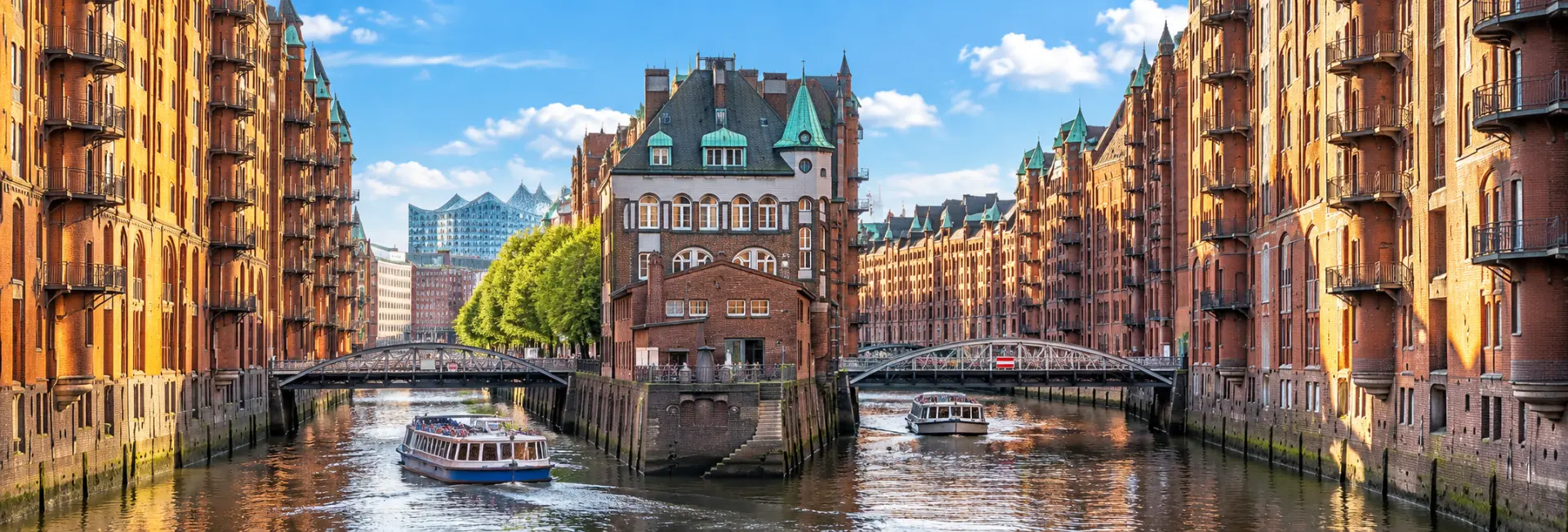
Speicherstadt is a district of towering red-brick warehouses rising straight out of a network of narrow canals in the heart of Hamburg's harbor. Built on thousands of oak piles between 1883 and 1927, it remains the largest connected warehouse complex in the world, a maze of gabled facades, iron footbridges, and dark green water that once handled coffee, tea, spices, and carpets shipped in from every corner of the globe.
Today the warehouses hold museums, offices, cafes, and one of Hamburg's most unusual tourist draws in Miniatur Wunderland, but the district hasn't lost the atmosphere of a working 19th-century port. A walk along its fleets, as the canals are locally known, still feels like stepping into an earlier version of the city, just steps from the glass towers of HafenCity next door.
Since 2015 Speicherstadt has carried UNESCO World Heritage status alongside the neighboring Kontorhaus office district, recognition of a building style and a way of moving goods that has largely disappeared everywhere else.
What makes a visit here different from most historic districts is the way the water is woven into everything. Streets, canals, and warehouse walls sit only a few metres apart in places, so the district can be explored equally well on foot, by bridge, or from a small boat gliding along the fleets below.
History
Building a Free Port
Speicherstadt exists because of a political compromise. When Hamburg joined the German customs union in 1888, the city insisted on keeping part of its harbor as a duty-free zone, so that goods could be stored and reprocessed without import tax before moving on elsewhere. Engineer Franz Andreas Meyer and architect Carl Johann Christian Zimmermann designed a purpose-built warehouse district for exactly that job, constructed in phases on a cluster of Elbe islands between 1883 and 1927.
Displacement and Construction
Building the district meant clearing an existing residential quarter of roughly 20,000 people from the Kehrwieder and Wandrahm islands, one of the more difficult chapters in Speicherstadt's history. In their place rose row after row of narrow-fronted, steep-roofed warehouse blocks, set on oak timber piles driven deep into the riverbed, with canals running directly alongside so barges could load and unload cargo through hoists built into the upper floors.
War Damage and a Changing Port
Allied bombing during the Second World War destroyed roughly half of the district, and reconstruction of the damaged blocks continued until 1967. Speicherstadt kept functioning as a working free port for decades afterward, but as shipping containers replaced traditional cargo handling, most of its original tenants moved to modern terminals elsewhere in the harbor. Hamburg's free port status was formally abolished on 1 January 2013, and the district completed its shift from customs warehouse to cultural and commercial quarter.
That transition happened gradually rather than all at once. Individual warehouse blocks were repurposed one by one over several decades, some turned into museums, others into offices or event spaces, so that by the time the district earned its UNESCO listing it was already a mix of working history and new cultural life rather than a preserved relic frozen at a single point in time.
Recognition & Status
Speicherstadt and the adjoining Kontorhaus district, including the Chilehaus office building, were inscribed as a UNESCO World Heritage Site on 5 July 2015, Hamburg's first entry on the list. UNESCO recognized the ensemble as an outstanding example of a purpose-built warehouse city and the office district that grew up around it during a period of rapid international trade.
- UNESCO World Heritage Site since 2015, alongside the Kontorhaus District and Chilehaus
- Protected as a listed historic monument since 1991
- The largest connected warehouse complex in the world, spanning around 26 hectares
- One of Hamburg's most visited historic districts, regularly paired with the neighboring Elbphilharmonie and HafenCity on city tours
The UNESCO listing specifically credited the district for representing a distinct era of international trade, when purpose-built warehouse cities like this one were constructed to move goods quickly through free ports across Europe. Speicherstadt is considered one of the best-preserved examples of that model still standing anywhere in the world.
Architecture & Streetscape
The warehouses share a consistent Gothic Revival style: dark red brick facades, pointed gables, decorative terracotta trim, and small corner towers that give the skyline a slightly fortress-like silhouette. Each block was built with its own hoist system on the canal side, so sacks and crates could be winched directly from barges into storage floors above, a detail still visible on many of the buildings today.
Underneath the ornamentation, the whole district sits on an enormous foundation of oak piles driven into the soft riverbed soil, a technique that let architects build heavy, multi-story warehouses on ground that would otherwise never have supported them. More than twenty bridges, several dating to the original construction phases, cross the canals that separate the individual warehouse blocks.
Despite the district's uniform brick palette, no two warehouse blocks are quite identical. Builders varied the gable shapes, tower placement, and decorative brickwork from block to block, so a slow walk through the streets reveals small differences in style that reflect the different construction phases spread across more than four decades.
Key Areas & Canals
Speicherstadt is threaded by a series of short canals, known locally as fleets, that once let barges reach almost every warehouse directly. The Brooksfleet, St. Annenfleet, Wandrahmsfleet, and Kehrwiederfleet each cut between different blocks of the district, and their water levels still rise and fall with the tide of the Elbe.
- Kehrwieder, one of the original Elbe islands the district was built on, now home to Block D and several of Speicherstadt's best-known attractions
- Wandrahm, the district's other founding island, cleared of its earlier residential quarter to make way for warehouse construction
- The Wasserschloss ("water castle"), a rounded, castle-like warehouse building at the point where two fleets meet, one of the most photographed spots in the district
- Kehrwiedersteg, a footbridge built in 1890 linking Speicherstadt to the newer HafenCity waterfront
Each fleet has its own character. Some are lined almost entirely by warehouse walls rising straight from the water, while others open up near a bridge or a small plaza, giving walkers a place to pause and take in the view before continuing on to the next block.
Notable Landmarks
The Speicherstadtmuseum, housed in an original 1888 warehouse, lays out the district's working history with tools, machinery, and reconstructed storage rooms from its coffee, tea, and spice-trading days. A short walk away, the Internationales Maritimes Museum fills ten floors of a former warehouse with model ships, uniforms, and maritime artifacts spanning several centuries of seafaring history.
Speicherstadt is also home to Miniatur Wunderland, the world's largest model railway exhibition, along with smaller specialty museums covering spices, customs history, and coffee. The Speicherstadtrathaus, a more ornate administrative building completed in 1904 for the district's original harbor authority, stands out from the surrounding warehouses with its Renaissance-influenced facade and corner bell tower.
Ways to Experience It
Most visitors simply walk the district, following the canals from bridge to bridge and pausing to look into the fleets below, but a handful of other ways to see Speicherstadt bring out details a walking route can miss.
- Self-guided walking routes along the main fleets and bridges, free and open at any hour
- Barge and small-boat tours along the canals, offering a water-level view of the warehouse facades
- Guided walking tours covering the district's history alongside the neighboring Kontorhaus office quarter
- Museum visits inside the Speicherstadtmuseum, the Internationales Maritimes Museum, and Miniatur Wunderland
- Evening illumination of several warehouse facades, which lights the district after dark in a program run since the 1990s
Best Time to Visit
Speicherstadt is an outdoor, open district with no gates or opening hours of its own, so it can be visited at any time, though its museums and shops keep their own daytime schedules. Early morning offers the quietest streets and the best light for photographing the brick facades reflected in the canals.
Evenings bring out the district's illuminated buildings and a calmer, more atmospheric version of the same streets that can feel crowded with tour groups in the middle of the day. Winter visits pair well with a stop in one of the district's cafes to warm up, while summer evenings tend to be the most popular time for a slow walk along the water.
Visitor Tips
A walk through the main part of Speicherstadt takes as little as thirty minutes, but allowing an hour or two leaves room to detour onto side bridges and step into a museum along the way.
- Wear comfortable shoes, since the cobbled streets and bridge crossings aren't especially stroller or wheelchair friendly in places
- Combine a Speicherstadt walk with a visit to Miniatur Wunderland or the Internationales Maritimes Museum, since both sit inside the district itself
- Photograph the Wasserschloss and the main fleets early in the day or after sunset to avoid the crowds that build up around midday
- Check individual museum websites for current hours, since many close earlier than typical tourist attractions
- Watch the tide, since the canals visibly rise and fall through the day and the light on the water changes with them
Nearby Attractions
Speicherstadt sits directly between Hamburg's historic city center and the newer HafenCity waterfront, making it an easy link between the two on foot.
- Elbphilharmonie concert hall and its free public viewing plaza, at the district's western edge
- HafenCity waterfront and its modern architecture
- Chilehaus and the wider Kontorhaus office district, sharing UNESCO status with Speicherstadt
- Hamburg Rathaus (city hall) and the historic city center
- Hamburg's harbor, with regular boat tours departing nearby
FAQs about visiting Speicherstadt
What is Speicherstadt? +
It's the largest connected warehouse district in the world, a cluster of red-brick, canal-lined buildings in Hamburg's harbor, built between 1883 and 1927 and now a UNESCO World Heritage Site.
Is Speicherstadt free to visit? +
Yes, walking through the streets and along the canals is free at any time. Only its individual museums and boat tours charge admission.
How long does it take to see Speicherstadt? +
A basic walk through the main streets takes about thirty minutes, but most visitors spend an hour or two, especially if they stop into a museum along the way.
Is Miniatur Wunderland part of Speicherstadt? +
Yes, the model railway exhibition occupies former warehouse space inside the district, alongside other museums like the Speicherstadtmuseum and the Internationales Maritimes Museum.
Why is Speicherstadt built on wooden piles? +
The ground beneath the district was soft, low-lying riverbed soil, so engineers drove thousands of oak piles deep into it to create a stable foundation heavy warehouses could safely stand on.
Is Speicherstadt still a working port district? +
No, its free port status ended in 2013, and the warehouses have largely shifted to museums, offices, and cultural venues rather than active cargo storage.
What's the best way to see the canals? +
A barge or small-boat tour gives a water-level view of the warehouse facades that a walking route along the bridges can't fully match.
What's nearby that I can combine with a visit? +
The Elbphilharmonie, HafenCity's waterfront, the Chilehaus and Kontorhaus office district, and Hamburg's historic Rathaus are all within easy walking distance.