Table of Contents
Overview
The Hamburger Kunsthalle is the art museum of the Free and Hanseatic City of Hamburg and one of the largest art institutions in Germany. Housed across three interconnected buildings just steps from the Hauptbahnhof and the Binnenalster lake, it holds a collection spanning roughly eight centuries, from medieval altarpieces to work made in the past few years.
Visitors move through galleries devoted to North German painting, Dutch and Flemish Old Masters, German Romanticism, and international modern and contemporary art, all within a single ticket and a single afternoon's walk. With more than 13,000 square metres of exhibition space and roughly 600,000 visitors a year, the Kunsthalle ranks among the most visited cultural sites in northern Germany.
History of the Museum
Origins and Founding
The museum's roots go back to 1817, when a group of Hamburg citizens formed the Hamburg Kunstverein (art society) to promote public access to art in the city. Their efforts led to a modest municipal painting gallery, the Städtische Galerie, opening its doors in 1850. As the collection grew through donations and purchases from Hamburg's merchant class, the society pushed for a purpose-built home worthy of the growing holdings.
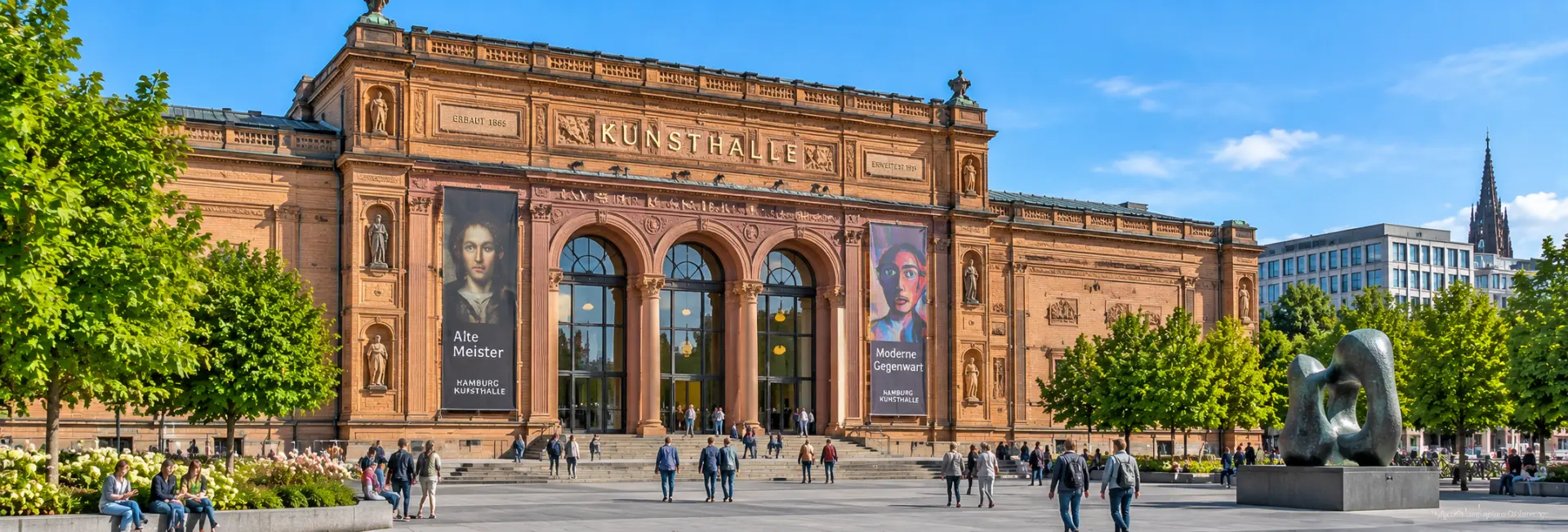
That building opened on Glockengießerwall in 1869, designed in a decorative brick style by architects Georg Theodor Schirrmacher and Hermann von der Hude. It gave the institution both its permanent site and its name: Kunsthalle, or "art hall."
Growth Through the Twentieth Century
Rising visitor numbers and an expanding collection prompted a major extension between 1910 and 1919, designed by Hamburg city architect Fritz Schumacher. Faced in pale shell-limestone rather than brick, the new wing added a domed hall and additional galleries, roughly doubling the museum's footprint.
The museum weathered upheaval during the Nazi era, when works by artists associated with Der Blaue Reiter and Die Brücke were condemned as "degenerate art"; a number of pieces were confiscated or lost during this period, with some later recovered.
A Contemporary Wing and Modern Renovation
In 1997, the museum opened its third building, the Galerie der Gegenwart, a white cube designed by architect Oswald Mathias Ungers and dedicated entirely to art made after 1960. A comprehensive modernization completed in 2016 restored the historic main entrance and refreshed the interior galleries and public spaces throughout the complex.
Architecture & Buildings
The Historic Main Building
The oldest of the three structures, completed in 1869, is built of decorative brick in a style influenced by the Italian Renaissance, with terracotta portraits of artists set into its façade. It houses the museum's historic main entrance and its collections of Old Master and nineteenth-century painting.
The Schumacher Extension and Kuppelsaal
Added between 1910 and 1919, this wing is clad in pale shell-limestone rather than brick, giving it a lighter, more restrained appearance than the original building. Its centrepiece is a domed hall, the Kuppelsaal, which links the historic building to the museum's later galleries.
Galerie der Gegenwart
Opened in 1997 and designed by Oswald Mathias Ungers, the Galerie der Gegenwart is a stark white cube faced in sandstone and set on a base of red granite. At more than 5,600 square metres, it is one of the largest single buildings for contemporary art anywhere in Germany, and its clean geometric lines contrast deliberately with the ornament of the two older buildings it adjoins.
- Three connected buildings spanning 1869 to 1997
- Historic brick façade, limestone extension, and a modern sandstone cube
- More than 13,000 square metres of combined exhibition and event space
Collections & Exhibits
Old Masters and North German Painting
The Kunsthalle's earliest holdings trace medieval and early modern painting from northern Germany, alongside Dutch, Flemish, and Italian works from the sixteenth and seventeenth centuries. Paintings by Rembrandt and other Dutch masters sit within galleries devoted to this period, offering a counterpoint to the museum's later, more famous Romantic canvases.
German Romanticism and the Nineteenth Century
The museum's collection of German Romantic and nineteenth-century painting is one of its defining strengths, built up largely through donations from Hamburg families over more than a century. It includes major works by Caspar David Friedrich alongside paintings by Philipp Otto Runge and Max Liebermann, tracing the shift from Romantic landscape painting toward the realism and impressionism of the later 1800s.
Modern and Contemporary Art
In the Galerie der Gegenwart, the collection continues into art made from around 1960 to the present, including work associated with Pop Art and the movements that followed it. Site-specific installations by artists such as Richard Serra, Jenny Holzer, and Ilya Kabakov were commissioned for the building itself and remain part of the permanent display.
Kupferstichkabinett
Beyond its paintings, the museum holds a print and drawing collection, the Kupferstichkabinett, numbering more than 130,000 works on paper. Because of their sensitivity to light, these works are shown in rotating, themed exhibitions rather than on permanent display.
Must-See Highlights
A handful of works consistently draw visitors to specific galleries within the museum:
- Caspar David Friedrich's "Wanderer above the Sea of Fog," the museum's best-known Romantic painting
- Paintings by Philipp Otto Runge and Max Liebermann in the nineteenth-century galleries
- Dutch Golden Age works, including paintings attributed to Rembrandt
- Richard Serra's large-scale installation "Measurement of Time" in the Galerie der Gegenwart
- Jenny Holzer's "Ceiling Snake" text installation along the stairwell linking the old and new buildings
- Bogomir Ecker's "Tropfsteinmaschine" (Dripstone Machine), which runs continuously across several floors of the building
Ways to Experience It
Most visitors explore the Kunsthalle independently, following the layout from the historic building through to the Galerie der Gegenwart, but the museum also offers several structured ways to see the collection:
- Guided tours in German, and on a more limited schedule in English, covering either the historical collection or the contemporary galleries
- Audio guides that can be picked up at the entrance for a self-paced walk through the highlights
- Temporary special exhibitions, usually requiring a separate or combined ticket, that rotate several times a year
- Family programmes and holiday workshops aimed at younger visitors
Because the special exhibitions change on their own schedule, it's worth checking the museum's official website before visiting if a particular show is the main draw.
Best Time to Visit
The Kunsthalle is open Tuesday through Sunday, with extended hours until 9 p.m. on Thursdays, and is closed on Mondays. The Thursday evening slot tends to be quieter than weekend afternoons and is a good option for visitors who want more room to look at the major paintings without crowds.
Weekday mornings, shortly after opening, are generally the calmest time to visit overall. Weekends and the run-up to the closing date of a popular special exhibition tend to draw the largest crowds, particularly in the galleries nearest the main entrance.
The collection is entirely indoors, making the museum a reliable option in any season, but it pairs well with a walk along the Alster lakes on a clear day before or after the visit.
Visitor Tips
- Standard admission is around €14, with reduced tickets for students and seniors at about €8; visitors under 18 are admitted free of charge
- Tickets can be bought in advance online or on-site at the main entrance on Glockengießerwall
- The museum is a short walk from Hamburg Hauptbahnhof, served by multiple U-Bahn and S-Bahn lines, making it easy to reach without a car
- Cafés inside the complex, including one in the historic main hall, offer a break partway through a visit, though café access generally requires a museum ticket
- Allow at least two to three hours to see both the historical collection and the Galerie der Gegenwart at a comfortable pace
- Check the official website in advance for any construction-related changes to entrances, parking, or accessible routes
Nearby Attractions
The Kunsthalle sits at the start of the Kunstmeile ("art mile"), a cluster of museums and galleries within easy walking distance of one another in Hamburg's Altstadt.
- Deichtorhallen, a pair of former market halls now used for large-scale contemporary art and photography exhibitions
- Museum für Kunst und Gewerbe Hamburg (MKG), a design and applied arts museum a short walk away
- Bucerius Kunst Forum, a smaller exhibition space focused on rotating shows
- The Binnenalster and Außenalster lakes, both within walking distance for a stroll before or after the museum
- Hamburg Hauptbahnhof and the shopping streets around Mönckebergstraße, useful for combining the visit with other errands in the city centre
FAQs about visiting the Hamburger Kunsthalle
What is the Hamburger Kunsthalle known for? +
It's one of Germany's largest art museums, best known for its collection of German Romantic painting, especially Caspar David Friedrich's "Wanderer above the Sea of Fog," alongside Old Master and contemporary galleries.
How much time should I plan for a visit? +
Most visitors need two to three hours to see the historic collection and the Galerie der Gegenwart together; art lovers who want to linger over a special exhibition should plan for closer to half a day.
Is the Hamburger Kunsthalle free to visit? +
Standard admission runs around €14, with reduced pricing for students and seniors, but visitors under 18 are admitted free of charge.
When is the best time to visit? +
Weekday mornings shortly after opening are the quietest, and the extended Thursday evening hours, until 9 p.m., are a good option for avoiding weekend crowds.
How do I get to the museum? +
The museum is a short walk from Hamburg Hauptbahnhof, which is served by several U-Bahn and S-Bahn lines, so most visitors arrive on foot from the station rather than by car.
Is the museum suitable for children? +
Yes, the museum runs family programmes and holiday workshops, though younger children may find some of the modern and contemporary galleries less engaging than the paintings in the historic building.
What else is nearby? +
The Kunsthalle anchors Hamburg's Kunstmeile, so the Deichtorhallen, the Museum für Kunst und Gewerbe, and the Bucerius Kunst Forum are all within easy walking distance, as are the Binnenalster and Außenalster lakes.