Table of Contents
Overview
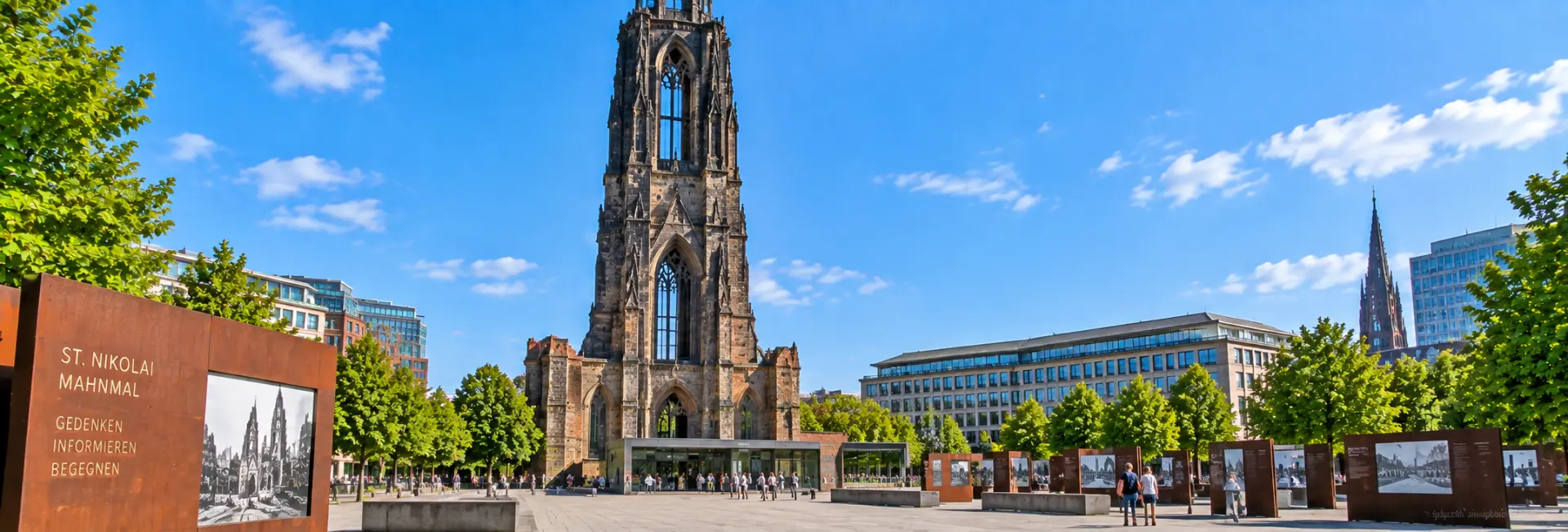
At the edge of Hamburg's old town, a slender neo-Gothic spire rises alone over an open square, framed by nothing but sky where a soaring church nave once stood. This is the St. Nikolai Memorial, known locally as the Mahnmal St. Nikolai: the deliberately unrestored ruin of one of Hamburg's five historic main churches, kept standing as a place of remembrance rather than rebuilt as a place of worship.
The tower survived the Allied bombing raids of 1943 that destroyed almost everything around it, and today it serves two purposes at once. Below ground, a permanent exhibition in the old crypt confronts visitors with the causes and consequences of the air war that shaped modern Hamburg. Above ground, a glass elevator carries them up the same tower to one of the city's best viewpoints, so a visit moves within minutes from a sober history lesson to a sweeping panorama of the harbour and skyline.
History
From Chapel to Main Church
A wooden chapel dedicated to Saint Nicholas, patron saint of sailors, was built on this site around 1195, close to the young settlement growing along the Alster and Elbe rivers. Over the following centuries it was rebuilt in stone and steadily enlarged, and by the 14th century it had grown into one of the largest hall churches in northern Europe. Its importance to the port city earned it a place among Hamburg's five Hauptkirchen, the main Lutheran churches that anchored civic and religious life.
Fire, Rebuilding, and a World Record
St. Nikolai was the first major building consumed by the Great Fire of Hamburg in 1842, which swept through much of the medieval old town. A design competition for the replacement went to the English architect George Gilbert Scott, whose neo-Gothic plan combined dense stone ornamentation with a single soaring spire. Completed in 1874 after nearly three decades of construction, the new church briefly held the title of tallest building on earth, and its tower is still one of the tallest church towers anywhere.
Destruction in the Second World War
In the summer of 1943, Allied bombers carried out a sustained air campaign against Hamburg, later remembered as Operation Gomorrah. Ironically, the very tower that made St. Nikolai famous also made it a target: as the tallest structure in the city, it served pilots as a navigation point for the raids that went on to destroy large parts of Hamburg and kill tens of thousands of residents. The nave and roof were gutted by the resulting firestorm, but the tower, spire, and crypt remained standing amid the wreckage.
From Ruin to Memorial
After the war, city authorities judged the damaged nave too costly and structurally uncertain to rebuild, and its remaining walls were largely taken down in the early 1950s. The tower itself was preserved through an agreement between Hamburg's mayor and the church council, with structural restoration beginning later that decade and formal monument protection following soon after. The St. Nikolai congregation moved to a newly built main church elsewhere in the city, and in 1977 the ruined tower and its grounds were formally dedicated as a memorial to the victims of war and tyranny. Restoration and public education work have continued since the 1980s under a dedicated foundation.
Architecture & Design
A Neo-Gothic Landmark
George Gilbert Scott's design drew heavily on English and continental Gothic cathedrals, translated into brick and sandstone for a Hanseatic setting. Pointed arches, delicate tracery, and a forest of pinnacles gave the church a silhouette unlike anything else in Hamburg's skyline, while the interior once held richly coloured stained glass and elaborate stone carving typical of high Victorian church design.
The tower is the building's defining feature. Rising roughly 147 metres, it was engineered as a freestanding spire of extraordinary height for its time, supported by a tapering stone lattice rather than the timber-framed spires common in earlier centuries. That engineering is largely why it survived the 1943 firestorm relatively intact even as the surrounding nave and roof collapsed: its slender, open structure gave the fire far less to burn and less surface for falling debris to catch on.
Reading the Ruins Today
What remains on site today is intentionally partial. Fragments of the nave's foundation walls and column bases are traceable at ground level, giving visitors a sense of the church's original footprint, while the tower stands largely intact above them. The contrast between the surviving Gothic stonework and the open, grassed-over space where the nave once stood is left visible rather than smoothed over, since the empty footprint is treated as part of the memorial itself.
The Memorial Museum
The Crypt Exhibition
The vaulted cellar beneath the tower, one of the few enclosed spaces to survive the bombing, now houses a permanent exhibition on the church's history and on the air war that destroyed it. Photographs, documents, film footage, and personal testimonies trace daily life in wartime Hamburg, the mechanics and scale of the bombing campaign, and the wider machinery of the National Socialist regime that made such destruction possible.
The exhibition deliberately widens its lens beyond Hamburg, drawing connections to the German bombing of Coventry in 1940 and the destruction of Warsaw, framing Operation Gomorrah as one episode within a broader history of aerial warfare against cities rather than an isolated local tragedy.
Memorial Sculptures and Symbols
Around the grounds, smaller memorial elements add further layers of meaning. A sculpture titled "Ordeal" commemorates prisoners of war and concentration camp inmates held at the Sandbostel camp near Hamburg, extending the site's remembrance beyond the bombing raids to the wider crimes of the era. A cross of nails from the ruins of Coventry Cathedral, itself destroyed by German bombing in 1940, was installed in 1993 as a physical symbol of reconciliation between the two cities.
Observation Deck & Carillon
The Panorama Lift
A glass-sided elevator, installed in the tower in 2005, carries visitors up to a viewing platform roughly 76 metres above the square in well under a minute. Because the cabin is glazed on three sides, the ascent itself is part of the experience, offering glimpses of the tower's interior brickwork before the view opens out over the rooftops.
From the platform, sightlines stretch across the Hamburg city centre to the Rathaus, the Alster lake, the harbour, and the warehouse silhouettes of Speicherstadt and HafenCity, with the Elbphilharmonie concert hall visible on a clear day. Information panels on the platform pair present-day photographs with images taken after the 1943 raids, holding the view of a rebuilt city alongside the view of the one that was destroyed.
The Tower Carillon
Since 1993, the tower has also housed a carillon of 51 chromatically tuned bells. Short melodies play automatically at set times throughout the day, and the bells are played live by a carillonneur on special occasions and, in ordinary weeks, at midday on Thursdays. The sound carries clearly across the open square where the church's nave once stood, filling what is otherwise a quiet, contemplative space.
Best Time to Visit
The memorial and its exhibition are indoor, sheltered spaces, so a visit works in any season, but the observation platform is at its best on clear days when visibility over the harbour and Alster stretches furthest — spring and early autumn tend to offer a good balance of clear skies and manageable crowds. Because the site sits in the open along a paved square, winter visits can be cold and windswept at platform height, so warmer clothing is worth packing even for a short elevator trip.
Mornings tend to be quieter than the afternoon, particularly before tour groups exploring the nearby old town and harbour arrive. Visitors keen to hear the carillon played live should aim for Thursday around midday, when the bells are rung rather than left on their automatic settings, or check for special commemorative dates such as 27 January and 9 November, when the memorial often holds dedicated events.
Visitor Tips
The memorial sits directly on Willy-Brandt-Straße in Hamburg's old town, within easy walking distance of the Rathaus and the Speicherstadt, and it combines naturally with a wider walk through the historic centre.
- Opening hours, admission prices, and elevator schedules change periodically, so confirm current details on the official Mahnmal St. Nikolai website or by phone before visiting, especially around holidays.
- A single ticket typically covers both the crypt exhibition and the observation platform, so plan time for both rather than treating them as separate stops.
- The glass elevator makes the viewing platform accessible to wheelchair users and visitors with limited mobility, though access to parts of the crypt exhibition has at times been more limited, so check ahead if step-free access throughout is essential.
- The nearest public transport stops are the Rödingsmarkt U-Bahn station and the Stadthausbrücke S-Bahn station, both a short walk away.
- Hamburg CARD holders typically receive a discount on admission, which is worth factoring in if you're visiting several attractions in one trip.
- Much of the site is outdoors and unsheltered, so dress for the weather even if you only plan to visit the museum.
Nearby Attractions
The memorial's central location puts several of Hamburg's best-known sights within a short walk. The Hamburg Rathaus, the city's ornate town hall, sits just a few minutes away and is free to view from its courtyard and square. The Nikolaifleet, one of the last surviving canal branches of the old Hamburg harbour, runs close by and is often called the birthplace of the port.
Heading toward the Elbe, the red-brick warehouses of Speicherstadt and the striking modern architecture of HafenCity — including the Elbphilharmonie concert hall — make for a natural continuation of a visit, especially since both are visible from the memorial's own observation platform. History-minded visitors can also detour to Deichstraße, one of the few streets to preserve Hamburg's historic merchant houses, or to the angular brick facade of the Chilehaus, a celebrated example of 1920s Expressionist architecture.
FAQs about visiting the St. Nikolai Memorial
What is the St. Nikolai Memorial? +
It's the preserved ruin of one of Hamburg's historic main churches, largely destroyed in WWII bombing raids and kept standing as a memorial, with a museum in its crypt and an observation platform in its surviving tower.
Why was the church never rebuilt after the war? +
Hamburg's authorities judged the badly damaged nave too costly and structurally uncertain to rebuild, so most of the remaining walls were taken down in the early 1950s and the surviving tower was preserved as a memorial instead.
How high is the observation platform, and how do you get up? +
A glass panoramic elevator installed in 2005 takes visitors to a platform roughly 76 metres up inside the tower, with the ride itself taking well under a minute.
Is there an entrance fee? +
Yes, a modest admission fee covers both the crypt exhibition and the observation platform; exact current prices are best checked on the official website since they can change.
How long should I plan for a visit? +
Most visitors spend around 45 minutes to an hour, split between the crypt exhibition and the trip up the tower, though history enthusiasts may want longer.
What does the museum exhibition cover? +
It focuses on the church's own history alongside the causes and consequences of the WWII air war, including the 1943 bombing of Hamburg, the earlier bombing of Coventry, and the destruction of Warsaw.
Is the site suitable for children or accessible for visitors with mobility needs? +
Older children can usually engage with the exhibition, though its subject matter is heavy and better suited to school-age visitors than very young children; the glass elevator makes the observation platform wheelchair-accessible, though some crypt areas have had more limited step-free access.
How do I get to the memorial by public transport? +
The closest stops are Rödingsmarkt U-Bahn station and Stadthausbrücke S-Bahn station, both within a short walk of the site on Willy-Brandt-Straße.
What's the connection to Coventry Cathedral? +
Coventry Cathedral was destroyed by German bombing in 1940, and in 1993 a cross of nails from its ruins was installed at St. Nikolai as a symbol of reconciliation between the two bombed cities.