Table of Contents
Overview
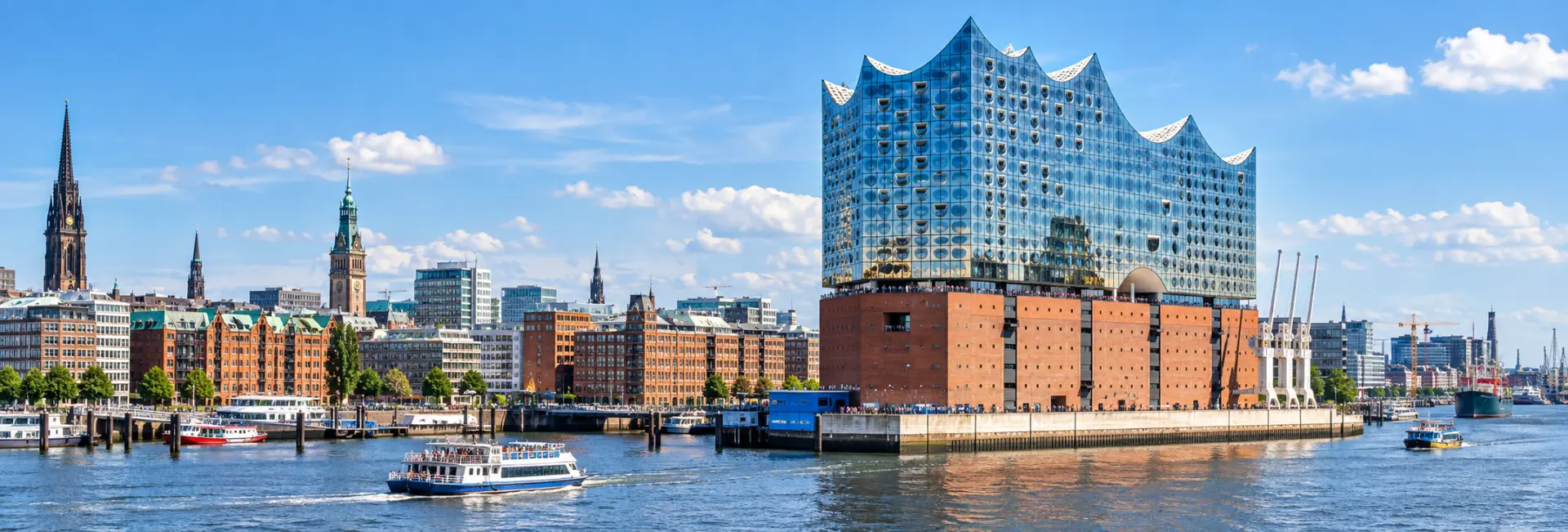
The Elbphilharmonie rises out of the Elbe river on the western edge of Hamburg's HafenCity, a glass structure shaped like a hoisted sail or a breaking wave, set directly on top of a squat red brick warehouse from the 1960s. Locals call it "Elphi," and its silhouette has become the defining image of the city's skyline since it opened in January 2017.
Underneath the architecture is a working concert hall complex, home to two auditoriums, a hotel, private apartments, and a free public viewing plaza that draws millions of visitors a year, many of whom never set foot in a concert. The building's decade of delays and ballooning costs made it a national talking point long before it opened, and its acoustics and design have made it one of the most acclaimed concert halls built anywhere this century.
What sets the Elbphilharmonie apart from most concert halls is how much of it is open to people who have no interest in attending a performance at all. The Plaza functions almost like a public square lifted into the air, and on any given day it draws far more casual visitors and passers-through than concertgoers, making the building as much a piece of civic infrastructure as a music venue.
History
An Ambitious Plan
The Elbphilharmonie began as a private initiative from architect and developer Alexander Gerard and his wife, art historian Jana Marko, who proposed converting the Kaispeicher A, a disused cocoa warehouse on the Elbe, into a concert hall. Swiss architects Herzog & de Meuron were brought in to design it, and the City of Hamburg eventually took over the project. The foundation stone was laid on 2 April 2007, with completion originally targeted for 2010 at an estimated cost of around 241 million euros.
A Decade of Delays and Disputes
Almost nothing about that original timeline held. Disputes between the city and its building contractor over the complex glass facade and a strengthened roof led to repeated construction halts, and the estimated cost climbed past 450 million euros by 2008 and beyond 500 million euros by 2012. Legal battles and redesigns stretched the project years past its original deadline, turning the Elbphilharmonie into a running symbol of public building projects gone wrong.
Opening Night
Construction officially finished on 31 October 2016 at a final cost of roughly 866 million euros, nearly ten times the original estimate. The Plaza opened to the public that November, and the concert halls followed on 11 January 2017 with a gala performance by the NDR Elbphilharmonie Orchestra under conductor Thomas Hengelbrock. Within weeks the building had drawn its first million visitors, and the reception, both for the architecture and for the acoustics inside, was overwhelmingly positive.
The years of bad headlines faded quickly once audiences and critics experienced the finished hall. Commentators who had spent a decade writing about cost overruns and construction disputes began instead writing about the clarity of the sound and the drama of the space, and the building's opening is now generally remembered as a turning point rather than the embarrassment it once threatened to become.
Architecture & Design
Old Warehouse, New Crown
Herzog & de Meuron kept the brick base of the original Kaispeicher A warehouse largely intact and set an entirely new glass structure on top of it, deliberately pairing Hamburg's industrial waterfront past with a strikingly modern silhouette. The roofline rises and dips unevenly across the building, reaching its highest point above the Grand Hall, and around a thousand individually curved glass panels give the facade a shifting, reflective quality that changes with the light and the weather.
The Tube and the Plaza
Visitors reach the building's public heart via an 82-metre curved escalator known as the Tube, which runs up through the old warehouse before opening onto the Plaza, a walkway that wraps around the building roughly 37 metres above the water. The Plaza sits at the seam between old brick and new glass, and a central light well lets visitors look up into the foyers of the concert halls above.
Inside the Grand Hall
The larger of the two auditoriums, the Grand Hall, seats around 2,100 people around a central stage in a tiered "vineyard" arrangement, so no seat sits more than about 30 metres from the conductor. Acoustician Yasuhisa Toyota designed the hall's interior surfaces, including a ceiling and wall cladding nicknamed the "White Skin," made from roughly 10,000 individually milled panels shaped to scatter sound evenly to every seat.
The vineyard layout, first popularized by concert halls such as the Berlin Philharmonie, was chosen specifically to close the physical distance between musicians and audience, and to avoid the long, boxy shape that can leave listeners at the back straining to hear. Toyota's panels work alongside a large suspended reflector above the stage to spread sound evenly through the terraces rather than letting it collect unevenly in any one section of seating.
Recognition & Status
The Elbphilharmonie is the tallest inhabited building in Hamburg, and its Grand Hall is widely regarded as one of the finest-sounding concert venues built in recent decades. Despite a construction history dogged by cost overruns and years of delay, the finished building was met with international acclaim once it opened, and it has since become Hamburg's most photographed landmark.
- Tallest inhabited building in Hamburg
- Home to the NDR Elbphilharmonie Orchestra's principal concert venue
- Grand Hall acoustics designed by Yasuhisa Toyota, known internationally for his concert hall work
- Plaza viewing platform passed 25 million visitors within eight years of opening, putting it in the same league as the world's best-known observation decks
Inside the Elbphilharmonie
Beyond the Plaza, the building holds two performance spaces. The Grand Hall is the main stage for orchestral and choral concerts, while the smaller Recital Hall, built in a more traditional shoebox shape, seats around 550 and hosts chamber music, solo recitals, and smaller ensembles. A third, more intimate space accommodates around 170 for experimental and educational programming.
The rest of the complex is given over to a 244-room Westin hotel occupying the eastern portion of the building, a set of private apartments in the upper floors to the west, and a mix of restaurants, bars, and a parking garage built into the lower levels. Most of this is only visible from the outside or from the Plaza, but the mix of uses is part of what keeps the building active well beyond concert hours.
That combination was a deliberate part of the original plan, since folding a hotel and private apartments into the building helped finance a project that would otherwise have relied entirely on public money. It also means the Elbphilharmonie rarely goes quiet, with hotel guests, residents, restaurant patrons, and Plaza visitors moving through the building at almost every hour it's open.
Ways to Experience It
The Plaza is free to enter and open to anyone, not just concertgoers or hotel guests, though a timed ticket is required to control the flow of visitors through the Tube. Same-day tickets are available at ticket machines near the entrance, and tickets can also be reserved in advance online for a small booking fee.
- Free, timed-entry access to the Plaza and its 360-degree views
- Guided tours covering the building's architecture, history, and construction saga
- Ticketed concerts in the Grand Hall and Recital Hall throughout the season
- Bars on the Plaza level that open before evening performances, available to ticket holders and casual visitors alike
- A visitor center with information on the current concert programme and tour schedule
Guided tours typically run in German and English and cover both the building's architecture and the story of its long, difficult construction, giving visitors context that a solo walk around the Plaza doesn't provide on its own. For anyone hoping to hear the acoustics rather than just see the building, booking a concert well in advance is the only way to get inside the Grand Hall itself, since general admission to the auditoriums outside of performances isn't offered.
Best Time to Visit
The Plaza is open daily from morning until midnight, and it can draw up to several thousand visitors on a busy day, with queues building around midday and on weekends. Arriving early in the morning or heading up in the evening, after most day-trippers have moved on, generally means a shorter wait and a calmer view.
Sunset is a particularly popular time to be on the Plaza, since the glass facade and the harbor below both catch the changing light, though this is also when queues tend to be longest. For a quieter, more contemplative visit, a weekday morning outside school holiday periods is usually the easiest option.
Visitor Tips
A Plaza visit on its own can take as little as twenty or thirty minutes, but most people linger longer to take in the view and walk the full loop around the building.
- Reserve a Plaza ticket online in advance if you have a fixed schedule, since same-day tickets can run out at busy periods
- Dress for wind, since the Plaza is an open-air walkway exposed to the harbor
- Book concert tickets well ahead of time, particularly for well-known soloists or orchestras, as popular performances sell out quickly
- The building is fully accessible by elevator for visitors who prefer not to use the escalators
- Combine a Plaza visit with a walk through the Speicherstadt directly behind the building, since both are covered by many of the same guided tours
Nearby Attractions
The Elbphilharmonie sits at the edge of HafenCity, one of Europe's largest inner-city redevelopment projects, and it makes a natural pairing with a walk through the historic Speicherstadt warehouse district immediately behind it. Hamburg's harbor and its boat tours are just steps away, and several of the city's other major sights are within easy reach on foot or by public transport.
- Speicherstadt warehouse district and its canals
- HafenCity waterfront and its modern architecture
- Miniatur Wunderland, the world's largest model railway, a short walk away
- Hamburg harbor, with boat tours departing nearby
- Hamburg Rathaus (city hall) and the historic city center
FAQs about visiting the Elbphilharmonie
What is the Elbphilharmonie? +
It's a concert hall in Hamburg's HafenCity district, built as a glass structure on top of a former 1960s warehouse, and it's home to two concert halls, a hotel, private apartments, and a free public viewing plaza.
Do I need a ticket to visit the Plaza? +
Yes, though it's free of charge. A timed ticket is used to manage the number of visitors going up through the Tube escalator at any one time, and these are available same-day at the venue or in advance online.
How do I get up to the Plaza? +
Most visitors ride the Tube, an 82-metre curved escalator that runs up through the old warehouse before a second short escalator carries you the rest of the way to the Plaza level.
Can I visit without buying a concert ticket? +
Yes, the Plaza is open to everyone regardless of whether you're attending a concert, and it includes bars, a light well looking up into the concert hall foyers, and views around the entire building.
How long did it take to build, and why did it take so long? +
Construction ran from 2007 to 2016, roughly six years longer than originally planned, due to repeated disputes between the city and its contractor over the building's complex glass facade and roof structure.
Is the Elbphilharmonie good for kids or first-time visitors? +
The Plaza is easy for visitors of any age, since it requires no special knowledge of music or architecture to enjoy the views, though the concerts themselves lean toward a classical music audience.
What's the best time to visit to avoid crowds? +
Early morning or later in the evening on weekdays tend to be quieter than midday visits on weekends, though sunset remains popular despite the longer queues.
What else is nearby? +
The Speicherstadt warehouse district, HafenCity's waterfront, Miniatur Wunderland, and Hamburg's historic Rathaus and harbor are all within easy walking distance or a short transit ride.