Table of Contents
Overview
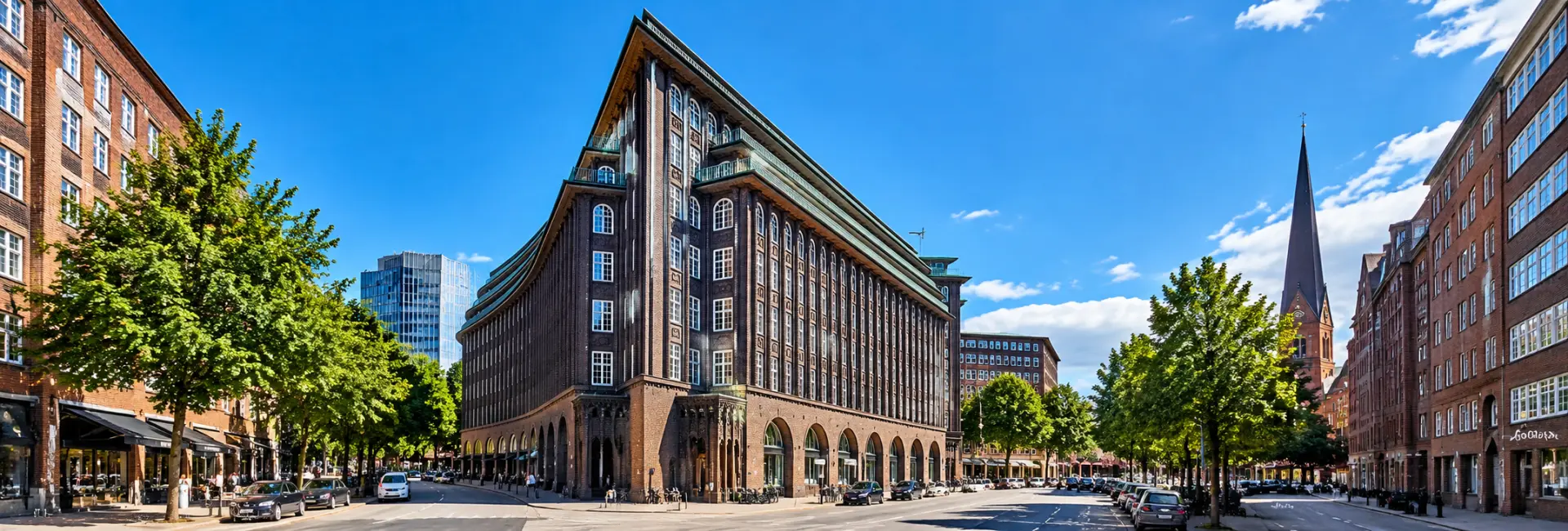
The Chilehaus is a ten-storey office building in the heart of Hamburg, and one of the most photographed pieces of architecture in northern Germany. Designed by Fritz Höger and finished in 1924, it is best known for its eastern end, where two brick facades meet at a knife-sharp angle that looks remarkably like the bow of a steamship pushing through the street.
The building was commissioned by Henry B. Sloman, a Hamburg merchant who made his fortune in Chilean saltpetre, and the name is a direct nod to the country that made him rich. What began as a private status symbol has become a defining image of the city, a textbook example of Brick Expressionism, and a UNESCO World Heritage Site.
Unlike a museum or a monument, the Chilehaus is still a working building. Offices, shops, cafes and the Instituto Cervantes language school occupy its floors, which means a visit is less about queueing for a ticket and more about walking around, looking up, and slipping through its archways and courtyards. It rewards slow attention, because the closer you look at the bricks, the more variety and craft you find.
History
A merchant with a Chilean fortune
Henry Brarens Sloman was born in Hull, England, in 1848 and built his career in Hamburg, where he became a leading importer of saltpetre from mines he owned in Chile. By 1912 he sat at the top of the city's list of wealthiest residents. Wanting a headquarters that matched his standing, he named the project after the country that had funded it.
Building through hyperinflation
Sloman bought the plot at auction in 1921, and construction began the following year under architect Fritz Höger, who treated the commission as the chance to make his name. Germany was in the grip of hyperinflation at the time, so the final bill is hard to pin down, though estimates put it above ten million reichsmark. Work still moved fast, with as many as 4,000 workers involved, and the building opened in February 1924.
From family property to heritage icon
The house stayed with the Sloman family until the 1980s and has changed hands several times since. Today it belongs to the real estate company Union Investment. It was placed under monument protection in 1983, and in 2015 it joined the UNESCO World Heritage List as the anchor of the Kontorhaus District. Sloman died in Hamburg in 1931, and the building carrying his Chilean connection has now outlived him by more than ninety years.
Architecture & Design
Brick Expressionism in Hamburg
The Chilehaus belongs to Brick Expressionism, a north German style of the 1920s that treated clinker brick as an expressive, almost sculptural material rather than a plain wall covering. Höger used dark Oldenburg bricks, around 4.8 million of them, and because they were fired unevenly the walls shift in tone as daylight and weather change. From a distance the mass looks solid and dark, but up close it turns out to be textured, warm and varied.
The ship's prow
The plot is an awkward, acute-angled wedge, and Höger turned that limitation into the building's signature. The two long facades converge at the eastern tip, at the corner of Pumpen and Niedernstrasse, into a narrow pointed edge that resembles a ship's bow. Curved, S-shaped frontages on the Pumpenstrasse side, together with strong vertical piers and set-back upper floors, stop a ten-storey block of roughly 42 metres from feeling heavy. Its 2,800 windows add to the rhythm of the walls.
Engineering beneath the brick
Behind the brick skin sits a reinforced concrete frame. The ground near the Elbe is soft, so the structure rests on concrete piles driven about 16 metres deep, and the cellar was sealed against flooding. The heating equipment was even built into a caisson designed to float, so that rising water could not destroy it.
Ornament and interiors
Sculptor Richard Kuöhl supplied much of the decorative work, including terracotta figures around the eastern tip and sculptural details in the entrance areas and stairwells. Inside, the staircases combine terracotta, tufa and glazed ceramic tiles, with wrought-iron grilles and rounded landings lit by tall arched windows. The building once had two sets of paternoster lifts, the continuously moving cabins, until a modernisation in 1991.
Recognition / Status
The Chilehaus was listed as a protected monument in 1983. Its biggest milestone came on 5 July 2015, when the UNESCO World Heritage Committee, meeting in Bonn, inscribed the Speicherstadt and Kontorhaus District with Chilehaus (reference 1467). The building is named in the property's title because it anchors the whole Kontorhaus quarter.
UNESCO recognised the site under criterion (iv), which honours outstanding examples of buildings and ensembles that illustrate important stages in human history. Here, the story is the explosive growth of international trade in the late nineteenth and early twentieth centuries and how it reshaped a port city. The warehouses of the Speicherstadt and the office houses of the Kontorhaus District are treated as two halves of one trading system.
The Kontorhaus District covers more than five hectares and contains six very large office complexes built between the 1920s and 1940s for port-related businesses. UNESCO names these buildings as key examples:
- Chilehaus
- Messberghof
- Sprinkenhof
- Mohlenhof
- Montanhof
- The former Post Office building at Niedernstrasse 10
- The Kontorhaus at Burchardstrasse 19-21
- Miramar-Haus
What to See at the Chilehaus
The eastern tip
This is the moment everyone comes for. The best view of the prow is from the east, where you can see the two facades rise and narrow into a single crisp edge. Look closely at the pavilion-like top and the terracotta ornament that decorates the point, which gives the bow its carved, almost Gothic character.
Entrance A and its Chilean symbols
Above the gates of Entrance A you can spot the coat of arms of Chile, a reminder of the trade that paid for the building. A condor, the national bird of Chile, also appears among the decoration. These details tie the architecture back to the story of its founder.
The Fischertwiete passage and courtyards
The Fischertwiete street runs right through the building, passing beneath high archways that link the two halves of the complex. Step through and you reach inner courtyards lined with arcades, where cafes, restaurants and small shops give the brick a lively, human scale. The view back up the walls from inside is very different from the dramatic outer silhouette.
Brickwork and stairwells
Things worth slowing down for include:
- The subtle colour shifts in the clinker, which change with the light
- Terracotta figures and reliefs by Richard Kuöhl around the entrances
- Wrought-iron grilles with gilded details protecting the courtyard portals
- Staircase lobbies finished in tiles, tufa and terracotta, where accessible
Ways to Experience It
Walk the outside
The simplest way to experience the Chilehaus is on foot. Circle the building slowly, starting from the east so that the prow appears in its full drama, then follow the long curved facade along the Pumpenstrasse. Each turn offers a different angle, and you will notice how the walls change from monumental to almost delicate.
Step into the courtyards
The inner courtyards and passages are part of the visit rather than an extra. They are the best place to pause for a coffee or a meal and to see the building as the people who work here see it.
Join a guided walk
Architecture walking tours of the Kontorhaus District regularly include the Chilehaus, and a guide can explain details such as the sculptural ornament and the story behind the site. Availability changes, so check current schedules with the local tourist office or a tour provider before you plan around one.
Photograph it
The building is a favourite subject for photographers, and the eastern viewpoint is the classic shot. Try a wide lens for the prow, then move in close for the brick texture and the ornaments around the entrances.
Best Time to Visit
The Chilehaus can be seen at any time of year, because the exterior is part of the public streetscape. What changes is the atmosphere. The clinker brick reads differently in bright sun, under grey Hamburg skies and in the rain, so a visit in any weather has its own character.
Daylight is best for the fine detail, while the evening lighting gives the walls a warmer, more theatrical mood, so many visitors like to see the building at both times. If you want to explore the courtyards, cafes and any accessible entrance halls, plan for a weekday during normal working hours, when the building is at its most active. Weekends are quieter for photographing the exterior with fewer people around, but the working parts of the building may be closed.
Summer gives long daylight hours for walking the Kontorhaus District, while winter brings early dusk that suits evening photographs. Dress for changeable weather whatever the season.
Visitor Tips
- Cost: Viewing the exterior is free, and no ticket is needed to walk around the building.
- Time needed: Half an hour covers the exterior and prow, while one to two hours allows for the courtyards, a coffee stop and photographs.
- Getting there: The Meßberg U-Bahn station on line U1 is the closest stop, and the same line connects with the Hauptbahnhof. Driving is possible but parking in the centre can be difficult and expensive.
- Respect the building: It is an active office and retail complex, so keep noise down, avoid blocking entrances and follow any signs about restricted areas.
- Interiors: Most upper floors are private offices. Access to entrance halls and stairwells can change, so treat them as a bonus rather than a promise.
- Accessibility: Check conditions on site, especially for the courtyards and passages, as details can vary.
- Opening times: Cafes, restaurants and shops keep their own hours, so confirm these locally before you plan a meal here.
Nearby Attractions
The rest of the Kontorhaus District
The Chilehaus is only the opening act. Just across the main road, the Sprinkenhof was built between 1927 and 1943 and was once Hamburg's largest office complex, with three inner courtyards and rich ceramic decoration. A short wander also brings you to the Messberghof, the Mohlenhof and other brick office houses that make the district feel like one connected open-air lesson in architecture.
Speicherstadt
The neighbouring Speicherstadt is one of the largest coherent ensembles of historic port warehouses in the world, stretching about 1.5 kilometres along narrow canals. Its Neo-Gothic brick blocks provide a fascinating contrast to the Chilehaus, and together the two districts share the same UNESCO listing.
More to explore
- Miniatur Wunderland, the huge model railway attraction located in the Speicherstadt
- HafenCity, Hamburg's modern waterfront district
- The Elbphilharmonie concert hall, which makes an easy add-on to a harbour-side walk
FAQs about visiting the Chilehaus
What is the Chilehaus and why is it famous? +
It is a ten-storey office building in Hamburg completed in 1924, famous for its pointed eastern end that resembles a ship's bow and for its dark clinker brick facades. It is regarded as a leading example of Brick Expressionism and is part of a UNESCO World Heritage Site.
Why is it called the Chilehaus? +
The name honours Chile, the country where the building's owner, merchant Henry B. Sloman, made his fortune trading saltpetre. Hamburg office buildings of this kind often carried names, and Sloman chose one that reflected the source of his wealth.
Can I go inside the Chilehaus? +
It is a working office building, so most interior spaces are private. The courtyards and passages are usually accessible, and some entrance halls may be too, but access can change, so follow any signage and check on site.
Do I need a ticket or pay an entrance fee? +
No. Viewing the exterior and walking through the public courtyards is free. Any cafes, restaurants or shops inside charge for their own products, and guided tours are priced separately.
How long should I spend there? +
Around 30 minutes is enough to see the exterior and the prow. Allow one to two hours if you want to explore the courtyards, stop for a coffee and take photographs.
How do I get to the Chilehaus? +
The nearest U-Bahn station is Meßberg on line U1, only a short walk away, and the same line also links with the Hauptbahnhof. The building is also easy to reach on foot from the Speicherstadt.
Where is the best place to take photographs? +
The classic viewpoint for the ship's prow is from the east, looking towards the corner of Pumpen and Niedernstrasse. Inside the courtyards you can get close-up shots of the brickwork and ornament, and evening lighting makes the walls look especially striking.
What else can I visit nearby? +
The Sprinkenhof and the other Kontorhaus buildings are within easy walking distance, and the Speicherstadt, Miniatur Wunderland and the HafenCity waterfront make natural additions to the same day.